


 Francais
 Deutsch
 Italiano
Refine Your Search
V2 stock footage and images
- Showing 7831 to 7836 of 9941 results more
more Hide
Hide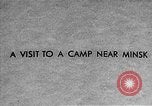
Heinrich Himmler and other German officers visit a camp near Minsk, Belarus.
German leader Heinrich Himmler visits a camp near Minsk Belarus during German occupation of Belarus in World War 2. He is accompanied by other German officers. Several men stand on stairs of a building. German officers stand in a line. Heinrich Himmler meets and talks to them. Several men stand on a balcony. Heinrich Himmler waves to them. His car leaves the area. Heinrich Himmler stops the car and talk to people, including a young boy, working in fields. The car moves on a road. Buildings in the background. He arrives at Minsk Ghetto. Wire fencing on the boundaries of the camp. The prisoners sit on the other side of wiring. He tours the camp area. (World War II period).
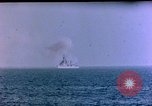
U.S. Navy ships bombard beach at Kerama Retto, Okinawa, during World War II
U.S. Navy bombardment of beach at Kerama Retto, Okinawa, during World War 2 invasion of Okinawa. LSMs (Landing Ship, Medium), destroyers and battle ships underway. Rocket barrage fired. Rocky shoreline of the island in the background. Details seen include: Time 00:25 is the battleship USS New Mexico, BB-40 firing main and secondary batteries. Time 00:41 is a detailed closeup bow-on view of the battleship USS New Mexico, BB-40. (Note: As seen, the USS New Mexico did retain its casemated 5-inch/51 caliber guns for the Okinawa invasion, contrary to some historic references.)
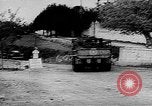
United States troops advance on mountain roads in Volturno River Valley, Italy, during World War II.
U.S. Army trucks moving along a paved mountain road in Volturno River valley region of Italy during World War 2. Sign at the road reads: "Road under direct observation and Artillery Fire. Keep 100 yds interval." U.S. troops gathered at roadside are passed by a jeep and a light truck with a protected anti-aircraft gun mounted in its back. Army signal corps soldiers installing telephone wires on an existing Italian pole. A peaceful valley pasture is disturbed by German artillery shells bursting in it. American army gunners firing a 105mm howitzers at German positions. A cluster of the shells bursting on a distant hillside. U.S. 155mm long tom guns being loaded and fired from camouflaged position in trees, and from under a camouflage netting. The shells exploding and raising white smoke along the base of hill overlooking the valley. Various views of the 155s firing. A wounded soldier being transported on a stretcher, down some mountainous terrain. U.S. infantry marching single file past a dead German soldier. Views of mountain roads blown away by retreating German forces. Combat engineers are challenged to build a bridge against a sheer cliff on the mountain. They employ jackhammers and manual tools and improvise support structures of heavy timbers. An engineer using a sledge hammer to drive a spike into the timbers. A team of men carry a heavy timber. Engineers creating a bridging structure, on the spot, to allow passage from one section of road to another. Finally, a jeep drives across the new bridge.
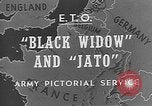
World War II. USAAF P-61 'Black Widow' night fighters in Europe. U.S. Navy testing of JATO on several aircraft in the USA
A short U.S. Army feature entitled,"Black Widow" AND "Jato." Introduction is overlayed on map of Europe. Opening sequence features P-61 Black Widows of the 422nd Night Fighter Squadron, stationed at Florennes/Juzaine (A-78), Belgium, during World War 2, Some of the aircraft are identifiable: P-61A 42-5577 (later nicknamed "Tactless Texan") and "Wandering Wench" (P-61A 42-5590). Narrator states their mission is to intercept German "flying bombs." Mixed footage of P-61s at various places and times, includes some with D-Day invasion stripes. Separate JATO-related footage features USN personnel fitting jet-assisted takeoff bottles on a Grumman F6F-3, possibly at NAS Patuxent River facility, Maryland. Later sequences show a JATO takeoffs by a Douglas SBD, and an F6F-3; and normal takeoff by a Grumman TBF, and a JATO takeoff by a Grumman F4F.
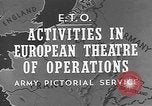
United States Army Operations in European Theater.
A map of Europe. 1st United States Army tanks advance in Duren, Germany. 2nd Army troops fire artillery shells in Sarreguemines, France. 7th Army in Strasboug captures small towns. U.S. Mine Exploders on road. Troops on field. German civilians evacuated. Wounded prisoners carried on stretchers. The U.S. troops firing. Smoke due to explosion. Men observe through binoculars. (World War II period).

Animated film shows Private Snafu battling a dragon and explains facts about fear to soldiers in World War II.
Animated film targeted at American soldiers during World War 2 talks about fear and the body's response to fear. shows the cartoon character Private Snafu as a knight. He rides on a horseback. He experiences fear as he battles a dragon. The effect of fear on body functions is explained. In danger the nerve messages from the brain stimulate the body for action. Narrator describes effects of nervous system and adrenaline on the body, including more glucose reaching the muscles from blood, improvements in vision and hearing, enhanced ability to run or fight.
CRITICALPAST.COM: About Us | Contact Us | FAQs - How to Order | License Agreement | My Account | My Lightboxes | Shopping Cart | Advanced Search | Featured Collections | Website Terms & Conditions | Privacy Policy ©2026 CriticalPast LLC.
License Agreement |
Terms & Conditions |
Privacy Policy
©2026 CriticalPast LLC.