


 Francais
 Deutsch
 Italiano
Refine Your Search
V2 stock footage and images
- Showing 8539 to 8544 of 9862 results more
more Hide
Hide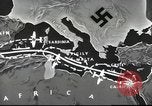
British efforts to supply their base on Malta during World War II
Montage of scenes arranged to convey essence of British efforts to support Malta by ship convoys through the Mediterranean Sea during World War 2. Animated map showing Axis aircraft over the supply routes. A British convoy in the Mediterranean. A sailor scanning for German aircraft. Formation of German Dornier Do-17 bombers overhead. Glimpse in plane's cockpit. On a British ship underway, an antiaircraft gun crew takes action and fires. Insert of a German JU-88 bomber in flight. Antiaircraft gunfire downing a German plane that crashes into the sea. Inserted headon view of a German Me-109 in flight. British gunner rotates to vertical following an attacking airplane overhead (not seen). Inserted view of airplanes in a dogfight at high altitude generating contrails. An aircraft crashing into the sea. Gunners on an Allied aircraft carrier firing at German airplanes. A Junkers Ju-88 viewed from deck of a ship as it drops a bomb. A Ju-88 shot down and crashing into the sea. Supply ship arriving at Malta, passing by its fortifications. Men in small boats surround the ship, at anchor. Bags of food supplies piled up on a wharf and filling an open boat. Local people lined up on the pier and picking up supplies.
U.S. Navy strikes at Japanese positions in Gilbert and Marshall islands early in World War II
View of Diamond Head, framed by palm trees on Waikaki Beach, Oahu, Hawaii. Street scene with building. Inside, a sign reading: "Commander in Chief U.S. Pacific Fleet." In his office, Admiral Chester Nimitz is seen holding a staff meeting. He and one of his staff look over charts with magnifying glasses. Animated map shows prospective supply lines overwater to Australia from Pearl Harbor and Panama. View of U.S. supply ships in a convoy underway in the Pacific Ocean. Soldiers in life vests looking over the railing of a troop ship. Animated map shows threats from Japanese bases in the Gilbert and Marshall Islands in World War 2. Task Force 8, assembled around the Aircraft Carrier Enterprise (CV-6) prepares to attack Japanese positions in the Marshall Islands. The Cruiser, USS Salt Lake City (CA-25) in calm waters. Deck of the Aircraft carrier Enterprise, filled with F4F aircraft with engines running. A Douglas SBD Dauntless aircraft takes off from the Enterprise. View from the carrier as the Cruiser Salt Lake City passes to starboard. U.S. Cruisers begin naval bombardment. Smoke rising from burning shore installation. Formation of Douglas SBD Dauntless aircraft overhead. Port in Australia, with ships docked and a sentry patrolling. Soldiers waving from a troop ship arriving. Troops disembarking. Body of a P-38 aircraft being offloaded. A Cruiser docked at end of wharf.
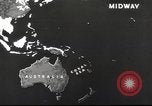
U.S. Navy task forces combat Japanese fleet in battle of Coral Sea and Battle of Midway in World War II
Animated map shows Japanese massing for attacks against Australia, Midway Island, and the Aleutians in World War 2. U.S. naval forces prepare for the battles of Coral Sea and Midway. U.S. warships seen underway in the Pacific Ocean. Crewmen on the aircraft carrier, USS Yorktown (CV-5) push a Douglas SBD Dauntless aircraft with folded wings. Senior officer on the carrier looking through binoculars. Ship's flight operations personnel are alerted by bugle over intercom to report to their stations. flight deck operational crews assemble on deck. Aviators assemble in ready rooms. They are told a Japanese carrier has been sighted and they are to attack its aircraft. Ready rooms are notified of enemy contact at 125 miles. The pilots scramble up stairs to the flight deck and their airplanes. They climb into cockpits Douglas SBD Dauntless planes, start engines, taxi, and take off one at a time. They form up in flights of 3 aircraft each and fly overhead. View of the Island on the Yorktown, as they wait for aircraft to return. Antiaircraft gunners wait in readiness for possible Japanese attack. A formation of Japanese Aichi D3A (Val) aircraft is sighted. They dive at the Yorktown, as her gunners fire away at them. Black flak clouds fill the sky. An explosion as a bomb strikes the Yorktown. She lists and burns and is wracked by another explosion. An SBD dauntless rocks loose near the end of flight deck. USS Yorktown along with other ships in the task force battling Japanese aircraft. A Japanese torpedo plane is downed on the surface of the sea. Flames and smoke at forward port area of Yorktown's flight deck. Gunners hit wings of attacking airplane. Firefighters on Yorktown set up hoses on her deck. More U.S. aircraft airborne to attack Japanese force only 15 miles away. U.S. dive bomber dropping a bomb. An SBD dauntless lands on a carrier deck. Navy aviators pose on deck. Closeup of a Dauntless landing. "Scorecard" compares U.S. and Japanese losses in the two engagements.
A U.S. submarine in operation during World War II in the Pacific.
U.S. Submarine, USS Pickerel (SS-177) docked in Pearl Harbor during World War 2. Crew members handling lines on deck. Navy ensign displayed on stern. Shipyard derrick in background. Sub's conning tower displays several miniature Japanese flags, representing victories. Boat's officers pose on deck. Other subs docked alongside in background. Sailors ride a motorized lift transporting a torpedo to the sub. Below decks, crewmen load torpedoes into firing tubes. The Pickerel starts moving out of her berth. Animated map shows pattern of U.S. submarine operations out of Pearl Harbor, fanning out toward Japan. Views of the submarine cruising on the surface. Binocular view of ships on horizon. Crew members clear the deck and go below. The submarine submerges. Crew working at duty stations. Captain at the periscope, orders firing of number 1 torpedo. It strikes a ship Which explodes and burns with billowing black smoke.
A Japanese Mitsubishi A6M3 Type 32 Zero fighter plane being tested at Wright Field, Ohio, during World War II
Army Air Forces records describe this as flight tests conducted at Wright Field on a Japanese Mitsubishi Type 0 MK2-SSF Hamp fighter plane, Army Air Forces (AAF) No. EB-201. (Recognized later, as a variant of the Zero, these Mitsubishi A6M3 Type 32 planes were renamed "Zeke 32.") Flight tests were made from January 9th to March 10th, 1944, to compare this aircraft with AAF fighters and to verify tests made in Australia by the Special Duties and Performance Flight of T.S.-7, Directorate of Technical Services, Melbourne. Test pilot in the cockpit with engine running. Closeup of pilot (possibly Captain Ralph C. Hoewing, who became first Commandant of the AAF Test Pilot School). He takes off from the airfield. and is seen in flight. Various aerial views of the Zero are seen including: flying overhead and from above as it flies over Ohio farmland. The pilot enters a shallow climb; and is seen from above and behind. He performs a slow descending roll. Finally, he buzzes the airfield at low altitude and high speed, and then brings the aircraft in for a smooth landing. (Note: This aircraft was rebuilt by the Allied Technical Air Intelligence Unit in Hangar 7 at Eagle Farm Airfield, Brisbane, Australia, from the wrecks of five Mitsubishi A6M3 Type 32 Zeke's captured at Buna, New Guinea, during the war.) [ Ref. WWW. hangar7.org.au ]
Japanese soldiers occupy the International Settlement in Shanghai after Pearl Harbor attack in World War II. Battle for Hong Kong
Japanese soldiers in Shanghai, China occupying the International Settlement following the attack on Pearl Harbor, in World War 2.. Japanese military trucks loaded with soldiers enter the north end of the Bund passing by the British Consulate. Japanese flag flutters from the top of the HSBC headquarters. A Japanese guard stands at the entrance to the HSBC headquarters next to a sign in Japanese and English that the premises have been occupied. Japanese Marines march on the street. Buildings along the side of the street. A soldier hands out warning notices writing in Chinese to a crowd of Chinese people explaining the occupation. The very end show Japanese troops in Kowloon shelling Hong Kong Island which is visible in the background.
CRITICALPAST.COM: About Us | Contact Us | FAQs - How to Order | License Agreement | My Account | My Lightboxes | Shopping Cart | Advanced Search | Featured Collections | Website Terms & Conditions | Privacy Policy ©2026 CriticalPast LLC.
License Agreement |
Terms & Conditions |
Privacy Policy
©2026 CriticalPast LLC.