


 Francais
 Deutsch
 Italiano
Refine Your Search
V2 stock footage and images
- Showing 9001 to 9006 of 9860 results more
more Hide
Hide
Japanese people carry belongings and board ships as they leave for Japan from Korea.
Repatriation of Japanese soldiers and civilians to Japan from Korea after conclusion of World War 2. Wide elevated view of buildings in Seoul, Korea. A long bridge spanning over a river. Electrified street car moving on street in Seoul. People walk on a road in a busy market place area. People buy from shops. Various shops in the market. Japanese people are being processed and checked for contraband before returning to Japan. Soldiers use DDT (Dichloro-Diphenyl-Trichloroethane ) to spray on people, including a young child, as a de-lousing measure. People wait at the port of Busan. People organizing luggage and belongings at port while awaiting travel. U.S. Army soldier inspecting baggage of Japanese civilians. Japanese men, women, and children carrying their belongings walk in a line to board ships. A man gives tickets to Japanese people boarding the ships. Japanese people crowded on the deck of a ship as it prepares to leave port.

Singapore citizens near residential apartments and women shop at a market place in Singapore.
Elevated and street level views of buildings and landmarks, and a market in Singapore after World War II. Various buildings including the Cathay Building (2 Handy Road, Singapore 229233) in central Singapore. Cars parked in front of the buildings. Traffic on a road. Boats anchored at a dock. Damaged buildings due to the war. Clothes hanging to dry outside houses in an apartment building. Children sit and eat. Singaporean locals eat. Women sit in cycle carts. Bananas in a shop. A man paints a tin container. Women shop and buy clothes. Women check out shoes, flasks, hand bags, watches and clothes. Clothing displayed on mannequins.
Tomas Garrigue Masaryk talk to men at the Lany Castle in Lany, Czechoslovakia.
The former President of Czechoslovakia Tomas Garrigue Masaryk with others in Lany, Czechoslovakia. Houses in the village of Lany. Trees in the foreground. Exteriors of the Lany Castle (Lány Castle, Zámecká 2, 270 61 Lány, Czechia). A path in between a garden. A fountain in the garden. The doorway of the castle. A staircase in the castle. Pillars in the foreground. Interiors of a room shows an office table, portraits, a bookshelf, and a bed. A flowerpot in the room. A woman places a tea pot in a tray and carries it away. Former Czechoslovakian President Tomas Garrigue Masaryk talks to others while having tea. A man talks to a woman. A boy shows books to Tomas Garrigue Masaryk. A horse drawn carriage moves through a mud road. Men take off their hats as they greet Masaryk from his carriage. Boys and Tomas Garrigue Masaryk sitting in the carriage. Women walk in a garden. Tomas Garrigue Masaryk seated on a sofa in the garden. A man reads newspaper and places it on table. A flag atop the castle.
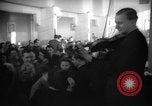
People eat and dance while an orchestra plays in a better class restaurant in Prague, Czechoslovakia
Customers enjoy dining, drinks and dancing in Prague, Czechoslovakia, shortly before the World War 2 era. Interior of a a fine restaurant in Prague. People dance as a band plays music. Close views of the orchestra playing music. People dine in the restaurant. People dance.
People pray in cathedral and exteriors of St Vitus Cathedral along with scenes of old town in Prague, Czechoslovakia
Monuments in Prague, Czechoslovakia. People pray in the St Vitus cathedral (III. nádvoří 48/2, 119 01 Praha 1-Hradčany, Czechia). Exteriors of the St Vitus cathedral. Tombs of the kings of the old Bohemian Empire. People fill water in a bucket. A street in Prague’s historic center. Exterior of a cathedral. The Vltava River in Prague. People walking on Charles Bridge (Karlův most, 110 00 Praha 1, Czechia). The Statues of Madonna, Saint Dominic and Thomas Aquinas on Charles Bridge.
Bishops pray inside a cathedral and view of the Wenceslas square in Prague, Czechoslovakia
The historic center of Prague, Czechoslovakia. Two priests open doors of Saint Vitus Cathedral (III. nádvoří 48/2, 119 01 Praha 1-Hradčany, Czechia). Bishops enter and pray in the cathedral. Statutes of bishops on the cathedral. Traffic at the Wenceslas Square (110 00 Prague 1, Czechia). Tram moving on Wenceslas Square, as seen from the National Museum (Národní museum, Václavské nám. 68, 110 00 Nové Město, Czechia). A statue in the foreground. Aerial view of the traffic on street.
CRITICALPAST.COM: About Us | Contact Us | FAQs - How to Order | License Agreement | My Account | My Lightboxes | Shopping Cart | Advanced Search | Featured Collections | Website Terms & Conditions | Privacy Policy ©2026 CriticalPast LLC.
License Agreement |
Terms & Conditions |
Privacy Policy
©2026 CriticalPast LLC.