


 Francais
 Deutsch
 Italiano
Refine Your Search
V2 stock footage and images
- Showing 9007 to 9012 of 9860 results more
more Hide
Hide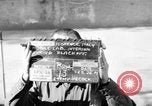
Enlisted U.S. Army soldiers at work in mobile laboratory under blackout conditions in Florence, Italy
The 24th General Hospital in Florence, Italy, in World War 2. Interiors of Laboratory. Enlisted man at work in mobile laboratory under blackout conditions. A man notes on a document.
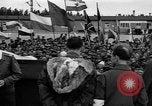
Captain David M. Eichhorn, Jewish chaplain of U.S. XV Corps, conducts services in Dachau, Germany.
First Jewish religious services on grounds of liberated Dachau Concentration Camp, Germany, late in World War 2. Captain David M. Eichhorn, Jewish chaplain of U.S. XV Corps, conducts services in Hebrew. People gather to listen to his speech. People stand holding flags.
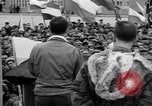
Captain David M. Eichhorn, Jewish chaplain of the U.S. XV Corps, addresses people during a ceremony in Dachau, Germany.
First Jewish religious services at liberated Dachau Concentration Camp, Germany, World War 2. Captain David M. Eichhorn, Jewish chaplain of the U.S. XV Corps, conducts services and addresses a crowd. People gather to listen to his speech. People stand holding flags.
German civilians and officers during the burial of dead of Wobbelin (Wöbbelin) concentration camp in Ludwigslust, Germany.
Burial of Wöbbelin concentration camp victims in Ludwigslust, Germany during World War 2. German civilians bury dead of Wobbelin concentration camp, five days after the camp was liberated by Allied forces of the U.S. Army 8th Infantry Division and the 82nd Airborne Division. Bodies laid out near graves. A large wooden cross at the back of each grave. A jeep driven on a road. German civilians near dead bodies. A large group of U.S. and German officers stand at attention during burial ceremonies. German civilians speaks into a microphone.
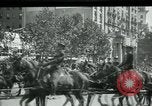
Memorial ceremony in Baltimore Maryland, for those lost in the sinking of the RMS Lusitania, in 1915
Film opens showing mounted U.S. soldiers riding teams of horses pulling empty caissons signifying those lost in the sinking of the RMS Lusitania in 1915. They ride along a major thoroughfare in the City of Baltimore. Buildings along the street are decorated with patriotic bunting. Scene shifts to view from a pier, of a U.S. Navy single-funnel gun boat is seen making way, slowly In Baltimore harbor. Closeup of Group of women, dressed in white, aboard the boat, ares seen holding a large memorial wreath over side of the boat. Next, the camera shows a U.S. Aeromarine AS-2 Float Plane landing in the water. As it taxis in, the scene shifts back to the women on the boat, holding the memorial wreath. They are seen from behind, as they hold it high over their heads, and cast it over the side into the water. View of the women clustered in the bow of the boat as it moves slowly in the water. Other persons are present on deck, including at least one soldier and photographers and reporters. The U.S. navy ensign of stars flies from the bow. Closeup of the women in the bow, who now throw flowers into the water. Closeup of a woman (possibly Lusitania survivor). She stands next to the gun boat (now docked) holding a bouquet of flowers and wearing a sash reading “Lusitania.” Next, the camera focuses on Lusitania survivor, British actress, Rita Jolivet, who stands on a pier with a building and automobile behind her. Scene shifts, again, to the ladies in white aboard the docked gun boat. Among those seen with them are two British Royal Navy officers in uniform. Final scene is of large public gathering at an outdoor pavilion. A military band is at the front of the gathering. Public figures are assembled on the stage. A color guard carrying American flags is moving through the crowd, toward the stage.
U.S. Army training film on bivouac area security; a convoy of truck moves through a bivouac area in the United States
A film titled 'The Bivouac Area' about the precautions to be taken to avoid enemy detection of a bivouac area during World War 2. Propellers of aircraft rotate as the engine starts. Aerial view of the truck convoys and tire marks on ground. A man observes pictures of a bivouac area in a training area of the United States. Explosion on ground. Man points on pictures of the bivouac area while studying the area. A man studies a map. A truck being driven. Men disembark truck and inspect the site. A truck convoy moves out of a jungle. A man directs the convoy. Trucks take turn and move towards the bivouac area. A board reads 'Stay on taped paths, Park under cover'. Men brush up grass to hide tire marks of the truck convoy. Tracks made by the moving truck convoy. Trucks parked in tree shadows. A truck under a tree shadow. A man jumps out of the truck and directs the truck to move forward in shade.
CRITICALPAST.COM: About Us | Contact Us | FAQs - How to Order | License Agreement | My Account | My Lightboxes | Shopping Cart | Advanced Search | Featured Collections | Website Terms & Conditions | Privacy Policy ©2026 CriticalPast LLC.
License Agreement |
Terms & Conditions |
Privacy Policy
©2026 CriticalPast LLC.