


 Francais
 Deutsch
 Italiano
Refine Your Search
V2 stock footage and images
- Showing 9349 to 9354 of 9858 results more
more Hide
Hide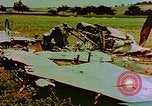
German farmers work in field around wreckage of American P-47 , a month after end of World War II in Europe
Wreckage of U.S. Air Forces P-47D-30, tail number 44-33495, of the 368th Fighter Group, 397th Fighter Squadron in a field, near Munnerstadt, Germany, a month after the end of World War 2, in Europe. Women work around the wreckage, turning hay. Street scene in a nearby small German village. Workers come home from fields. Buildings on either side of the street. Civilians move on an ox cart. Person carries hay in a wooden hand cart. Water running from faucet in the village square. (Reportedly, the pilot of the P-47 was William T. Wright, who was killed in the crash, on April 15, 1945.)
Underwater pipelines,petroleum casks and electrically operated fire lines are revealed off coast of England soon after World War II
Britain reveals and demonstrates operation of a literal fire wall off the cliffs of Dover that had been set up to stop a potential German invasion of England. With World War 2 in Europe recently ended, Britain demonstrates the underwater pipelines and petroleum casks that would have generated a fire line to stop German invasion troops, ships and aircraft. Demonstration of the defenses: Large smoke column rises. Electrically operated fire lines are set on fire along coast line to burn forces of any incoming invasion. British Army soldiers near a line of mines, inland, that served as a second line of defense. A mine area is exploded for demonstration.

Ground crew repairs fuselage of USAAC L-5 aircraft at airfield in Saidor,New Guinea, during World War II
Crew work on L-5 Sentinel aircraft of the U.S. Army Air Corps 25th Air Liaison Squadron, at an airfield in Saidor,New Guinea during World War 2. Ground crew removes jack from under landing gear of an L-5. Other L-5's seen parked on the airstrip. Ground crew work around them. Man under L-5 aircraft makes repairs to fabric on the fuselage.
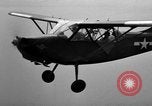
USAAC 25th Liaison Squadron transport Indian Punjab soldiers who escaped from Japanese prison camp at New Guinea in World War II
U.S. Army Air Corps (USAAC) Stinson L-5 Sentinel of the 25th Liaison Squadron "Guinea Short Lines" in flight over water during World War 2. Aerial view of Stinson aircraft in flight, and view from inside an airplane of Madang air strip (recently captured by Australian forces) pock marked with craters. Dogumur Bay in the background. L-5 lands and taxis on the battered strip. Other aircraft parked in the background. Crew men refuel L-5 aircraft, named "Little Larry," from fuel drums with funnel over wing. Australian soldiers carry litter bearing bandaged Indian Punjab soldier, who escaped Japanese prison camp. Airmen of 25th Liaison Squadron help the Indian Punjab soldier into the Stinson L-5 Sentinel aircraft. The Punjab soldier in cabin of the L-5 aircraft. American Sergeant (pilot) removes his passenger's hat, so he can be seen more clearly as he poses for the camera. An L-5 lands on the beach. Other L-5 aircraft parked on beach. Personnel in the background. L-5 (transporting the injured Indian Punjabi soldier) takes off in the opposite direction. Other L-5s in grass near beach. Scene shifts completely, to the injured Punjabi being assisted as he steps from the L-5, after landing back at the 25th Liaison Squadron base in Saidor, New Guinea.
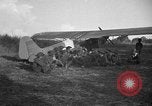
Indian Punjab soldiers freed from Japanese prison camp are interviewed by Australian soldiers in Senai, New Guinea, during World War II
Indian Punjabi soldiers freed from Japanese prison camp, are seated in shade under wing of a U.S. Army Air Corps L-4 Grasshopper airplane, at an air field in Senai, Papua New Guinea, during World War 2. They are being interviewed by an Australian Sergeant and an officer. The Punjab former prisoners have been provided uniforms including ranger hats. (They have short hair and no beards, so they may include Sikhs, Dogras, Pathans, and Punjabi Muslims, but haven't yet obtained material for their traditional turbans.) The Sergeant makes notes and sketches on a pad as the escaped POWs provide information about their experiences and information of possible value regarding Japanese forces. Scene shifts to the Punjab soldiers sitting in a grass-roofed hut, with the native Chief of Senai. Several of them sit in in front of the hut, smoking long-stemmed native pipes. The Senai Chief poses with a Punjab Sergeant. Two Stinson L-5 airplanes take off from the Senai field. A group of liberated prisoners prepares and eats a meal.
L-4 airplanes of 25th Liaison Squadron take off with Indian soldiers liberated from New Guinea Japanese prison camp in World War II
Two Indian Punjab soldiers, liberated from a Japanese prisoner camp, walk towards a Piper L-4 Grasshopper airplane of the USAAC 25th Liaison Squadron, parked on a muddy field at Senai, New Guinea, in World War 2. A U.S. Airman escorts another Punjab soldier. Several grass huts are seen in the background. The Indian soldier boards the airplane. The airplane's pilot approaches and stops momentarily, to allow cameraman to photograph the passenger, before he gets into the front cockpit. Side of the airplane is painted with the words: "Guinea Short Lines" and image of a kangaroo. Next, the airplane is seen splashing water during taking off from the muddy field, past several persons watching from the side of the field. Another L-4 begins to take off.
CRITICALPAST.COM: About Us | Contact Us | FAQs - How to Order | License Agreement | My Account | My Lightboxes | Shopping Cart | Advanced Search | Featured Collections | Website Terms & Conditions | Privacy Policy ©2026 CriticalPast LLC.
License Agreement |
Terms & Conditions |
Privacy Policy
©2026 CriticalPast LLC.