


 Francais
 Deutsch
 Italiano
Refine Your Search
V2 stock footage and images
- Showing 1189 to 1194 of 9858 results more
more Hide
Hide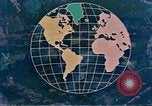
Men at work in the control station after the launch of satellite Explorer 1 and space probe Mariner 2 in the United States.
Space research programs by the National Aeronautics And Space Administration (NASA) in the United States. Animation depicts a network of tracking stations that monitor space probes on a manned satellite and astronauts in an orbit. The status and the position of space vehicles and scientific data are transmitted from the tracking stations to the mission control center. Scientists, engineers and technicians draft the data. Satellite Explorer 1 is launched. Scientists inspect a space vehicle. They demonstrate space probe Mariner 2. Missile Mariner 2 is launched to planet Venus. A satellite antenna gives signals. Men at work in the NASA control station.
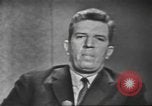
Kennedy and Nixon comment on the Indochina War, Quemoy and Matsu islands, and U-2 flights during their third debate.
Nixon and Kennedy debate questions regarding relations with Communists during the third Kennedy-Nixon Presidential Debate in the United States. Douglass Cater of Reporter magazine asks Republican candidate U.S. Vice President Richard M Nixon to comment whether there was a valid criticism of his statement of foreign policy. Nixon answers and states that the criticism is not valid. Regarding Indochina, he says that the U.S. would not have tolerated Indochina falling under Communist domination. And as a result of that the civil war there ended. He states that he supports the President's position and thinks that the President was correct in ordering the U-2 flights. Referring to Quemoy and Matsu he states that he objects to the constant reference to surrendering these islands. Democratic candidate Senator John F Kennedy disagrees with Nixon's statement on Indochina and states that reason Indochina was preserved was the Geneva Conference. On the question of the U-2 reconnaissance aircraft flights he states that he has never criticized them and never suggested stopping of espionage. On the question of keeping the Communists in doubt about the U.S. defending Quemoy and Matsu he states that the U.S. should meet its commitments to Formosa (Taiwan) and the Pescadores. He concludes by saying that he disagrees with Nixon as Nixon is extending the administration's commitment.
U.S. 1st Army, 23rd Regiment, 2nd Division soldiers walk along street and enter houses in Mechernich during World War II.
U.S. 1st Army, 23rd Regiment, 2nd Division soldiers attack on Mechernich, Germany during World War 2. U.S. soldiers move along street. Civilians watch. Soldiers break down door of house and enter. Soldier directs civilians and German officers by wave of hand. Woman unlocks door of house and soldiers enter. German Army prisoners, including one who is a young boy soldier, being searched by soldiers. U.S. officer speaks with civilian.
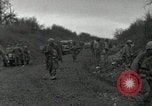
Infantrymen of U.S. 94th Division,301st Regiment destroy a German roadblock in Oberleuken, Germany (WW2)
Infantrymen of U.S. 94th Division, 301st Regiment advance in Oberleuken, Germany during World War 2. Infantrymen advance along a road. A German roadblock destroyed by explosions. Soldiers clear debris after destroying the roadblock. Soldiers use minesweepers over the area. M4 Sherman tanks and infantrymen pass after clearing of road. Soldiers set detonation wire into place. ( Note: The final column of M4 Sherman tanks are worth noting as they are M4A2 dry stowage tanks received from the British as evidenced by the "T" numbers visible on a number of the tanks in the clip and British spare track stowage. The tanks are fitted with U.S. radios, as evidenced by the antenna.)
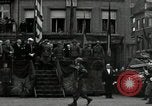
U.S. troops of 2nd Armored Division parade in Belgian town of Hasselt, during World War II
Troops of the 82nd Reconnaissance Battalion, U.S. 2nd Armored Division, pass in review before their Commanding General, Brigadier General Isaac White, who stands on a stage with Belgian officials, in the town of Hasselt, Belgium during World War 2. The troops are led by the 66th Armored Regiment military band. A contingent of the marchers carries numerous American flags. Civilian spectators line the sidewalks, and Belgian officials in formal dress with medals, watch the parade which ends at a World War I memorial monument in the square. General White carries wreath of flowers and places them at the foot of the memorial, which is inscribed: "1914 - 1918." The U.S. troops parade from the scene. Group of children applaud. Camera focuses on young woman, in crowd, smiling and applauding. View of flag bearing inscription: "Hasselt Liberators."
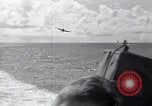
U.S. Navy FM-2 Wildcat fighters land on flight deck of USS Marcus Island, during invasion of Palau Islands in World War II
The escort carrier, USS Marcus Island (CVE-77), off the coast during invasion of Palau Island in World War 2. Several FM-2 Wildcat fighter aircraft of Fleet Composite Squadron 21 (VC-21) are seen making routine approaches and landings aboard the carrier. On their tails, they display "Diamond" G-Symbols enclosing the numeral "7."
CRITICALPAST.COM: About Us | Contact Us | FAQs - How to Order | License Agreement | My Account | My Lightboxes | Shopping Cart | Advanced Search | Featured Collections | Website Terms & Conditions | Privacy Policy ©2026 CriticalPast LLC.
License Agreement |
Terms & Conditions |
Privacy Policy
©2026 CriticalPast LLC.