


 Francais
 Deutsch
 Italiano
Refine Your Search
V2 stock footage and images
- Showing 1579 to 1584 of 9860 results more
more Hide
Hide
United States aircraft S-2D Tracker parked on the aircraft carrier USS Wasp underway in the Atlantic Ocean.
United States Navy aircraft carrier USS Wasp (CVS-18) underway in the Atlantic Ocean. Smoke rises up from its smokestack. United States anti-submarine warfare aircraft S-2D Tracker parked forward on the starboard side. View of the starboard and stern of the ship. Ship underway and going into a port turn.
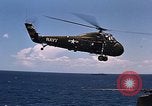
A UH-2A Seasprite helicopter lands on the flight deck of the USS Princeton underway at a sea in Vietnam.
Seventh Fleet Operations in Vietnam. A U.S. Marine Corps UH-34D helicopter in flight. A supply ship in the background. The flight deck of USS Princeton (LPH-5). Starboard bow of USS Seminole (AKA-104). The starboard beam of USS Seminole. An Amphibious Transport Dock (LPD) underway in the far background. A shoreline in the background. A U.S. Marine Corps CH-46A Sea Knight helicopter flies over the flight deck. Rotors of the helicopters in the foreground. Mountains in the background. Port beam of a ship underway. The UH-34D helicopter lands on the flight deck. High ranking officers debark from the helicopter. They are greeted by officers. They walk by several pallets of supplies. A UH-2A Seasprite helicopter in flight over the water. It lands aboard the USS Princeton. Supplies in the foreground. Men around a forklift. A man in a yellow shirt walks up to the side of the helicopter. The doors of the helicopter slide open. (Vietnam War period).
John Edgar Hoover talks about German saboteurs captured in the U.S. and other enemy agents during World War 2.
Opening scene depicts (dramatized) the presence of German submarines off the Atlantic Coast, delivering Nazi German saboteurs of Operation Pastorius to Long Island, New York and to Florida in 1942. View of German submarines in the ocean. A scientist in a FBI laboratory examines explosives found when the sabotage attempt was uncovered, including blocks of TNT and explosives designed to look like lumps of coal. J. Edgar Hoover describes how the explosives were designed to target American citizens and war industries during World War 2. Paddy wagons with military guards standing on read door platforms are seen entering court facility in Washington DC. View inside the paddy wagons of German agents ("submarine saboteurs") being brought to military trial. View of the accused and the military officers of the court sitting in court during the trial. Military judges are seen seated during the trial proceedings. View of a wall of file cabinets and a hand reaching into a cabinet marked "secret." Past events show Adolf Hitler in meetings with his staff. An animated map shows Nazi symbol overlaying an outline of the United States. A United States flag in the background. The director of the FBI (Federal Bureau of Investigation) John Edgar Hoover in the United States. He sits at a desk in his office. He talks about enemy agents, Hitler's desire to punish the United States, and the victory of the United States over them.
PBY Catalina transfers U.S. soldiers from Morotai Island in New Guinea to Mindanao in Philippines during World War 2
A U.S. Navy PBY transfers soldiers from Motorai Island in New Guinea to Mindanao in Philippines. Soldiers get into a truck. Few American soldiers seated in a truck. The soldier's belongings being transferred to the truck. Two men carry boxes. Few soldiers outside a tent. PBY Catalina (Patrol Bomber Consolidated Aircraft), an American flying boat of the 2nd Emergency Rescue Squadron on an airstrip. Other aircraft in view. Two trucks parked beside the flying boat. Men transport material from the trucks onto the aircraft. Soldiers board the aircraft with their belongings.
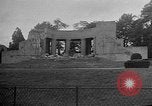
A French soldier ties the French flag to World War I memorial in Reims, France (WW2)
Allied forces occupy Reims, France during World War II. A French soldier affixes French tricolors on bronze statue in war memorial created by Paul Lefebvre (2 Pl. de la République, 51100 Reims, France) near the Place de la Republique. Rubble is seen at this memorial to the fallen of World War I, which has been badly damaged, during the current conflict.
SB2C Helldiver a dive bomber takes off from the USS Hancock CV-19) in the Pacific Ocean.
A Curtiss SB2C Helldiver bomber takes off from the deck of the USS Hancock (CV-19). Men on the deck direct the take off. Another aircraft carrier and a destroyer in the background.
CRITICALPAST.COM: About Us | Contact Us | FAQs - How to Order | License Agreement | My Account | My Lightboxes | Shopping Cart | Advanced Search | Featured Collections | Website Terms & Conditions | Privacy Policy ©2026 CriticalPast LLC.
License Agreement |
Terms & Conditions |
Privacy Policy
©2026 CriticalPast LLC.