


 Francais
 Deutsch
 Italiano
Refine Your Search
V2 stock footage and images
- Showing 2431 to 2436 of 9860 results more
more Hide
Hide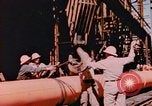
Role of Iron and steel in construction of Liberty Ships. Use of cranes for heavy construction during World War 2.
Building a Liberty Ship in California shipyards (Sausalito or Richmond) during World War II. Raising an 8-ton steel mast from which a ship's boom will extend for loading operations. The gantry crane operator seen in control cabin. A house of steel is built to sit on the deck of an attack transport ship. It is lifted with the help of crane and put into the ship. Several cranes are used to move a 100 ton, 4000 horsepower diesel engine into place in the ship's hold.

Preliminary steps in manufacturing steel during World War 2 for the war effort
"Making Steel for War" shows powered shovel digging iron ore out of an open pit mine. After obtaining the Iron Ore ,it is crushed and shipped to steel mills. Countless open railroad cars filled with iron ore in a marshalling yard. Iron ore being loaded into an ore carrier ship. The ship carrying the Iron Ore reaches its destination, where huge cranes with claw buckets reach in and remove the iron ore from the ship. View of steel mill complex including rail yard, furnaces, and numerous structures. Powered shovel digging limestone out of open pit mine and loading it on to conveyer. Coal being discharged from coking ovens and bursting into flames when it contacts the open air. .
Using electric furnace for steel making during World War 2
Steel is manufactured in sufficient quantities in electric furnaces where higher temperatures are attained under close control in a manufacturing plant. Two workers inspect the furnace. Another worker manipulates electrical switches and controls on a panel. Molten iron seen splashing through open furnace door. Workers wearing protective glasses manually shovel measured quantities of alloying elements into the hot furnace at the factory.
Manufacturing steel using the Bessemer process (WW2)
Manufacture of Steel during World War II in United States. Bessemer converter seen in tilted position being charged with molten iron from a ladle, under control of crane operator. Bessemer converter operator manipulates lever to cause converter to tilt up and air to blast through the molten iron. This burns excess carbon, silicon and manganese and converts the iron into steel. Molten steel is poured into molds. which are removed after steel solidifies. Hot ingots are moved on rail cars to a place, where they attain a uniform temperature and are ready for rolling. Ingots stored in pit.

Steps in rolling a finished steel product (WW2)
Steel production in the United States during World War II. Overhead crane lifts steel ingot and places it into carrier that discharges it onto bed of blooming mill, where it is shuttled back and forth between different segments of water-cooled rollers until it is finally converted into a long steel bar. The steel bar is then rolled through a continuous bar mill, where it is reduced in thickness as it passes successive stations of the mill. At the end, the bar is cut into uniform lengths.
Manufacturing steel plates and sheets from ingots (WW2)
Steel production in the United States during World War II. A steel slab produced from an ingot, is spread on a rolling mill, where it is shuttled back and forth through a succession of water-cooled rollers until it obtains the desired shape. Temperature is monitored and recorded by automatic device. Side view of hot steel plate passing between two rollers. Rolling mill operator seen in control booth. Worker monitors gauges on a panel.. The steel plate continues to reduce in thickness until it becomes a steel sheet.
CRITICALPAST.COM: About Us | Contact Us | FAQs - How to Order | License Agreement | My Account | My Lightboxes | Shopping Cart | Advanced Search | Featured Collections | Website Terms & Conditions | Privacy Policy ©2026 CriticalPast LLC.
License Agreement |
Terms & Conditions |
Privacy Policy
©2026 CriticalPast LLC.