


 Francais
 Deutsch
 Italiano
Refine Your Search
V2 stock footage and images
- Showing 2425 to 2430 of 9860 results more
more Hide
Hide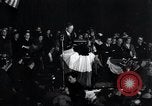
Col. Charles Lindbergh talks about interventionists in America during an America First Committee meeting (WW2)
A meeting of the America First Committee at the Manhattan Center in New York City during World War II. A large crowd inside the Center. The Committee members on stage. Colonel Charles A Lindbergh on the podium. He addresses the meeting. Photographers take pictures. He talks about U.S. entering the War, interventionists in America, principles of Democracy, opposition to U.S. entering the War, inadequate preparation, and division of the American people. People wave U.S. flags and applaud.
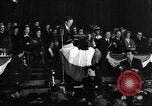
Col. Charles Lindbergh asks for people's support against U.S. entry into the War during an America First Committee meeting (WW2)
A meeting of the America First Committee at the Manhattan Center in New York City during World War II. A large crowd inside the Center. The Committee members on stage. Colonel Charles A Lindbergh on the podium. He addresses the meeting. Photographers take pictures. He talks about the U.S. military situation, U.S. entry into war, and U.S. contribution to progress of mankind. He requests the people to join the America First Committee and asks for their support. People cheer and applaud.
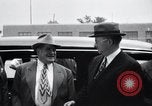
Donald Nelson and party visit the Ford Bomber Plant in Detroit, Michigan (WW2)
Chairman of the War Production Board Donald Nelson and party visit the Ford and Chrysler plants in Detroit, Michigan during World War II. A C-45 military transport aircraft lands at the new Ford Bomber Plant. The visitors get off the plane. They are greeted by the Ford Motor Company founder Henry Ford and others. W. Averell Harriman converses with Henry Ford. Nelson, Harriman and Oliver Lyttelten pose. Photographers take pictures and cameramen record the event. A stationary U.S. bomber B-24 Liberator with engines running. Civilian guard patrolling in the foreground. Hangar and civilian cars in the background. The visitors and hosts near the first bomber built by the Ford Bomber Plant. Henry Ford has trouble being heard because of the aircraft engine noise. The B-24 engines are shut down. Aviator Charles Lindbergh, in civilian clothes, with two U.S. military officers. Henry Ford and others get into a car.
Donald Nelson and party inspect tanks at the Chrysler Tank Arsenal in Detroit, Michigan (WW2)
Chairman of the War Production Board Donald Nelson and party visit the Ford and Chrysler plants in Detroit, Michigan. The visitors get out of a car at the Chrysler Tank Arsenal. They are greeted by a manager. Interior of the plant. The party inspects the plant. Tanks on the assembly line. A tank is lifted. The group comes out of the plant. Tanks on proving grounds. The visitors stand by and watch. Back of a man's shirt reads 'Tank Arsenal Inspection Road Test'. Tanks being put through challenging tests in mud and obstacles on proving grounds. (World War II period)
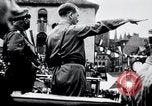
Glimpses of Adolf Hitler generating public enthusiasm during his rise to power and in World War 2.
Fuhrer Adolf Hitler in various rallies and parades in Germany. Hitler with Ernst Rohm, Chief of Sturmabteilung (SA) Stormtroopers, on small reviewing stand, at outdoor event in a town. Hitler running to meet German Army General at an outdoor event. He gives Nazi salute. General salutes with baton, and another officer salutes with traditional military hand salute to the brow. Hitler and the General shake hands. Hitler on a podium, with Rudolf Hess (or Heß) behind him. Martin Bormann, sitting in an audience. Hitler on podium, giving animated speech. Goebbels and Goering sitting in audience. Huge crowd giving enthusiastic cheers and salutes to Hitler at outdoor event, where Hermann Goering stands on balcony beside Hitler. Motorcade in Munich, with enthusiastic spectators lining the sidewalks. Hitler walking down a street accompanied by Hermann Goering and a phalanx of Stormtroopers, as spectators cheer from the sidewalks.
Construction of Liberty Ships vital to War Effort in World War 2
World War II Liberty Ships that carry war materiel like guns,tanks and planes, in the Marine Shipyard in Sausalito, California, across bay from Richmond California shipyards. View of Vice Admiral Emory Scott Land (retired), speaking about the need for ships, and more ships, for the war effort. Among Liberty ships shown are Billy Mitchell, George Chamberlain, Waslater, Cermak and Charles Summer. Ships with bow numbers 434, 432, and others lined up under construction. View of Senate bill 3500, Merchant Marine Act of 1936 authorizing merchant ship building to support commerce and National Defense. Marine architects and engineers work with blueprints and models to optimize design for fleet of merchantmen that would eventually be called "Liberty Ships." National Posters seen. One shows burly shipyard worker with sledge hammer and reads: "Swing it Brother." Another shows convoy of ships at sea and reads: "You Build ''em. We'll sail 'em." Construction begins. Timbers, plates, anchors , engines, steel blades, and other of the hundred thousand items needed build a ship. Crowds of Shipyard workers leaving after a work shift. A sign on building reads,'It can and will be done', and another, under which workers walk advertises war bonds . Shaping metal with gas torches. Fabricating ribs of steel. Spray painting. A woman welder named Mary Smith, welding with torch. Cutting steel using patterns and torches. Fabricating bulkheads. Riveting. Derricks lift heavy assemblies.
CRITICALPAST.COM: About Us | Contact Us | FAQs - How to Order | License Agreement | My Account | My Lightboxes | Shopping Cart | Advanced Search | Featured Collections | Website Terms & Conditions | Privacy Policy ©2026 CriticalPast LLC.
License Agreement |
Terms & Conditions |
Privacy Policy
©2026 CriticalPast LLC.