


 Francais
 Deutsch
 Italiano
Refine Your Search
V2 stock footage and images
- Showing 2737 to 2742 of 9862 results more
more Hide
Hide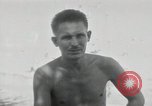
An American soldier recounts his experience as a prisoner of war in Manila, Philippines (WW2)
An American soldier named Gene Kneebone from Grass Valley City, California being interviewed in Manila, Philippines. Kneebone recounts his experience as prisoner by Japanese forces in World War II during the interview. He states how he was beaten up at military police headquarters after two of his friends escaped from the Japanese prison camp.
Americans taken as prisoners being served food at Nichols Airfield in the Philippines (WW2)
American prisoners of war, captured by Japanese troops during World War II, being served food by Red Cross at Nichols Airfield near Manila, Philippines. An American soldier writes in a notebook. Two other soldiers stand near a dish antenna as one of them speaks over a phone.
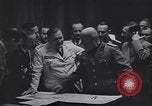
German troops planning and launching May 1940 attacks across Luxembourg, Belgium, and Holland; Rotterdam blitz scenes (WW2)
Hermann Goering, Benito Mussolini, Adolf Hitler and others as Italy joins Germany in declaring war against Britain and France June 10, 1940 (World War II). Animated map illustrates possible Axis war plans. Aerial view of Maginot line. Fire burning from German bombing in Scandinavia. Windmill turning in Holland. Map outlines Allied strategy for defense. Views of the Ardennes Forest. French Generals examining map. British Field Marshal John Vereker (Viscount Gort) studying map with two Generals. Narrator states they dismissed German attack through the Ardennes. May 9, 1940 - News headline reports German troops on move. Netherlands and French recruit troops mobilizing. French army soldiers standing at train station platform and loading into passenger railroad trains. Exterior of the Basilique du Sacre-Coeur (Basilica of the Sacred Heart) at Montmartre, Paris. People lighting candles. Statue of Madonna and Child. Views of several churches. A Catholic Bishop blessing people. People kneeling in prayer. Hitler and other Nazi leaders, including Heinrich Himmler, Goebbels, Bormann, Hess, and Rohm, haranguing crowds. Hermann Goering leading crowd in salutes. Ludwig Muller, Reichsbischof, Hitler supporter. Many views of Germans shouting Sieg Heil. German troops moving out on May 10, 1940. Hermann Goering, chief of Luftwaffe, in uniform. German pilots run to airplanes. Ju-87 Stukas take off. D0-17 bombers take off. German tanks, motorcycle troops, armor and infantry cross borders of Luxembourg, Belgium, and Holland. Map depicts action. German forces destroy obstacles at border crossings and move past windmill in Holland.He-111 bombers in flight. German paratroops jump from Ju-52 transport over Rotterdam. They capture key facilities. Troops riding on tanks. Dutch General Henri Gerard Winkelman walks with German officer over Maas-bridges in Rotterdam. He and delegation enter building at Rijsoord to sign surrender on May 15, 1940. German bombers destroy Rotterdam. View of German bomber bomb bay doors open and bombs away toward targets. The city in flames, with sound. Remains of the city. Numerous dead civilians.
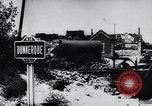
Evacuation of Allied forces from Dunkirk in World War 2; French children being evacuated; Italy readies for war
Highway sign reads M 16, Dunkerque. German Ju-87 Stuka dive bombers fly low and drop bombs. Offshore, a flotilla of warships and civilian ships and boats approaches. British spitfire fighters engage German warplanes. Gun camera footage of dogfights. Allied troops boarding boats while being bombed. Rescued French and British soldiers on decks of ships. View of destruction at the Dunkirk shore. Rescued troops disembarking in England. Prime Minister Winston Churchill reviews group of ordinary British citizens who participated in the evacuation and shakes hands with naval officers. Generals of the French High Command expressing dismay. Map shows battlefront. Parisians getting newspapers and French parents and families evacuate French children South for safety. Women are seen kissing their children goodbye as they load onto buses to be evacuated to safety. Anguished women wave as their children depart. Change of scene to sandbagged French defensive positions in Paris. American intelligence officer, using animated map,describes German sweep of France. Benito Mussolini with son-in-law, Minister of Foreign Affairs, Count Galeazzo Ciano. Italian motorcycle troops and infantry enter France. U.S. President Franklin D. Roosevelt condemning the Italian action. Mussolini accompanied by Italian officers, struts along a street as Italian troops watch from sidewalk. He reviews a contingent of youth in uniforms that look like Alpini.
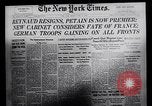
France surrenders to Germany during World War 2
French Marshal Petain, now Premier, following Battle of France, walks to a car and seen later at conference table with Pierre Laval and other national leaders. View of Adolf Hitler, with close associates, expressing delight after signing of the second armistice at Compiegne,ending resistance by France, on June 22, 1940. German honor guard marching near Marshal Foch's railroad car where the 1918 armistice was signed. Monument of Marshal Foch. Hitler, Hermann Goering, and Admiral Raeder, head of the Kriegsmarine, review the honor guard. German stand at steps of the rail car. Raeder, and Goering, both carrying Marshal's batons, flank Hitler. French Army General Charles Huntziger, accompanied by General Jean Bergeret,Air Minister, Vice Admiral Le Luc, Commander of Maritime Forces, and Ambassador Leon Noel, are escorted by two German officers. They enter the railroad carriage. View inside, as Hitler, Goering and German representatives stand when they enter. Newspaper headline describes tax on France for German occupation. French prisoners of war in an outdoor yard and being moved to Germany. French prisoners in bucket brigade and carrying construction materials. French workers engaged in labor to support German war effort. Unhappy French children. Public funerals for persons executed by the Germans. German flag draped over the Foch statue. Hitler's touring motorcade passes Arc de Triomphe in Paris in early morning when streets are empty. Parisians gather on streets to hear German orders broadcast. Many express distress. In Southern France, Military units carry their colors as they depart for North Africa. General Charles de Gaulle is among the marchers. De Gaulle seen reviewing contingents of French military. Free French soldiers parading in London, England. Military officers salute as the ship carrying Regimental colors departs. French colors carried beside unit with American flag. General Charles de Gaulle and General Henri Giraud at 1943 Casablanca Conference (Roosevelt and Churchill seated).

United States 10th Army invades Okinawa,Japan during World War 2
A film titled ' Invasion of Okinawa' shows Admiral Chester William Nimitz after his declaration to attack Okinawa in Japan. United states 10th Army launches an invasion on Kerama island in Ryukyu,Japan. Admiral Nimitz,General Buckner and Admiral Richmond Turner direct the operations. American soldiers take over the island after heavy bombardment. They invade Okinawa and land on the island behind naval bombardment.
CRITICALPAST.COM: About Us | Contact Us | FAQs - How to Order | License Agreement | My Account | My Lightboxes | Shopping Cart | Advanced Search | Featured Collections | Website Terms & Conditions | Privacy Policy ©2026 CriticalPast LLC.
License Agreement |
Terms & Conditions |
Privacy Policy
©2026 CriticalPast LLC.