


 Francais
 Deutsch
 Italiano
Refine Your Search
V2 stock footage and images
- Showing 319 to 324 of 9857 results more
more Hide
Hide
German civilian Matthias Gierens is hung until death for murdering a downed American flier in Germany in World War 2.
German civilian Matthias Gierens, a 37 year old railroad worker, is hanged in Rheinbach Germany for the August 15, 1944 murder of a downed American flyer, who was later identified as U.S. Army Air Forces 2nd Lieutenant Lester E. Reuss, from Forsythe, Montana. Reuss was the navigator on U.S. Army B-17 bomber #42-31183 which was downed by German aircraft after it attacked the Airdrome at Wiesbaden, Germany. Gierens and three other German civilian men, Peter Kohn, Peter Back, and Matthias Krein, were convicted on June 2, 1945 in Ahrweiler, Germany, for the murder of the American airman after his parachute landing near Priest, Germany. The trial was the first Allied trial in Germany of civilians charged with a war crime. Military police are seen escorting Gierens toward the gallows in a prison yard in Rheinbach. A German Catholic priest performs the rites. U.S military officer reads charges as Gierens is readied for execution (the officer is possibly Lt. Col J.V. Roddy, of San Francisco, who was in charge of the hanging). Trap door opens and Gierens is hung. The U.S. Army executioners were Master Sgt. John C. Woods, a former Texas State executioner, and Staff Sgt. Thomas Robinson, of Bronx, New York. Witnesses present included seven U.S. Lieutenant Colonels and one British officer, a number of Military Police, news correspondents, and photographers.
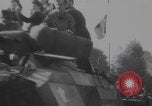
French civilians cheer Free French troops as they liberate Paris (WW2)
Parisians celebrate the liberation of Paris from Nazi Germany during World War 2. A French M4 Sherman tank carrying French women and soldiers of the Free French Second Armored Division pass by crowds. More M4 Sherman tanks, Jeeps, M3 half-tracks of the 2nd Armored Division with troops enter Paris. Smiling people along sidewalks wave and welcome incoming troops and vehicles. French men and women wave the French tricolor flag welcoming United States troops to Paris. Crowds of civilians welcome troops. Nun greeting a soldier with a Faire La Bise (French cheek kiss). French civilians welcome a Free French Second Armored Division M3 half-track “LONGCHAMP” carrying troops. Civilians milling around troops to welcome them. Happy French civilian crowds smiling and flashing the “V for Victory” sign. French women surround an army Jeep with troops parked near a Paris Métro exit. A soldier snuggles and gives a woman a kiss on her cheeks. Soldier and a woman kiss. Soldier stands on top of a Free French M4 Sherman tank throwing chewing gum candies at French civilians.
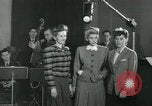
Andrews Sisters Patricia Marie, Maxine Angelyn and Laverne Sophie record Boogie Woogie Bugle Boy for 'V-Disc
A Colonel thanks Andrews Sisters on behalf of the Music Section of the Special Services Division for recording the three discs. Patricia Marie, Maxene Angelyn and Laverne Sophie record a song named 'Boogie Woogie Bugle Boy'. Musicians check instruments during the recording. Studio staff work on the pressing of the phonograph record. (Note: Although "Boogie Woogie Bugle Boy" was recorded commercially for Decca Records on January 2, 1941, this filmed V-Disc recording session took place over three years later on September 25, 1944.)
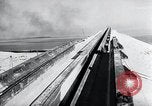
German V-1 rocket launcher on rollers
Views of the rocket launching inclined rail or track. Man working to place a V-1 launcher with rollers onto the rail assembly in Germany. Views of launcher and rollers up close as it is moved slowly along the rails. (World War 2 period)
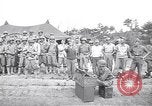
Chaplain conducts V-E (Victory in Europe) Day thanksgiving services in Okinawa, Japan during World War II.
Group of U.S. servicemen gather in clearing near tents, on Okinawa, on May 8, 1945, (V-E Day) to give thanks for the end of World War 2 in Europe. One sits at improvised organ. Officers and a Chaplain enter the clearing. The Chaplain distributes song sheets and conducts the group in singing, accompanied by organist. At conclusion, all turn and face the American flag flying nearby.

Americans send letters to service personnel overseas via "V-mail," during World War II
View of a U.S. Post Office building. Patrons line up inside, to use the new "V-mail" system for sending mail to service personnel overseas, during World War 2. They are seen writing letters on special forms that also serve as envelopes, when folded. Senders stamp, and mail them, just like ordinary letters. Next, after being opened and passed by military censors, the letters are fed into machines and photograpned onto rolls of microfilm. Views of microfilm in 100 foot rolls, that carry 1500 letters, each. View of a strip of microfilm with individual letters on it. Bags of mail on the floor of an Army postal facility and a soldier holding one small bag of microfilm letters that contains the same number of letters as all the other bags. Servicemen overseas reading their letters (that have been blown up and printed at normal size).
CRITICALPAST.COM: About Us | Contact Us | FAQs - How to Order | License Agreement | My Account | My Lightboxes | Shopping Cart | Advanced Search | Featured Collections | Website Terms & Conditions | Privacy Policy ©2026 CriticalPast LLC.
License Agreement |
Terms & Conditions |
Privacy Policy
©2026 CriticalPast LLC.