


 Francais
 Deutsch
 Italiano
Refine Your Search
V2 stock footage and images
- Showing 313 to 318 of 9857 results more
more Hide
Hide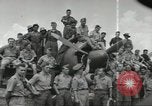
Pilots and planes of the Royal Netherlands Indies Army Air Corp, or ML-KNIL, in Singapore during World War II..
Scenes of the Royal Netherlands Indies Army Air Corp (ML-KNIL) at Kallang Airfield in Singapore during World War 2. Group of Dutch pilots gathered together for a group photo around aircraft B-3111, the plane of Lt. Frederik Pelder. The pilots are from 2-VLG V which was ordered to Singapore when the shooting war began, arriving 9 December 1941 and returning back to Semplak on 18 January 1942. Skull and cross bones held by commanding officer of 2-VLG-V, Captain Jacob Pieter van Helsdingen. The pilots and crew laugh and smile for the group photo shoot. A Dutch Martin 139WH (export version of the B-10) being loaded with bombs. Machine gunner seated in position in the aircraft. The Dutch Martin 139WH in flight overhead. Several views of Dutch Brewster B-339D fighter aircraft taxiing and in flight. Dutch pilots "scramble" (in response to alarm )and run quickly to their "Brewsters." Dutch Brewster B-339D aircraft take off in flights of three and join up in formation. An Australian Hudson I aircraft with Twin Wasp engines seen briefly as it taxis on the airfield.
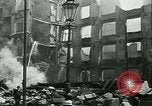
British response to Nazi air raids in Battle of Britain, and use of American radar in the European Theater during World War II.
The role and contribution of the U.S. Army Signal Corps in combat and war. Opening scenes show bomb damage due to German Luftwaffe blitzkrieg air raids (The Blitz) in Southern Counties of London earlier during Battle of Britain in World War 2. Firemen and rescue workers try to extinguish the fires with water hoses. The rescue workers conduct operations amidst bomb damaged buildings and rubble. Severely damaged buildings. Rubble strewn all over the streets in England. A Food Flying Squad van makes its way on the streets. Food distributed from the van. A British man walks amidst the rubble. Relief work in progress. Buckets of food and water lying at camps. Displaced civilian people eat and drink. London civilian residents evacuate numerous areas. Evacuees walk across a bridge. Big Ben seen in the background. Allied bombers in flight. Royal Air Force de Havilland Mosquito aircraft track and shoot down enemy aircraft. The dogfights result in mid air explosions. Two soldiers operate a U.S. radar designed to direct antiaircraft fire in combat area. The radar tracks a target moving up to 600 miles an hour. The soldiers track down aerial targets, the gun directors make adjustments and the antiaircraft guns are fired at buzz bombs. Enemy V-1 Flying bombs are hit and downed before they can reach the coastline. German V-1 rockets are tracked over England by radar and shot down. An V-1 is hit. It descends to the ground and explodes. France: A downed V-1 flying bomb is examined. The wreckage of a V-1 in a field. Soldiers and civilians near the wrecked V-1 Flying Bomb
Saga of a U.S. Navy Task Group, the USS Guadalcanal and escorts, that captures the German U Boat (U-505) in World War 2
Historic U.S. Navy capture of German submarine (U-505) during World War 2. Crew assembles on flight deck of the USS Guadalcanal (CVE-60). Its Captain, Daniel V. Gallery, looks out from deck above. A Task Group of the Atlantic Fleet, consisting of the Guadalcanal, and five Destroyer escorts: the Pillsbury, Chatelain, Pope, Flaherty and Jenks, proceeds to operate against German submarines West of the Cape Verde Islands. Aboard the Guadalcanal, men train to capture a submarine, intact, if possible. The boarding team includes: Chief Photographer's Mate, Clifford Werler; Chief Pharmacist, Raymond Jackson; LTJG Mylo Keck; Ensign Fred Mittaugh; and Electrician First Class, William Stein; Ensign James Griffin; Machinist Mate 2nd Class, Walter Waller and Commander Earl Torcino. On June 4, 1944, the USS Chatelein makes sound contact with a submarine. The Task Group attacks it and forces it to surface under heavy gunfire. The German crew is rescued. Task Force boarding party successfully occupies and prevents the U-505 from sinking.
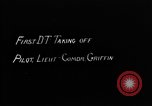
U.S. Douglas DT-2 aircraft lands on United States Ship Langley while its is underway in the Pacific Ocean.
United States ship Langley underway as a U.S. Douglas DT-2 aircraft piloted by Lieutenant Commander V.C. Griffin takes off from aboard the Langley. On March 10, 1924 U.S. Douglas DT-2 aircraft comes in for landing and makes a touch and go landing. Aircraft lands on the flight deck. Aircraft taxis along the flight deck of aircraft.
Network of United States Veterans Administration offices serving veterans of World War 2
United States Veterans Administration's role for the war veterans of World War II. War veterans of World War 2 exit a separation center building with smiles on their faces, holding up discharge papers in 1945 at the end of World War 2. Veterans at United States Veterans Administration office. A map of United States depicts the 13 cities in which the Veterans Administration offices have been set up. Map of U.S. depicts the network of Veterans administration offices and traveling Veterans Administration representative locations across the United States. A traveling V.A. representative enters the "John Dyson" grocery, feed, fertilizer, and general store in a small town. Sign outside the building reads "Attention Veterans" and describes the weekly visit scheduled at that location.
British Colonel Archibald Percival Wavell and 2nd Battalion, Black Watch in Oppeln,Upper Silesia
Colonel Archibald Percival Wavell (Rt. Hon. Archibald Percival Wavell, 1st Earl Wavell) Commander of the 2nd Battalion, Black Watch (Royal Highland Regiment) is seen conversing with a Colonel of local German forces in Oppeln,Upper Silesia. (This is during the period when elements of the British Durham Light Infantry, the Black Watch and the 2nd Battalion, Royal Canadian Leinsters, were serving, under the auspices of the Inter-Allied Commission of Government and plebiscite, as "peace keepers" to stop conflict between the Germans and Polish insurgents, in Upper Silesia.) Colonel Wavell is showing his counterpart a flexible spring mace, which the latter manipulates and examines. Behind them on a railroad siding are flat cars carrying Mark V tanks of Company B, 5th Battalion, British Tank Corps. Numbers: E18 and E17 appear on two tanks, respectively. Scene shifts to a checkpoint supported by soldiers of the Black Watch. A German officer checks credentials of a civilian leading a goat. He is permitted to pass and walks along smoking a pipe. A German lights the cigarette of a Black Watch soldier. German soldiers relax at edge of woods where they fly the Imperial flag of black, White, and red. A wagon load of German irregulars is pulled by a horse. They display the German flag. A team of horses pulls two caissons with irregulars riding on them.
CRITICALPAST.COM: About Us | Contact Us | FAQs - How to Order | License Agreement | My Account | My Lightboxes | Shopping Cart | Advanced Search | Featured Collections | Website Terms & Conditions | Privacy Policy ©2026 CriticalPast LLC.
License Agreement |
Terms & Conditions |
Privacy Policy
©2026 CriticalPast LLC.