


 Francais
 Deutsch
 Italiano
Refine Your Search
V2 stock footage and images
- Showing 403 to 408 of 9857 results more
more Hide
Hide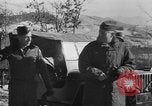
Lieutenant General Lucian K. Truscott assumes command of the 5th Army in Italy during World War II
On 10 December 1944, Lieutenant General Lucian K. Truscott, Jr. (newly appointed Commander of the 5th Army) arrives by jeep at a U.S. Army encampment in Italy during World War II. He is escorted the headquarters of II Corps, on the Apennine front below Bologna, where he is greeted by Major General Geoffrey T. Keyes. They walk together around a building. The next day General Truscott is seen saluting as he is escorted by Major General Willis D. Crittenberger, Commander 1V Corps. Next, General Truscott is seen at the headquarters of the Brazilian Expeditionary Forces contingent of the 5th Army, where he greets its Commander, General João Baptista Mascarenhas de Morais and his aides. As General Truscott leaves, his jeep passes a Brazilian honor of soldiers who salute him. Brigadier General, Donald Carlson. new Chief of Staff of the 5th Army, accompanies Generals Truscott and Crittenberger to a forward observation post near the village of Castelluccio. They observe from a bunker overlooking a valley, where white smoke is rising. (Narrator states that the smoke screen indicates the position of the Allied line of the IV Corps Sector on 11 December.) Next the three American officers are seen making their way up a mountain side, with smoke rising from the town of Vergato, in the background below, where heavy fighting is taking place. (World War II; WW II; World War 2; World War Two)
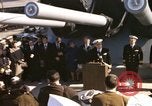
U.S. Navy officers, sailors and mayors during a ceremony aboard USS Springfield (CLG-7) in Boston, Massachusetts.
USS Springfield return to Boston, Massachusetts. A ceremony in progress on board the ship. U.S. Navy Rear Admiral Means Johnston speaks at the ceremony. Mayor N.O. Howarth of Massachusetts is present. Johnston at a podium. A Lt. Governor Sargent speaks from the podium under 6" guns. The commanding officer receives a scroll from the Lt. Governor Sargent. Lt. Governor Sargent presents a folded flag to the C.O. A cameraman with his movie camera. Johnston introduces Mayor N.O. Howarth of Springfield, Illinois. The Mayor steps up to the podium and speaks. Mayor Howarth holds the key to the city. The key to the city is presented to the C.O. by Mayor Howarth. Crew stands at quarters during the ceremony. Officers and men during the ceremony. Mayor C.V. Ryan, Springfield, Massachusetts, steps up to the podium to give his remarks. Mayor Ryan speaks from the podium. The C.O. speaks to Mayor Howarth. Dignitaries stand at one side during the ceremony. A captain poses with the Mayors and other dignitaries. Craig Trefethen, SN, seated in a wheelchair. A sailor lost his legs when a mooring line snapped aboard Springfield in Naples. Craig Trefethen smiles for the camera. Johnston and visitors look at the Terrier missile. Missiles on a launcher in the foreground. The Terrier missile slides onto a launcher in the left foreground. The fantail of the ship, showing a UH-2A copter parked in the background.

Various aircraft perform at an air show and parachutists descend at the National Air Races in Cleveland, Ohio.
Thrills at the National Air Races in Cleveland, Ohio. A V-formation of P-l2s in flight. Crowd-filled stands at the Cleveland Air Races. A formation of U.S. Navy F4B-4s in sets of three in flight Clarence MacArthur flies a 1910 Curtiss pusher-type aircraft. Waco Taperwing aircraft trails smoke in a dive, levels off and climbs. Milo Burcham flies in a P-12 aircraft. Mary Pickford looks up at the sky and points. Two policemen, a civilian and an army officer stand in the background. A crowd-filled grandstand. Milo Burcham in the aircraft rolls over and flies upside down. He flies low over the ground and goes into a vertical climb. People stand behind a fence. A Kinner Bird minus a wheel in flight. Its engine stops. It touches the ground down and skids. Parachutists jump from two Ford Trimotor C-3As. A number of parachutists descend and two of the parachutists land.
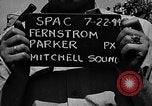
USAF Brigadier Generals James Parker and Dale Gaffney are introduced prior to air show in Spokane, Washington, during World War II
At the start of an air show in Spokane, Washington, during World War 2, a U.S..Army Air Force Colonel introduces Brigadier General James G. Parker, Commanding General of the 4th Air Force, headquartered in San Francisco. General Parker says a few words of greeting. People applaud. The Colonel then introduces Air Force Brigadier General Dale V. Gaffney, Commanding General of the Alaska Wing, Air Transport Command. He also says a few words. Then, (sound only) the Colonel introduces a Major, from Spokane, who had survived the Bataan Death March and also successfully escaped from a Japanese prison camp.
Londoners celebrate the end of war in Europe during World War II.
Victory in Europe Day (V-E Day) celebrations during World War 2 in London, England. Celebrating Londoners watch two Norwegian soldiers waving their national flags from a monument upon which they climbed. Two American soldiers walk carrying American flags. British people gather at news stand where paper headline reads: "ALL OVER." Perfume company adverisement unfolds under Allied flags. Several women wearing colorful fez hats walk together.
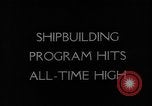
Ships are launched from a ship building yard on the eve of Maritime Day in New York, United States.
View of a large ship building yard in New York, USA during World War 2. Engineers and workers at work. Cranes handle large ship parts. Workers weld ship parts. Large cranes in operations. America celebrates Maritime Day with mass decoration of merchant seamen. New York's Mayor La Guardia awards medal to victims of German submarine raids. U.S. Navy sailors aboard a ship wave and cheer. Sign on the bow of the Victory Ship has a giant "V" symbol and reads 'Ships for victory'. The American flag on the bow. Several large Victory ships are launched from the shipyard, including the SS Irving S. Olds. Ships get underway in the harbor.
CRITICALPAST.COM: About Us | Contact Us | FAQs - How to Order | License Agreement | My Account | My Lightboxes | Shopping Cart | Advanced Search | Featured Collections | Website Terms & Conditions | Privacy Policy ©2026 CriticalPast LLC.
License Agreement |
Terms & Conditions |
Privacy Policy
©2026 CriticalPast LLC.