


 Francais
 Deutsch
 Italiano
Refine Your Search
V2 stock footage and images
- Showing 409 to 414 of 9857 results more
more Hide
Hide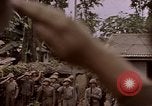
U.S. forces raise American flag over Saipan and senior U.S. officers converse afterwards, during World War II
Scene opens showing American troops assenbled in a clearing on Saipan for a formal flag raising ceremony, following the defeat of Japanese forces defending the island in World War 2. Camera pans over the assembled officers and troops. All salute as the flag is raised by military police. View of the American flag atop the flag pole. After the ceremony, Some of the senior American officers present stand about conversing. Admiral Raymond Spruance, Commander of the U.S. 5th Fleet, is seen wearing a pith helmet. Close to him is Lieutenant General Holland M. Smith, Commander, V Amphibious Corps. Also seen, in fatigues, is Major General Sanderford Jarman, Commanding General, U.S. Army 27th Infantry Division. The remainder of the film shows them and other senior officers mingling and conversing with one another.
The U.S. Navy battles the enemy and animation of enemy air power attacking the United States.
The need to develop air power in the United States. Battleships underway at sea. Eleven bi winged single engine aircraft fly in a V formation. A line of 6 battleships in water off the coast of New England, U.S. A 1920 vintage battleship fires a salvo from its guns at the enemy. The battleships fire guns. Shore batteries fire large guns. Sailors load a deck gun. An early model submarine. The submarine submerges. Its periscope visible above water surface. Naval crafts set their depth charges and fire them. Depth charges going off in the background. A ship sinks. A United States Army Air Service ( USAAS ) Curtiss PW-8 aircraft in flight. 4 bombs fall away from the aircraft. The bombs hit and explode on USS Alabama. Smoke rises as explosions occur on the ship. A ship rolls over and sinks. A USAAS Curtiss-Martin NBS-1 bomber in flight. Two bombs fall away from the aircraft. Explosions in water. Aerial and ground shots of a ship sinking. Large guns of a battleship fire. Animation of enemy airships and aircraft flying over water towards New York. Release of the aircraft from the airships. Aircraft flying over New York City. Aerial view of skyscrapers of the city. A Curtiss- Martin NBS-1 bomber in flight. Two bombs fall toward the ground. Animation of explosions against the New York skyline. A USAAS Curtiss JN-4 aircraft in flight. A bomb falls towards the ground. Animation of bombs hitting New York City. A machine gunner in a fighter aircraft fires at another aircraft. The aircraft falls and burns. Bomb explosions in the city. An observation balloon catches fire and falls. A man in a parachute descends near the balloon. Animation of a burning city. An early model submarine cruising. A bi winged twin pontooned aircraft in flight over a group of battleships and destroyers. A group of aircraft in flight. A Fokker T-2 aircraft in flight. Animation of an airship flying over a city and tying up to a mast located on the top of a tall building. A flag of the U.S. flutters in breeze.
As the United States enters World War II, U.S. military forces are seen, deployed in various places throughout the world.
American troops are seen in arctic gear moving on skis through blustery snowy weather in Iceland, during World War 2. They were sent in 1941 to relieve British troops occupying Iceland since 1940, during World War II. A guard post at the American camp, with Quonset Hut in background. Closeup of U.S. sentry in arctic gear holding rifle with bayonet affixed. View from above, of numerous tents partially covered with snow in the American camp. Change of scene shows U.S. troops disembarking from transport ships at the British Isles. They march with their combat gear onto a square where Army trucks wait to transport them inland. Another scene shows the American troops, viewed from behind, parading in London. Other scenes show them marching in various areas of London. Saint Paul’s cathedral is seen in the background of one scene. A large number of American M3 Stuart Light tanks move on a railroad train in Britain. Scene shifts to the Middle East, where railroad cars and various military supplies for Russia are be offloaded from American ships. A Russian officer is seen signing receipts for war materiel, from a U.S. Army Technical Sergeant. A row of American Army trucks are lined up behind them. The Russian and American exchange salutes, and shake hands. Next, a troop ship carrying American troops is seen arriving at a port in India, where they disembark with their gear. An American Army Sergeant in a pith helmet pays attention to a little Indian girl. Scene shifts to China, in 1942, where Brigadier General Claire Lee Chennault, Commander of the China Air Task Force, of the Tenth Air Force, that replaced the American Volunteer Group (Flying Tigers), is seen with Brigadier General Caleb V. Haynes, Commander of the India Air Task Force. A colonel joins their discussions. A Consolidated B-24 Liberator bomber is parked behind them. View of Curtiss P-40 Warhawk fighter planes, with Flying Tiger markings, parked on a flight line. A B-24 bomber landing on a runway, between hills, deep in China. Closeup of Nationalist China Generalissimo Chiang Kai-Shek, saluting. Huge numbers of Chinese troops assembling in a formation. Next, an expeditionary force of American troops is seen arriving on a troop ship in Australia. They line the ship’s deck and wave. General Douglas MacArthur arriving in Australia to assume the office of Supreme Commander, South West Pacific Area (SWPA). .Glimpses of U.S. Navy activities in Australia: setting up defenses of islands; unpacking a Kingfisher float plane and making it ready for use on a desert island. The final segments of the film show American forces in August ,1942 sailing to Adak in the Aleutian Islands, to strengthen American defenses there. Troops seen descending by rope ladder from the American transport ship USS J Franklin Bell (PA-34), into her landing craft for deployment on Adak Island. Scenes of landing craft reaching the beach and offloading troops, vehicles, and supplies. View of beach filled with supplies. One landing craft is clearly marked with ""P34" showing that it belongs to the USS J Franklin Bell ( later reclassified as APA-16).
Dead and wounded U.S. soldiers are pulled from the burned-out truck and are evacuated at Cholon in Vietnam.
Tet Offensive scenes from the Vietnam War. V-100 armored commando car moves followed by U.S. soldiers. It enters into a narrow street., where it stops and U.S. soldiers pause by a wrecked 2 and a half ton truck. Fallen American soldiers on the ground. Smoke rises up from fire in the background. Dead and wounded are pulled out from the truck. Wounded are given first aid, placed on litters and carried to ambulance. M-113 APC (Armored Personnel Carrier) is seen.
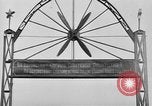
German Operation Barbarossa on the Eastern Front in World War II
Opening scene shows a Russian steel gateway topped by a propeller and two stars. Camera pans down to show that this is the entrance to a Soviet airfield containing a damaged hangar and Soviet military aircraft scattered about. Closeup of a destroyed Soviet airplane. A damaged Soviet Tupolev Tu-2 bomber. Numerous damaged Soviet Polikarpov I-15 bi--wing fighter aircraft. Caissons and Soviet artillery sitting at a railroad siding. Closeup of a damaged artillery piece. Numerous pieces of abandoned soviet artillery, sitting next to heavy guns mounted on rail cars. Soviet tanks missing their turrets. A German soldier examines what looks like a damaged British Mark V tank of World War I vintage. Camera pans over a number of undamaged Soviet tanks parked in a field. Thousands of captured Soviet prisoners of war are seen on a hillside, and then marching under guard. Closeup of one with a large star on his uniform hat. Soviet prisoners being marched about ten-abreast along a road. (Note: about 20 thousand Soviet troops were captured by the Germans in Operation Barbarossa.)

A new rolling mill begins operation at the first Metallurgical Plant in Uzbekistan, USSR
Title slate reads,"the First Metallurgical Plant in Soviet Central Asia." Narrator says construction started 4-years ago during the Battle of Stalingrad in World War 2 (1942-43). Interior of the plant is shown from a vantage point high above the factory floor. Strips of hot steel are seen being extruded from a rolling mill. Closeup of the rolling mill in action and workers standing beside it. Closeup of the mill's rollers and hot steel blank passing through them. Workers handle the hot steel with long tools, as they move it back and forth to different sets of rollers. Narrator says the rolling mill has a capacity of 50 thousand tons per year. Closeup of two steel workers. Change of scene with view from above and then from below, as a furnace is tapped and molten steel flows into a crucible, emiting smoke and flames. Closeup of Uzbek steel workers employed at the steel plant. Next, workers are gathered in a ceremony marking the opening of the new rolling mill. A plant supervisor speaks before the gathering. A huge picture of Joseph stalin forms a backdrop. (Note: This is the The Uzbek Metallurgical Plant, aka V. I. Lenin Uzbek Metallurgical Plant, located in Bekabad, Tashkent Oblast,Uzbekistan. The 300-millimeter light rolling mill, seen here, began operating in October, 1946.)
CRITICALPAST.COM: About Us | Contact Us | FAQs - How to Order | License Agreement | My Account | My Lightboxes | Shopping Cart | Advanced Search | Featured Collections | Website Terms & Conditions | Privacy Policy ©2026 CriticalPast LLC.
License Agreement |
Terms & Conditions |
Privacy Policy
©2026 CriticalPast LLC.