


 Francais
 Deutsch
 Italiano
Refine Your Search
V2 stock footage and images
- Showing 4459 to 4464 of 9941 results more
more Hide
Hide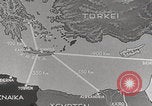
German officer briefs troops, Allied prisoners in Crete (WW2)
Map of Crete showing its distance to Athens (Greece), Tobruk (Libya), Alexandria (Egypt) and Beirut (Lebanon) during World War II. Luftwaffe Junkers Ju-52 aircraft parked on an airfield (likely Maleme airfield). German military officer points to the area near Chania on a map of Crete during a meeting with troops. German officer briefing soldiers and pilots. Allied prisoners of war march in Crete. A medic applies medicine to a British soldier’s wounded hand. A German soldier points to captured British prisoners. A prisoner sits on the ground and leans on a wall near a German guard.
Workers shovel coal, locomotive train with coal cargo, oil field with derricks (WW2)
Men shoveling pile of coal near a factory during World War II. Pile of coal outside a factory or power plant. A locomotive train transporting coal cargo. Mass of oil derricks on oil field with pumpjack working in the foreground.
German troops board Junkers Ju-52 transport planes bound for Sudetenland, Czechoslovakia before WW2.
German troop movement to Sudetenland in Czechoslovakia just before World War II. Mercedes Benz heavy trucks are parked on air field as lines of German Wehrmacht soldiers stand at attention on the other side of the field. A German officer reads instruction from a booklet. Wehrmacht troops marching on the field, toward aircraft. Two Junkers Ju-52 aircraft parked in airfield. A German officer salutes to a flight crew, who then board an aircraft. German soldiers marching to the airplanes. German soldiers climb aboard transport plane. A soldier hands over rifles to his comrade inside the aircraft. Nazi soldiers take their bicycle and belongings with them to the aircraft. German soldiers push a motorcycle into a transport plane. Crewman closes the door of the aircraft after the last soldier boards the plane. Junkers Ju-52 aircraft taxi and takes off from airfield.
German troops and medics arrive in Liberec, Czechoslovakia before WW2.
German soldiers bring their equipment and bicycles as they leave an airfield in Germany for Liberec, Sudetenland (Czechoslovakia) prior to World War II.. German medics walk toward a Red Cross Ju-52 plane (with Swastika emblem on the empennage). A Ju-52 plane taxiing. German medics and soldiers crowd near the aircraft. Transport planes flying over an airfield and after landing. Aerial view of Liberec. A group of Ju-52 transport planes approach and then landing on airfield. German soldiers unload supplies and materiel from the aircraft. A group of German aircraft in flight over Liberec.
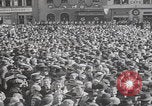
Liberec civilians cheer at the arrival of German troops, Hermann Göring and Adolf Hitler review troops just before WW2.
Luftwaffe Junkers Ju-52 transport planes land in Liberec, Sudetenland (Czechoslovakia) prior to World War II. German troops exit from the plane after landing. The empennage of the Junkers Ju-52 bears the Nazi Swastika. German soldiers running across the airfield. More Luftwaffe planes taxiing and landing at the airfield. A German aircraft marshaller making signals with flags. German Army march in a military parade in the city center of Reichenberg (today Liberec). Some of the soldiers are beating drums. Nazi Swastika banners adorn the buildings. Liberec civilians crowd Adolf-Hitler-Platz and watch German troop parade with warm reception. Sudeten German women hold small Nazi flags. A group of cheering civilians walk and perform the Hitler Salute in front of German troops. Young and old women in the crowd smiling. Café, pharmacy, and other storefronts are adorned with Swastikas. Liberec civilians cheer and throw flowers in front of the German Army. Luftwaffe Commander-in-Chief Hermann Göring inspects German troops in Liberec. Soldiers salute at Göring upon his arrival. Göring gives a military salute to troops. A Bohemian German girl mouths "Heil !". Göring shake hands and talks to soldiers and civilians while army photographer takes pictures. Adolf Hitler arrives in Liberec. Göring accompanies Hitler as they both review troops and civilians. Girls in the crowd perform the Nazi salute for Adolf Hitler. Hitler speaks to Göring. Hitler performs the Nazi salute to the people of Liberec during the motorcade.
Reichsmarschall Hermann Göring inspects Luftwaffe and Wehrmacht troops in Sudetenland (Czechoslovakia) prior to WW2.
Sudeten Germans welcome Luftwaffe Commander-in-Chief and Reichsmarschall Hermann Göring and German troops into Reichenberg (today Liberec), Czechoslovakia prior to World War II. Liberec civilians crowd Adolf-Hitler-Platz (nám. Dr. E. Beneše 1/1, 460 59 Liberec, Czechia ?) and watch German troop parade with warm reception. Nazi Swastika banners adorn buildings in Liberec. Hermann Göring addresses the crowd on stage. The Nazi Germany Reichadler (Imperial Eagle) emblem is on display behind Göring. German troops stand at attention in front of the stage. German troops and band in military parade on the streets. Feet of Wehrmacht soldiers marching. Liberec civilians cheer and perform the Hitler salute. Hermann Göring and other military officials join the parade. Hermann Göring visits an airfield in the afternoon. Luftwaffe officers salute and talk to Göring. Göring with a bewildered expression. Ju-52 planes with Nazi Swastika markings landing and taxiing on airfield. Göring and other officials watch the planes. A group of Ju-52 planes on the ground. German soldiers run while pulling a wagon. They march in a single file in front of Göring. Civilian perform the Nazi salute to arriving troops. Göring nods and talks to Sudeten German boys and girls. A woman pins a corsage of flowers on a German soldier’s chest. A soldier speaks to Göring. German soldiers stand in front of bicycles in the airfield. Göring bids good-bye to a Sudetenland official and leaves in a staff car. Göring waves from departing car. Göring arrives in Karlovy Vary (Karlsbad/ Carlsbad), Czechoslovakia. Crowds gathered at the city center and the (likely Muehlbrunn) colonnade to welcome Göring. Karlsbad civilians perform the Nazi salute to welcome Göring. Göring’s guard clears out the way for Göring and other officials. Göring and other Nazi officials board a car. Göring inspects the Luftwaffe and airfield. Göring and a German soldier salute to each other. Göring holds his Luftwaffe Generalfeldmarschall baton while inspecting his troops. Göring speaks to the Luftwaffe and soldiers in attendance. Wehrmacht soldiers form a line.
CRITICALPAST.COM: About Us | Contact Us | FAQs - How to Order | License Agreement | My Account | My Lightboxes | Shopping Cart | Advanced Search | Featured Collections | Website Terms & Conditions | Privacy Policy ©2026 CriticalPast LLC.
License Agreement |
Terms & Conditions |
Privacy Policy
©2026 CriticalPast LLC.