


 Francais
 Deutsch
 Italiano
Refine Your Search
V2 stock footage and images
- Showing 4735 to 4740 of 9941 results more
more Hide
Hide
Jane “Candy” Kendeigh assisting wounded U.S. soldiers after Iwo Jima during World War 2.
Clip starts with a closeup shot of the red cross symbol on the side of a medical transport vehicle. Then it switches to a shot of a few U.S. Marines stepping onto a bus, while one woman (possibly Kendeigh) and a few other soldiers stand on the porch of a building beside the bus. Injured Marines on stretchers are seen being carried to a Douglas R4D transport aircraft, before a closeup shot of more soldiers on stretchers lying on the ground. Then Jane Kendeigh, the first Navy flight nurse to land in an active Pacific combat zone, is seen speaking to one of the men on the ground. A few soldiers are seen being moved into another R4D transport plane, with Kendeigh watching. Then, a closeup shot of Kendeigh and another Marine examining something on a clipboard, before another stretcher is loaded onto the plane. Kendeigh is seen inside the airplane, speaking to a few of the men, some sitting and some wounded lying on beds or stretchers. Finally, a closeup of one soldier, appearing to be asleep.
German actor Paul Wegener speaking; Hitler Youth celebrate Winter Solstice (WW2)
Scene from a movie production showing German actor and film pioneer Paul Wegener as he dumps a sack on the ground. Paul Molander talks in one of the scenes from the 1945 German film “Der Fall Molander” (“The Molander Case”). Scene changes to Hitler Youth members skiing downhill in the dark with torches in their hands as they celebrate the German folk festival Winter Solstice in World War II. A Hitler Youth stops at the bottom slope and lights a bonfire with his torch. Crowds of Hitler Youth gather by the bonfire with their torches at night. Hitler Youth leader Baldur von Schirach is seen in the event.
Figure skater Lydia Veicht performs at bomb-damaged Berlin Sportspalast (WW2)
German figure skater Lydia Veicht performs at the Berlin Sportspalast in Berlin, Germany. The Berlin Sportspalast stadium is seen without a roof after sustaining damage from Allied bombings in World War II. The steel skeleton of the roof supports is visible. The stadium seating is filled with spectators dressed in warm clothing. Ice skater Lydia Veicht gracefully spins and jumps on ice. A German soldier watches the show with his child. Some of the audience include German soldiers in uniform. Women and men applaud the performance. A man and a woman perform on ice. Soldiers huddled together in a blanket as they watch. A group of figure skaters in short Dirndl-inspired costumes perform a dance on ice.
Allied and Nazi German prisoner exchange in Dunkirk, France (WW2)
Animated map showing the Atlantic coast of France in World War II. Allied and German officers facilitate a prisoner exchange at Dunkirk, France. A group of Allied prisoners of war are gathered at a port in Northern France for a prisoner exchange. Red Cross workers exchange papers with officers. An injured prisoner is carried by two soldiers as the prisoners of war board a boat. A boat loaded with German soldiers pulling away from the port. Some of the soldiers wave happily to the camera. Soldiers taking pictures and videos with cameras. German soldiers getting out of boat and celebrating. German officers at staff meeting, with maps behind them. German military officials broadcast to the people of Germany about the repatriation of captured troops back to Germany.
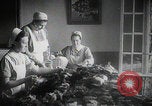
German Red Cross women pack Christmas gifts; German soldiers receive letters (WW2)
German Red Cross women packing Christmas gifts for German soldiers in World War II. A Christmas card, Christmas decorations, and gifts for soldiers on the table. German soldiers in trenches in the frontlines receive letters from home. Postal mail call in a wooded area. A German soldier reads a letter and looks at a photograph of a woman. Allied invasion fleet underway for the D-Day landings in Normandy. A German tank crosses a bridge. Abandoned Allied trucks and wreckage from D-Day. An Allied ship lists to starboard. Strong waves crashes into a wrecked pontoon causeway.
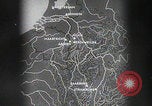
German troops launch surprise counter offensive in the Ardennes (WW2)
Animated map showing the Rhineland region in Germany, Strasbourg (Strassburg), the Ardennes, and Netherlands in World War II. Night scene of rockets being fired as the German Army launched a major offensive through the Ardennes, starting the Battle of the Bulge. German Army fire Nebelwerfer rockets at night. Rockets hit enemy targets. German officer signals the artillery to fire. A heavy gun barrel is seen recoiling as it fires. German artillery crew firing field pieces. German soldiers in trench watch Allied positions being shelled. German troops firing an anti-aircraft gun hidden under branches of foliage. German soldier with camouflaged helmet. Captured United States Army soldiers walking by the Siegfred Line. Dragons Teeth antitank barriers are seen in the background. German soldiers riding on Stug III Ausf. F tank destroyers and half tracked vehicle (Sd.Kfz.251) pass by on muddy road. The captured American prisoners of war are made to march with their hands over their heads. German soldiers carrying Panzerfaust anti-tank weapons while marching in mud up to their ankles. Others carry MG 42 machine guns and belt ammunition. American helmets scattered on the ground. Dead Allied soldiers after the surprise German attack in the Ardennes.
CRITICALPAST.COM: About Us | Contact Us | FAQs - How to Order | License Agreement | My Account | My Lightboxes | Shopping Cart | Advanced Search | Featured Collections | Website Terms & Conditions | Privacy Policy ©2026 CriticalPast LLC.
License Agreement |
Terms & Conditions |
Privacy Policy
©2026 CriticalPast LLC.