


 Francais
 Deutsch
 Italiano
Refine Your Search
V2 stock footage and images
- Showing 4741 to 4746 of 9941 results more
more Hide
Hide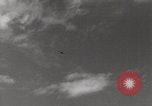
Aircraft over Pearl Harbor during Japanese attack in World War 2; destroyed U.S. aircraft on ground
Multiple shots of American F4F Wildcat fighter aircraft at low altitude during or shortly after the bombings on Pearl Harbor, Hawaii. One airplane, smoking from its engine, flies directly over the cameraman (possibly a hit Japanese aircraft). U.S. sailors put out the fires that have engulfed aircraft on the ground during the Japanese attack. Many of the airplanes have been totally destroyed.
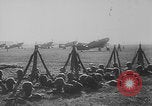
German flying squadron practices shooting in World War 2
During the German invasion of Poland in World War II, a German flying squadron is shown preparing to practice shooting behind the front lines. Their Messerschmitt Bf 109 planes are shown, as well as German troops sitting on the ground preparing. Two soldiers without their jackets are shown talking in front of a practice target on the ground. They appear to be repainting the target. The airmen's planes are shown flying and shooting the ground near the square practice target. An airman with no shirt stands on top of a truck looking at the planes through binoculars while other fully uniformed soldiers watch while seated nearby. From a distance, a plane can once again be seen flying and shooting at the targets.
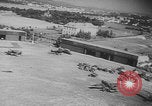
German military use of airport in Bromberg, Poland as a base during World War 2
Long shot aerial view from a low-flying airplane shows airport in Bromberg (Bydgoszcz), Poland. View of many German Air Force planes, as well as various outbuildings. Narrator describes that after the German invasion of Poland during World War II, the Germans took over the airfield to use for their own military aircraft and operations. Bomb craters on ground from German bombing on September 1st, 1939. View from inside a hangar looking outward on destroyed aircraft debris. More shots of debris on the airfield. Several Polish aircraft are shown in various states of ruin. German soldier approaches a Polish biplane with gun damage to the skin of the fuselage.
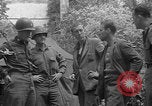
Escaped U.S. Army bomber pilots speak with officers after rescue during World War 2
Two escaped U.S. Army Air Force aircraft pilots, shot down in enemy territory in December 1943 during World War II, speak with U.S. officers after their rescue in 1944. Both pilots are dressed in civilian clothing, and one wears improvised shoes. (Footage shot around the time of the Battle of Cisterna).
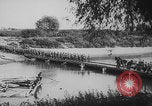
German troops cross temporary bridges in Poland during World War 2 occupation
During the German invasion of Poland during World War II, German army forces cross new temporarily built bridges. The troops are composed primarily of soldiers on foot, with horse-drawn supply wagons and some mounted cavalry. German troops crossing on a low and simply-made bridge with no guardrails. Debris in the water near the bridge. Horse-drawn wagons entering a different bridge. View of crooked rails on hastily-made bridges. A soldier on a bicycle rides up a muddy road beside a horse-drawn supply wagon. Another wagon ahead contains another bicycle. A third bridge is crossed. On the opposite bank, a wagon pulled by two horses speeds off the bridge, kicking up dust. A soldier runs behind. Horses run to pull wagons up a hill, and then slow at the top. The troops walk along a road.
Allied Army vehicles in front of the Platterhof Gasthaus near the Berghof (WW2)
View of Hitler's famous mountain Eagle’s Nest residence, the Berghof, in the Obersalzberg of the Bavarian Alps near Berchtesgaden, Bavaria, Germany. View of the snow covered Berghof as seen below the mountain. Snowcapped Bavarian Alps behind alpine trees. U.S. Army vehicles in front of the Platterhof Gasthaus, known as the General Walker Hotel after World War II, in Obersalzburg, Germany. Some vehicles come and go in front of the Platterhof Gasthaus. 101st Airborne Division soldiers perform a changing the guard ceremony. An officer inspects the troops.
CRITICALPAST.COM: About Us | Contact Us | FAQs - How to Order | License Agreement | My Account | My Lightboxes | Shopping Cart | Advanced Search | Featured Collections | Website Terms & Conditions | Privacy Policy ©2026 CriticalPast LLC.
License Agreement |
Terms & Conditions |
Privacy Policy
©2026 CriticalPast LLC.