


 Francais
 Deutsch
 Italiano
Refine Your Search
V2 stock footage and images
- Showing 4765 to 4770 of 9941 results more
more Hide
Hide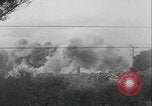
German reconnaissance aircraft reveals Allied ships in the port of Anzio, Italy, German 28cm railway gun bombards port during World War 2
German soldiers fire anti-aircraft guns and use panoramic sights to scan the skies. The narrator notes that the attack has been repelled, and that the skies are clear. Close ups of the German soldiers, some smoke pipes. A reconnaissance aircraft takes off from a German airfield near near the port of Anzio, Italy. Aerial views from the plane, flying several kilometers above the port of Anzio where Allied naval ships are docked. A German soldier inside the reconnaissance plane turns on a camera to document the port. Many Allied ships are docked. The reconnaissance plane lands back at the German airfield, and the film is transported to a tent to be analyzed. Allied ships can be seen in the images using a magnifying lens. A photograph of the Anzio port is marked with specific positions of Allied vessels. Scene changes to a German Krupp K5 railway gun, dubbed "Anzio Annie" by Allied forces, as it is moved into position. The 28cm artillery gun fires, smoke billowing from the barrel. Explosions in the distance and clouds of smoke erupting, seen through binoculars. A team of German soldiers reload and fire the rail gun several times. Smoking explosions litter the port of Anzio in the distance.
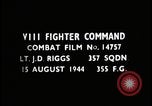
Aerial views of railway classification yard and aerial strafing of railroad target, from USAAF fighter, in Europe, during World War 2
High aerial view of a railway marshalling yard (classification yard), many railroads extend outwards in all directions. Scnes taken from U.S. Army Air Force (USAAF) fighter aircraft. Scene changes to low aerial flight toward smoking train, aircraft strafes the German held railroad target. The aircraft makes multiple passes shelling the train. Another aircraft can be seen ahead, rising out of its low attack. Large black clouds of smoke rise from the destroyed train. From mounted gun camera footage of Lieutenant J. D. Riggs of the 357th Squadron, 355th Fighter Group, VIII Fighter Command.
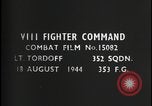
U.S. Army Air Force Fighter (USAAF) strafes ground targets in Europe during World War 2
Footage from aircraft-mounted camera of Lieutenant Tordoff of the 352nd Squadron, 353rd Fighter Group, VIII Fighter Command, U.S. Army Air Force. The Fighter makes multiple passes on roadway targets and German vehicle convoys, destroying vehicles and causing plumes of smoke. Another pass damages a vehicle on a railroad. Subsequent passes of roadway targets, including a moving vehicle. The aircraft strafes another ground target causing a massive explosion and sending a piece of debris flying. Additional ground attacks by the aircraft, large plume of smoke above a target.
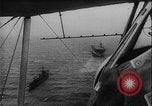
Crew of German submarine U-29 awarded Iron Cross after sinking British HMS Courageous aircraft carrier in 1939, during World War 2
Aerial view of British aircraft carrier HMS Courageous and a destroyer nearby, which was sunk by German submarine (type VIIA U-boat) of Nazi Germany's Kriegsmarine, on September 17, 1939. Scene changes and German submarine U-29 emerges from the water. Submarine cruises surfaced above water, German soldiers stand on the deck. The victorious submarine comes into port in Wilhelmshaven, Germany, on September 26, 1939. Soldiers standing on deck saluting. Nazi flag flies. Crew of the U-boat walk across plank to dock and assemble. The crew, standing in a line, shake hands and greet other German officers. The commander and crew are decorated with the Iron Cross award. Close ups of smiling crew. Nazi flag flying. Taken from a Spanish newsreel.
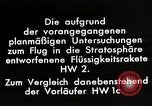
Dr. Johannes Winkler and his designs for Liquid fueled rockets.
German Rocket pioneer Johannes Winkler and his liquid fueled HW2 rocket. Diagrammatic drawing of the HW2 liquid fueled rocket, that Winkler designed based on his prior experience with the HW1c. He considered liquid fuel the key to achieving stratopheric heights. Dr. Winkler in his laboratory with rocket models. He is seen outdoors, setting the HW2 on a launch stand. Views of the HW2 ready for launching. View of data recording devices built by Dr. Winkler. Cold fumes seen from liquid oxygen. View inside laboratory of HW2 with its data instrumentation. Original Shear diagrams for the HW1c and HW2 rockets. The HW2 in its casing and a cutaway drawing of it. View of quick opening valve for liquid methane and liquid oxygen.
Crewmen of Torpedo Squadron 8 pose near aircraft on the flight deck of USS Hornet underway in the Pacific Ocean.
A film on aviators and crewmen of Torpedo Squadron 8 who gave their lives on June 4, 1942 near Midway Island in the Pacific Ocean during the Battle of Midway of World War II. Names of Lieutenant Commander John Charles Waldron and Horace Franklin Dobbs who was the chief radioman. They pose in front of an aircraft. Ensign Henry R. Kenyon Jr. and Airman 2nd Class Darwin L. Clarke pose near an aircraft and talk. Ensign E. L. Fayle and Seaman 2nd Class Aswell L. Picou pose seated on the wing of an aircraft. Lieutenant Raymond A Moore and Airman 1st Class Tom Hartsel Pettry seated near a bomb loaded in the aircraft. Ensign William Robinson Evans and Airman 3rd Class Ross Eugene Bibb pose. Lieutenant (jg) Jeff Davis Woodson and Airman 2nd Class Otway David Creasy Jr pose near an airplane. Ensign William W Creamer and Seaman 2nd Class Francis Samuel Polston draw a face on a bomb loaded in an airplane and pose. Other crewmen who pose are: Lieutenant James Charles Owens Jr. and Airman 1st Class Amelio Maffei, Ensign Ulvert Matthew Moore and Airman 3rd Class William F Sawhill, Lieutenant (jg) George Marvin Campbell and Airman 2nd Class Ronald Joseph Fisher, Ensign John Porter Gray and Airman 3rd Class Max Arthir Calkin. Ensign G. H. Gay who was rescued and Airman 3rd Class George Arthir Field pose. Ensign Grant W Teats and Airman 2nd Class Hollis Martin, Ensign John Ellison and Carneiro, Ensign William Abercrombie and Aviation Pilot Robert B Miles, Airman 3rd Class Robert K. Huntington and Airman 2nd Class Bernard P Phelps. A chaplain at funeral services on the deck of the carrier USS Hornet (CV-8). The volley squad fires guns and the bugler blows taps. Sunset at sea. U.S. Navy SBD Dauntless in flight overhead.
CRITICALPAST.COM: About Us | Contact Us | FAQs - How to Order | License Agreement | My Account | My Lightboxes | Shopping Cart | Advanced Search | Featured Collections | Website Terms & Conditions | Privacy Policy ©2026 CriticalPast LLC.
License Agreement |
Terms & Conditions |
Privacy Policy
©2026 CriticalPast LLC.