


 Francais
 Deutsch
 Italiano
Refine Your Search
V2 stock footage and images
- Showing 4759 to 4764 of 9941 results more
more Hide
Hide
U.S Army troops traverse steep terrain on skis and by foot on Mount Rainier in Washington State during World War 2
U.S. Army ski troops walk in single file up the slopes of Mount Rainer. Soldiers at the front use skis to create a switchback pathways for troops on foot, who follow behind. The soldiers carry packs and rifles. Close up shows the soldiers covered in snow as they ascend. A soldier walks past with food in hand. The troops struggle to gain footing in the deep snow. Side shot shows soldiers using their hands to assist the ascent up a steep slope, snow-covered Mount Rainer in the background. Elevated shot shows the men as they walk up a slope, view of pine trees and an alpine lake in the background. A group of soldiers on foot traverse a bare slope toward a high ridge line, pausing to allow time for ski troops in the front to clear a path. The group of soldiers climbs the final rocky face to the ridge.
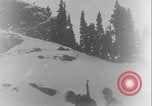
U.S. Army ski troops climb rocky face using ropes and ice axes near Mount Rainier in Washington State during World War 2
U.S. Army ski troops pack equipment, eat, and drink with Mount Rainier in the background. Close up of a soldier as he laces his boots. A soldier begins ascending a rocky face while tethered by rope to a partner below. A line of soldiers connected by rope trudge up a steep face. Men at the top of the face pull the rope taut to give the soldiers below a handhold. Close up shot looking down at a soldier as he climbs with the rope, pack and rifle on his back, wearing gloves. A final group of soldiers in white caps ascend, bringing the rope up with them as they climb. Multiple shots with mountain vistas in background. At the top of ridge a few soldiers lose traction on slick ground, but the tethering system prevents them from falling.
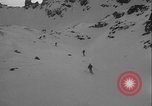
U.S. Army ski troops descend and traverse slopes of Mount Rainier in Washington State during World War 2
U.S. Army troops ski down a slope with packs and rifles. The soldiers move in a single file line, pushing hard with their poles to cover flatter terrain. A large group of soldiers stands on a bald outcropping, a mountain visible in the background. Soldiers in white caps ski single file down a short, steep slope and turn hard at the end, view of Mount Rainier's slopes in the background. A skier wipes out at the turn.
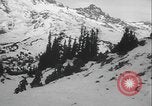
U.S. Army ski troops conduct mock skirmish exercises on snowy terrain near Mount Rainier in Washington State during World War 2
U.S. Army troops quickly ascend a snow-covered rock outcropping, rifles in hand. The soldiers stay low to the ground and dive into position, forming skirmish lines with rifles aimed. Close up shot of the soldiers mock firing their weapons. Soldiers in white camouflage uniforms stay low and advance their position on a snowy slope, diving to the ground and aiming their weapons. The soldiers retreat; one of the soldiers holds a pistol, another stumbles in the snow. A group of eleven soldiers in both dark and white uniforms pose for a photo with the vast slopes of Mount Rainier in the background. Close up shots of the soldiers' faces as they smile for the camera.
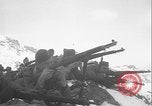
U.S. Army ski troops conduct combat exercises on mountain slopes near Mount Rainier in Washington State during World War 2
U.S. Army ski troops on an elevated outcropping lay prone in a line and mock fire their rifles, the snowy slopes of Mount Rainier in the background. A small squad of soldiers army crawl to the edge of the ridge for a better view, aiming their weapons. Scene changes and a large group of soldiers rush forward over the ridge, diving forward into a laying position and raising their weapons. A line of soldiers standing next to upright pairs of skis quickly change into white camouflage uniforms and then rush forward, establishing their mock position as they dive to the ground and aim their rifles.
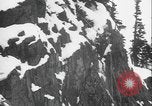
U.S. Army ski troops rappel down a rocky cliff side near Mount Rainier in Washington State during World War 2
U.S. Army troops rappel rocky cliff face using rope with Mount Rainier in the background. Soldiers with backpacks and rifles over their shoulders descend a tall cliff with their boots to the mountainside. Some of the soldiers wear white winter camouflage gear, others dark uniforms. The soldiers walk the side of a steep snowy slope with a partially-frozen alpine lake in the background. Low angle shot of a soldier as he descends the cliff face above.
CRITICALPAST.COM: About Us | Contact Us | FAQs - How to Order | License Agreement | My Account | My Lightboxes | Shopping Cart | Advanced Search | Featured Collections | Website Terms & Conditions | Privacy Policy ©2026 CriticalPast LLC.
License Agreement |
Terms & Conditions |
Privacy Policy
©2026 CriticalPast LLC.