


 Francais
 Deutsch
 Italiano
Refine Your Search
V2 stock footage and images
- Showing 4843 to 4848 of 9941 results more
more Hide
Hide
Nikita Khrushchev and Dwight D. Eisenhower arrive in Paris, France for the Four Power Paris Summit.
The Four Power Paris Summit in Paris, France after the 1960 U-2 incident. Wreckage of a United States Air Force Lockheed U-2 spy airplane in Moscow, Soviet Union. A diagram of a U-2 aircraft. People look at photographs on a wall. A photograph of a man. Soviet Premier Nikita Khrushchev at the exhibit with Soviet dignitaries. Mr. Khrushchev gives statements to journalists. A Russian aircraft carrying Mr. Khrushchev and Soviet dignitaries taxis in Paris. A United States Air Force aircraft carrying U.S. President Dwight D. Eisenhower and U.S. dignitaries lands. President Eisenhower addresses people at the airport. A motorcade rolls through the streets. French soldiers at attention in review. Cars drive past them. Exterior of a building.
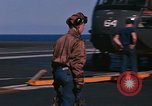
SH-3A helicopters loaded with homing torpedoes are hooked up with tractors aboard USS Randolph, Mediterranean Sea.
Activities aboard USS Randolph. Plane captain carries tie downs along flight deck. Two ordnance men stand next to aircraft in the background. Aircraft S-2Es parked in the background with wings folded. SH-2s spotted by a tractor. Tractor pulls SH-3A helicopter. Man in blue shirt stands in front of helicopter. He lifts the tow bar. Tractor backs up and helicopter is hooked up. Ordnance men wheel a homing torpedo over deck off to left in the background. SH-3A parked next to an S-2E. Man works with tow bars in the mid background. Tractor moves by in the foreground, towing an SH-3A. Helicopter comes to a stop showing part of tail section. Man works with a chain tie down, securing helicopter to deck. Two gas crewmen working next to helicopter, checks the fuel nozzle.
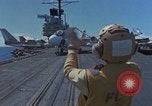
Activities aboard the U.S. Aircraft carrier Ranger (CV-61) during deployment in Western Pacific and Indian Ocean, 1982.
Navy yellow shirt plane director guides an A-6E Intruder aircraft of VA-145, with folded wings, on deck of the USS Ranger (CV-61). The aircraft displays tail code NE of Carrier Air Wing 2 (CVW-2) and the Swordsmen insignia of VA-145. Closeup of an F-14A Tomcat tail, displaying the red wolfhead insignia of VF-1 (The Wolfpack). An aviation fuels purple shirt clambers over the top of the F-14A. Two aviation ordnance red shirts seen transporting 20mm belt ammunition across the deck for the the ship's Phalanx CIWS anti-missile Gatling gun. Yellow shirt directs a Grumman E-2 Hawkeye tactical airborne early warning (AEW) aircraft as it proceeds along the flight deck.
United States 182nd Regiment lands and invades city of Cebu in Philippines.
U.S. 182nd Regiment lands on Cebu. U.S. landing crafts approach Cebu beach. Troops wade ashore. Palm trees in the background. Major General William H Arnold mapping the drive to city. Equipment is unloaded by men. U.S. troops advance toward Cebu city and encounter road blocks. They sweep for land mines on their way to city. A Bomb is taken out of a hole. Dead body of American soldier killed by land mine. 4.2 inch mortars are brought forward by the 80th Chemical Mortar Battalion (CMB) on beach. Tanks and troops advance towards a village where first organized enemy resistance is encountered. Troops take cover behind trees and fire rifles at Japanese snipers hiding in houses. Trooper throws grenade in house and moves back. Explosion in house. House is set on fire. Wounded Japanese comes out of house and falls down. Troops advance further. Troops greeted by civilians. Native carriages, tanks and troops advance in village. Japanese prisoners under guard. Troops move through rubble and wreckage of building in village. Troops advance through old military installation Fort San Pedro. Wreckage of building. Troops move along streets of Cebu. (World War II; WWII;World War 2; WW2)
U.S. Naval warships operating and bombarding Corregidor Island during World War II
A U.S. Vought OS2U Kingfisher scout plane flies low over the water near Corregidor Island, during World War 2. View of sailor standing next to a Kinfisher plane, on deck, with a destroyer in camouflage underway, in near background. Smoke rising over Corregidor Island, from Navy bombardment. Pilot climbing aboard a Kingfisher scout plane. Sailor gives launch signal, with a flag, and the plane is catapulted. Another scout plane is launched from number 2 catapult. A Kingfisher in flight. View of Corregidor from shipboard. A destroyer bombarding the island closein. Crew members in steel helmets and face and eye protection, at a gun station. Officers on bridge of cruiser, observing through binoculars. A Cleveland Class, single stack, light cruiser. Officers on bridge of the camera cruiser. Two destroyers underway. Sailors in an antiaircraft gun position. A Brooklyn Class light cruiser.
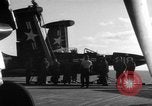
Activity aboard the USS Philippine Sea (CVA-47) during the Korean War
Carrier activity aboard USS Philippine Sea (CVA-47) in the Pacific ocean, during the Korean War. Flight deck of the aircraft carrier. Grumman F9F-2 Panther aircraft of VF-112 on flight deck. An F4U-4B, of Fighter Squadron VF-113, is towed past the F9F-2. An AD4 Skyraider of Attack Squadron VA-115, with bombs under its folded wings, is backed into line on the deck. Deck crew maneuvers F9F-2 into position at side of deck. Star rockets brought on deck by small rocket cart. More views of AD4s with bombs under folded wings. Many AD4s, on the flight deck, with wings folded and engines running or cranking with props turning.
CRITICALPAST.COM: About Us | Contact Us | FAQs - How to Order | License Agreement | My Account | My Lightboxes | Shopping Cart | Advanced Search | Featured Collections | Website Terms & Conditions | Privacy Policy ©2026 CriticalPast LLC.
License Agreement |
Terms & Conditions |
Privacy Policy
©2026 CriticalPast LLC.