


 Francais
 Deutsch
 Italiano
Refine Your Search
V2 stock footage and images
- Showing 4909 to 4914 of 9941 results more
more Hide
Hide
115mm toxic rocket M91 of United States Army in United States.
A helicopter takes off from a field. A rocket launcher of 45 rocket openings divided in 5 rows of 9 columns each is placed on ground. It is stabilized by 2 hooks and 2 trail assemblies. A soldier hammers it in ground. Another soldier views through telescope.
African American citizens attending a church in U.S.; views of 1938 Louis versus Schmeling boxing; African American troops training
African American soldiers and Women's Air Corps singing and attending a church during World War 2. A pastor rises to pulpit and address the gathering. He names a few soldiers and they smile. A woman gives her introduction and smiles. Views of boxing match in June 22, 1938 as boxer Joe Louis knocks out opponent Max Schmeling. African American soldiers at army training camps readying for service in World War 2. They drill and climb stairs then jump down in initial paratrooper training. Other training drills of soldiers are also seen. Flags of United States and Germany. First page of Constitution of United States is shown. The reverend takes a book. Face of Adolf Hitler is printed on cover page of Mein Kampf held by the pastor. The cleric reads from the book. People listen to him. He closes the book and keeps it aside, still speaking
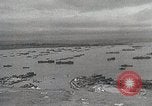
Allies in Britain prepare for D-Day invasion of Normandy, in World War II.
Allied invasion task force loading tanks, vehicles, troops and equipment on ships,at British ports, in readiness for the D-Day invasion of Normandy, in World war 2. Armored vehicle seen loaded onto USS Boone County (LST-389) at Falmouth in Cornwell, England on June 2, 1944, as troops load various ships. Troops near anchored craft USS LCI(L)-84 and another vessel (possibly marked 48 or 49). Tanks, bulldozers, and heavy equipement being loaded. View of Landing Ship Tank LST-621 and then LST-317 being loaded. DUKW vehicles in queue to load. A U.S. Army soldier is hoisted aboard a British Royal Navy ship in a special harness. British sailors around him and another U.S. Army soldier on the deck. Invasion troops from England and the United States spending their waiting time aboard ships. Three seen playing musical instruments: Accordion, guitar, and violin. Several play cards. Two practice gymnastics. Some prepare weapons and ammunition (view of LST-506 or LCI-506 in background). Navy sailors and U.S. Army troops huddled together in tight groups as they are briefed by their respective officers regarding the invasion mission.
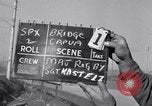
Allied military traffic using bridge across Volturno River, built by U.S. Army engineers in World War II
Traffic moving across a Bridge over Volturno River built by 1st battalion U.S. Army 343rd Engineers in Capua, Italy,during World War 2. The original bridge has been demolished and sits in the river bed. Closer view of the site. Traffic moving on the intact bridge is mostly military. View from water of an almost completely submerged section of the destroyed bridge. View from opposite shore of old buildings across the river, including the tower of the Cathedral of Capua (Cattedrale dei SS. Stefano e Agata). Camera pans from various places, including sandy bank of the river. Closer views of bridge show pedestrians walking across it. (Note 1: The bridge built by 343rd Engineers, from October 16th to November 9th, was a semi-permanent structure, 332 ft high, 370 feet long, and classified as a two-way Class 40 or one-way Class 70 bridge. A million vehicles crossed it during the entire Italian campaign. Note 2: reportedly, opening slate refers to Major Linden Rigby, 196th Signal Photo Company, involved in the making of this film.)
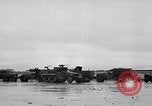
Mortar carrier T-21 at Aberdeen proving ground in USA.
Mortar carrier T-21 circles the field at Aberdeen proving ground. It moves over rough and level terrain. Soldiers open rear door revealing mortar. Soldier climbs into the carrier and inspects grenades and other equipment. (Note: The 4.2" M2 heavy mortar recoil was hard on the halftrack chassis so the T-21 was cancelled and never adopted.) (World War II period).

General Eisenhower as a World War II officer and as the U.S. President.
Scenes from life and career of Dwight D Eisenhower, 34th President of United States. U.S. Air Force plane lands and the President disembarks the plane in India, in 1959. He is greeted by the Indian President Dr Rajendra Prasad and other dignitaries. Emblem of 'Panama'. Sign of 'welcome Ike Crusader'. Large crowd welcomes Eisenhower. Motorcade goes through the city's street. Milestones in General Eisenhower's life and the international esteem with which he is held. Lt Col Eisenhower concerned about U.S. isolationism in 1940 as World War 2 is underway. Explosions in Europe due to bombing by German aircraft. Eisenhower and other officers in the General Staff study a map. Eisenhower plans the strategy as the commander of Operation Torch (he is shown talking to General George C. Marshall and Winston Churchill). President Eisenhower visits 4 continents and meets several leaders. Large crowds welcome him. General Eisenhower prepares for D-Day Invasion of France during World War 2. June 5, 1944: The Allied forces including troops, artillery, equipment, ammunition, aircraft and ships prepared. June 6, 1944: The Allies invade Normandy. Troops wade through the water during D-Day Normandy beach landings, while under enemy fire. German soldiers surrender. May 7, 1945: Nazi General Alfred Jodl signs the unconditional surrender of his government. General Eisenhower returns to the U.S. He receives a hero's welcome in New York during a parade. He visits his hometown in Kansas. Pictures of his family, childhood and college days. Eisenhower on his visits to various countries as President.
CRITICALPAST.COM: About Us | Contact Us | FAQs - How to Order | License Agreement | My Account | My Lightboxes | Shopping Cart | Advanced Search | Featured Collections | Website Terms & Conditions | Privacy Policy ©2026 CriticalPast LLC.
License Agreement |
Terms & Conditions |
Privacy Policy
©2026 CriticalPast LLC.