


 Francais
 Deutsch
 Italiano
Refine Your Search
V2 stock footage and images
- Showing 4969 to 4974 of 9941 results more
more Hide
Hide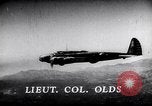
Lieutenant Colonel Robert Olds commands record-breaking cross country flight in U.S. Army Air Corps YB-17 bomber
View of YB-17 bomber piloted by Lieutenant Colonel Robert Olds, Commander of the U.S. Army Air Corps 2nd Bomb Group, seen aloft, during an historic non-stop flight from March Field, California, to Langley Field, Virginia. The YB-17 lands at Langley Field. Next, Lieutenant Colonel Olds is seen discussing the flight, while surrounded by U.S. Army officers all wearing campaign hats. Glimpse of YB-17s of the 2nd Bomb Group parked on the ramp at Langley Field.
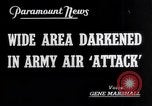
First blackout drill in Farmingdale New York, and mock bombing of aircraft factories early in World War II.
Aerial views of Mitchel Field in Hempstead Plains of Long Island, New York. Major General Frank Andrews of U.S. Army Air Corps, General Headquarters Air Force, and staff standing around a large plotting board, with models of airplanes, guns and boats on the plotting board. They are planning a test of the defense of aircraft factories in the region from air attack. Five PB-2As parked in a row at Mitchel Field. Crew operating range finder and aircraft sound detector. Soldiers turn searchlight to the right. Fireman opens switch box door on wall and pulling switch to notify power station staff of the drill, which was the first aerial bombardment blackout drill of its kind in the United States. Workman pulling main power switch in power station to create blackout conditions in city as protection from aerial bombing. Night time aerial views of City of Farmingdale in New York lit up and then going dark all at once as power is cut during blackout. Batteries of the 62nd anti aircraft post artillery swing into action operating searchlights directed at incoming bombers. The bombers drop flares during the test, as ground crews practice locating the "enemy" aircraft in search light beams.B-10, the all metal monoplane bomber in flight during night. Flares descending. In the mock test, the bombers prevail and the defenses fail to protect all of the aircraft factories. End of clip shows elevated night time views of New York City and Times Square area as seen from the air and from high up tall skyscraper buildings of Manhattan. Bright lights and lit signs of city seen from above as narrator suggests the threat against New York City from aerial bombardment by a foreign force (early in World War 2).
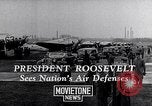
President Franklin D Roosevelt views various airplanes in United States.
President Franklin D Roosevelt and Chief of the Army Air Corps Major General H. H. Arnold seated in a car. Car stops in front of XB-15 bomber, then car pulls away. Views of U.S. Navy Consolidated PB2Y Coronado Flying Boat (XPB-2Y1) taxis and takes off from water.
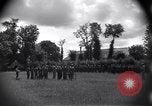
Decoration ceremony for U.S. Army Air Forces 9th Air Force fighter pilots in France during World War II.
Decoration ceremony conducted by Lieutenant General Brereton, Commander of U.S. Army Air Forces 9th Air Force, at advance airfield, Criqueville (A-2) France, during World War 2. Nine pilots of the 354th Fighter Group are lined up at attention in a field. A photographer clicks pictures. Two officers stand beside a table on which medals are kept. Captain Beerbower marches towards Lt Gen Brereton. The Lt Gen decorates him. Lt Gen Brereton decorates a major, a captain and a lieutenant, shaking hands with them. The company stands at attention. The honored men stand back in a line. General Brereton is seen, later, conversing with Captain Beerbower (wearing Silver Star). Among those decorated in this ceremony were: Capt. Don M. Beerbower (Silver Star); Capt. Wallace N. Emmer, Distinguished Flying Cross (DFC) and Lieutenant Carl Bickel (DFC).
Captain Don M. Beerbower, 353rd Fighter Squadron, and his P-51,
U.S. Army Air Forces 354th Fighter Group in Normandy. Ground crew run to pull camouflage from P-51 at advance air strip Criqueville (A-2) in Normandy during World War 2. The P-51 prop turns,engine starts, and it taxis forward. The name "Bonnie B II" is painted on the fuselage, and 17 swastikas are painted below the cockpit. A Mustang is painted on the tail. It's serial number is 43-12375. The aircraft stops. The name, Captain Don M. Beerbower,is painted below the cockpit. He stands up and climbs out of the airplane, wearing his oxygen mask and helmet. Scene shifts to a loudspeaker in a control facility.A soldier is seen talking on the radio in a plexiglassed enclosure. A flight of P-51s approaches the field. They break off and proceed to buzz the field. (Note concerning Captain Beerbower,of Hill City, Minnesota, seen in this clip. He served as acting Commander of the 353rd Fighter Squadron and was later promoted to Major. He was Commander of the 353rd Fighter Squadron when killed in action, by ground fire while flying his P-51, Bonnie B II, leading an attack on a German airfield near Reims, France, on August 9, 1944. His decorations included: the DSC, Silver Star,DFC (3), Air Medal (26), British DFC, Purple Heart, Distinguished Unit Citation and Campaign Medals.)
Allied Forces in Battle of Casablanca and North Africa in World War II
Operation Torch in World War 2. Allied invasion convoy off Casablanca, Morocco. American troops on ship's deck, cleaning and checking their rifles. Closeup of a wire from the Invasion Task Force Commanders, listing signals that will tell of the French forces' decisions. Closeup of U.S. troops boarding Higgins Boat from a transport ship. Rear Admiral H. Kent Hewitt on the USS Augusta (CA-31). U.S. President Roosevelt, Free French Commander, Charles de Gaulle, and French General Giraud, all issue calls for French forces not to resist Allied invasion. View of triple turret 8-inch guns on the USS Augusta. Sailors in their bunks. Suddenly guns from the shore begin firing on the invasion convoy. Shells explode in water near convoy ships, as sailors man battle stations and begin returning fire on Casablanca. French defenders signaled friendly attitude by directing searchlights vertically. British spitfire aircraft launch toward Algiers, from Gibraltar. British troops in an amphibious landing at Algiers on November 8, 1942. View of French Admiral Jean Darlan. Allied troops enter Algiers. American airborne troops parachute from C-47 transport aircraft over Oran, Algeria. Next section covers Battle of Casablanca: Allied warships fire at Vichy French ships and aircraft and more troops head to shore in landing craft. Sailors firing anti-aircraft guns from landing craft, at enemy aircraft overhead. A U.S. carrier-based SBD Douglas Dauntless aircraft as it descends in the sky. French sailors load 380mm guns on battleship Jean Bart and fire her guns. Glimpse of French Shore defense guns firing with shells exploding in waters offshore. Gunners aboard U.S. warship loading a heavy gun. Angered over British attack on the French Fleet in 1940, Admiral Daran refused to negotiate with the British. Inserted footage of French battleship Dunkerque exploding during British attack on French fleet at Mers-el-Kébir, July3, 1940. A tank driving ashore from a landing craft. Closeup of a French soldier (from the rear) firing his rifle at invading Allied troops. Allied medical corpsmen on the sandy shore, running with a litter. A jeep pulling a towed artillery field piece ashore from the surf. Medical corpsmen carrying a wounded on a stretcher. Allied troops fighting defenders in Casablanca. Animated map shows German invasion of Vichy France. View of Philippe Pétain, Head of Vichy France. View of Admiral Darlan saying goodbye to U.S. Lieutenant General Mark Clark after secret meeting of the two. Officers of German Armistice committees departing a North African city. Cheering crowds are happy to see them depart in a truck. French crowds cheering American troops. British Lieutenant-General Kenneth Anderson arriving at Algiers. French General Henri Giraud salutes. General Dwight D. Eisenhower salutes. Parading color guard with flags of France, Britain, and the U.S. Animated map shows German forces pouring into Tunisia. View of German troops on deck of a ship and at ship's anti-aircraft positions. General Eisenhower conferring with British and French allies. Camels used on rough terrain. American writes "Tunis Toonerville." in chalk. Allied troops sitting on floor of freight rail car with door open as old steam engine moves the train. Animated map shows German and Allied supply lines. A U.S. Douglas A-20 Havoc bomber landing on an airstrip. Numerous German warplanes parked in Tunisia. U.S. M2 tanks and other military vehicles moving along narrow mountainous roads. Locomotive transporting mules in stock cars. C-47 transport airplanes drop British and American airborne troops. Commandos disembark from ships at Bone, Algeria. Allied aircraft parked on a captured enemy airfield, under attack by German Dornier Do 17 and Heinkel He 111 bombers. A Parked American B-25. Allied soldiers firing small arms and anti-aircraft guns at German planes.
CRITICALPAST.COM: About Us | Contact Us | FAQs - How to Order | License Agreement | My Account | My Lightboxes | Shopping Cart | Advanced Search | Featured Collections | Website Terms & Conditions | Privacy Policy ©2026 CriticalPast LLC.
License Agreement |
Terms & Conditions |
Privacy Policy
©2026 CriticalPast LLC.