


 Francais
 Deutsch
 Italiano
Refine Your Search
V2 stock footage and images
- Showing 4987 to 4992 of 9941 results more
more Hide
Hide
Air operations aboard USS Constellation (CVA-64) in Tonkin Gulf.
Bombs come over on hi-line from USS Camden (AOE-2) during replenishment at sea in Tonkin Gulf. Life net with bombs framed in the background. Water between USS Camden and Constellation shows twin fuel hose. Supplies transferred. Bombs hi-lined across water to USS Constellation. Flight deck safety net. Rack of bombs over hi-line, passing by twin fuel line connected between two ships. Rack of bombs taken off deck of USS Camden, coming over on hi- line. Forklift busy on deck, moves supplies into position. Bombs arriving to ship. Men at work on weather deck of USS Camden. Another rack of bombs is picked up on hi-line. Bombs coming over, leaving ship's side and moving towards CVA (Attack Aircraft Carrier). Looking aft on port side of Camden, crewmen stand in dungarees aboard CVA looking on during replenishment. Two fueling stations operate. UH- 46D picks up supplies from stern of USS Camden during vertical replenishment. Side no "OE-2" on port bow of USS Camden. Party works on port weather deck of USS Camden. Rack of bombs picked up from deck. Second rack picked up on second hi-line and sent out over side. Port side of USS Camden during the underway replenishment. Flight deck edge safety net. Bombs coming over at various stations while refueling goes on. Working party at work on deck area of USS Camden. Another rack of bombs leave side of ship. Forklift moves another rack of bombs in position.
Yankees win World Series for fifth straight Major League Baseball championship, 1953
Newsreel clip highlighting the New York Yankees' victory in the 1953 Baseball World Series over Brooklyn Dodgers (their fifth consecutive championship). Highlights from game two: Mickey Mantle of the Yankees hits a two-run homer off Preacher Roe to drive the Yankees to victory and put them up two games to none in the Series. Older woman bounces and cheers in stands. Game three: at Ebbets Field, Dodgers catcher Roy Campanella drives a home run to left field off Vic Raschi, Dodgers win. Fan in sunglasses cheers. Game four: Duke Snider (seen in closeups) hits double, home run and double to lead the Dodgers to victory and even up the Series at 2-2. Black, white Brooklyn fans cheer. Game five: Mickey Mantle (seen in closeup) hits a grand slam to squelch Dodger hopes. Game six: the Dodgers' Carl Furillo hits a two-run homer in the ninth inning to tie the game, but the Yankees' Billy Martin singles up the middle in the bottom of the ninth to score Hank Bauer and win it for the Yankes. Fans cheer as Yankees celebrate on the field. (Note: The first World Series was held in 1903. So this was the 50th anniversary of that sporting event.)
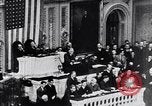
President Franklin D. Roosevelt addresses the Congress during "Four Freedoms" speech of 1942; also war production scenes
President Franklin D. Roosevelt addresses the U.S. Congress in his "Four Freedoms" speech during the State of the Union address on January 6, 1941, in Washington DC, United States. During his address, various war production worker and war materiel manufacturing images are also shown (before the entry of America into World War 2, but during lend-lease production): Tanks, airplanes and flying boat aircraft are shown. Workers at war production factories making artillery shells and munitions. Scenes at a manufacturing plant building bomber aircraft warplanes during World War 2. They appear to be B-25 Mitchell bombers. Workers work installing plexiglass nose cone gunner shield. They assemble various parts of airplanes. Scenes of biplane aircraft in formation and diving. Large, flat landing barge filled with American soldiers approaches a landing area.
U.S. Navy warships engaged in exercises and maneuvers to maintain readiness in 1940.
Film opens showing two U.S. Navy Colorado-class battleships leading two others in a line of U.S. Navy battleships underway in a harbor area. Glimpse of officers on bridge of a battleship. Prow of ship creating wake. Variety of U.S. warships engaged in tactical exercise maneuvers. Several views of Mahon-class destroyers leading the fleet seaward in battle order. At TC: 1:54, USS California (BB-44) is seen from port side while underway. Next, Curtiss SOC Seagull observation planes are launched from warships and fly over the fleet in flights of three each. New Mexico class battleship underway at TC: 02:20. The USS Tennessee (BB-43) is seen at TC: 2:25. Closeups of observation aircraft in flight with pilots visible. The USS Aylwin (DD-355) seen around 2:45, then the USS Farragut (DD-348), the USS Case (DD-370), and the USS Monaghan (DD-354). Sailors astern on a destroyer launch depth charges. Wickes-class 4-stack destroyers on the horizon dropping depth charges. Closeup of ashcan depth charges rolling off stern of destroyer. New Mexico class battleships maneuvering. (World War II period).
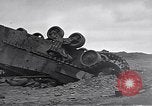
Wrecked landing vehicles and U.S. marine casualties on Iwo Jima during World War II
Destroyed American armor and U.S. marine casualties, on Iwo Jima in World War 2. Views of several Wrecked landing vehicles tracked (LVT) overturned on sands of Iwo Jima, during World War 2. Body of a marine under wreck of LVT(A)-1. Smoke rising in distance. LVTs racing across a flat area of Iwo Jima. U.S. marines carrying a wounded one on a stretcher. They place him down on the ground and check his wounds. Closeup of the wounded marine, speaking to them.
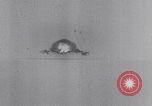
Surrender of Japan, ending World War II; imprisoned Japanese officials; German concentration camp scenes
View of first atomic explosion (Trinity) on July 16, 1945, at New Mexico, United States. View of the battleship, USS Missouri, in Tokyo Bay, Japan, with entire ship's company on deck in dress whites, Japanese military high command and several formally dressed Japanese diplomats standing on the ship's deck. Brief closeup of General Douglas MacArthur. Japanese foreign minister, Mamoru Shigemitsu, bending to sign the instrument of surrender ending World War 2, on September 2, 1945. Supreme Commander, General Douglas MacArthur, seated, signing the document. Lieutenant General Jonathan M. Wainwright and British Lieutenant-General Arthur Ernest Percival stand behind MacArthur. General Hsu Yung-chang signs for China. View of sailors observing the historic moment from every possible place aboard the ship. Large numbers of aircraft flying over the ship. Scene shifts in flashback to Manila, Philippines, where dead bodies of civilians litter the streets in silent witness of Japanese wartime atrocities. Some have hands tied behind their backs. Views of destitute Filipino mothers and children wandering through the rubble. A sign identifies the 98th Evacuation Hospital. Inside, a doctor and a nurse stand over the bed of Japanese Prime Minister, Hideki Tōjō, who attempted suicide by pistol, when apprehended, but was taken for treatment and is seen resting in his bed. View of Japanese Adrmiral Shigetarō Shimada, Minister of the Navy, behind bars in prison. Also seen in prison are Japanese general of the Japanese Imperial Army and Governor-General of the Philippines, Shigenori Kuroda;. General Masaharu Homma; and militarist Colonel Kingoro Hashimoto. Scene shifts to bodies of numerous victims of German death camps. American Army medics attend to some survivors rescued from the camps.
CRITICALPAST.COM: About Us | Contact Us | FAQs - How to Order | License Agreement | My Account | My Lightboxes | Shopping Cart | Advanced Search | Featured Collections | Website Terms & Conditions | Privacy Policy ©2026 CriticalPast LLC.
License Agreement |
Terms & Conditions |
Privacy Policy
©2026 CriticalPast LLC.