


 Francais
 Deutsch
 Italiano
Refine Your Search
V2 stock footage and images
- Showing 4993 to 4998 of 9941 results more
more Hide
Hide
Soldiers, equipment, airplanes, training centers, commanders and others forming the organization of the United States Army.
Organization of the United States Army in World War 2. Massive group of soldiers doing exercise calisthenics on a parade field. Large groups of soldiers march and salute the U.S. National Flag. A tank production factory with war production workers. Soldiers boarding a troop transport ship. View of the USAT Edmund B. Alexander troop ship (formerly USS America, ID-3006) at a harbor filled with U.S. Army troops in transport. Graduation ceremony underway at a military service academy (possibly Westpoint) and awards given. Selection of soldiers for the U.S. Army. Infantrymen and artillerymen fighting in a battle. Generals and Chiefs of Army staff at a discussion and facing the globe in U.S. Capitol. Animated flowchart showing various levels of service and departments in the U.S. Army. Secretary of War is the Supreme Commander, followed by Chief of Staff and a Deputy Chief; general staff succeeds the hierarchy. Operations division has three major constituents: - Strategy and Policy group, Theater Group and the Logistic group. Nine theaters of operations are shown on globe. Military officials at work. Soldiers working in clerical duties and message centers. Personnel typing and filing papers. A soldier emptying a bin of shredded papers. Soldiers in intelligence operations listening to message transmissions and wearing headphones. Letters of soldiers transported in a bomber aircraft seen taking off. Commanders discuss, training to ground, air and navy soldiers. Westpoint cadets in a training exercise with transit sighting devices in a field. Officers including a U.S. Army 4 star general (possibly General Malin Craig) review a map. Trucks ready to supply equipment at war front. Construction site of the Pentagon, with dirt, trucks, and buses in the foreground. Pentagon in the background and Washington Monument in the distant background. Four groups of general staff, G-1, G-2, G-3 and G-4 are there to look after various departments such as induction, promotion, information, policy, mobilization, size, conflicts, transport and supply.
Improvement of miners, condition of mines and factories and civilians of war affected countries of Europe, by Marshall Plan.
Film titled 'Me and Mr. Marshall' depicts developments of coal mines in Germany and aid to other European nations affected by World War II. German coal miners dig deep in a coal mine soon after the end of World War 2. Volunteers awarded at a ceremony. Volunteers board a train and proceed for work at coal mines. Volunteers eat food, give their shoe size, under go training on mine machinery. Miners on lift move underground. Miners at end of the day walk out tired and blackened by coal dust, from a mine. Miners take hot showers after work and get clean clothing hung high on ropes. Salary given to workers for a day's work. Headlines of German newspapers about Marshall Plan. General George C. Marshall speaks his plans at a meeting in Washington DC, America. Aerial views of ruined buildings and factories, wrecked harbor, refugees in tenements in Europe after World War II. Buildings, monuments and bridges in London and Eiffel Tower and other buildings and civilians on roads in Paris, and view of Kremlin in Moscow, Soviet Union. Map shows countries under Marshall recovery plan. View of meeting in progress of Conference for European Economic Cooperation in July 1947, in the Grand Dining Room of the French Foreign Office. Meetings of leaders of nations adopting Marshall plan. Ruins of industries of Germany. Ruins on the ground after war in London, with Big Ben in the far distance. Workers at a factory. Miners take a horse inside a coal mine. Empty coal cars at a German coal mine. Men push coal cars full with mined coal out from mine, on rails. Views of buyers in suits at a German trade show and conference, promoting German products and industries to potential buyers in other countries, a few years after the end of World War 2. U.S. Congress and President Harry Truman in Washington DC approve the Marshall Plan and provide monetary aid to other European countries. Scenes in Germany as it recovers economically after the war: Workers in a factory. Harbor, fruit and vegetable market; customers in a bakery; coal cars and machinery at a coal mine under normal operation under the plan.
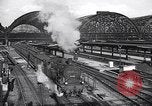
Repair of wrecked railroads, power plants, factories and coal mines at Ruhr Valley in Germany after World War II.
Wrecked railroads, Coal mines, power plants and factories being rebuilt and rehabilitated in Germany after World War 2. Railroad trains moving on tracks in Germany soon after World War 2. German civilian workers repair rails and tracks destroyed by Allied bombers. German workers in a tire factory build railway and automobile tires, in Munich. Trucks manufactured at a truck factory drive out of the factory. People lined to see some of the items produced for export. British occupied Ruhr Valley. Wrecked Krupp factories in Ruhr Valley. A German steel smelting plant in operation, workers pour molten steel. Coal cars leave Ruhr Valley. Animated charts show production and export of coal during 1937 and 1946. German miners enter and leave mines. Miners eat and take half of their food out to German children.
Test flight of "airphibian": A combination airplane and automobile invented by Robert Fullton in Danbury Connecticut
A test flight of the Fulton FA-2 Airphibian roadable aircraft in Danbury Connecticut. The two-seater small aluminum coupe lands and its inventor, Robert Fulton, a descendant of steamboat inventor Robert Fulton, is seen. Fulton unscrews and removes the propeller. Then the fly hook wings, and fuselage are removed to convert the plane into a car. Fulton drives the Fulton FA-2 Airphibian on a road, passing another car.
The Cuban Missile Crisis. The Limited Nuclear Test Ban Treaty.
October, 1962, U.S. Air Force U-2 reconnaissance aircraft, tail number 56-6707, of the Strategic Air Command (SAC) 4080th Strategic Reconnaissance Wing, lands at Laughlin Air Force Base, Texas. View of Photographic evidence, brought back by the U-2, showing Soviet missiles being set up in Cuba. President John F. kennedy broadcasts to the nation about the crisis on October 22, 1962, announcing measures being taken by the USA to address the situation. A B-58 Hustler bomber landing. Airmen removing camera from nose of a reconnaissance aircraft. Air Force Sergeant, photo interpreter, reading wet film in a base laboratory. U.S. Naval officers and sailors in Command Center viewing large wall map of the world. U.S. Air Force SAC B-52 bombers taking off. View of United Nations Headquarters building in New York City. On October 25, 1962, U.S. Ambassador to the UN, Adlai Stevenson, confronts Soviet Ambassador Valerian Alexandrovich Zorin about missiles in Cuba.He looks at Zorin, and says,"Don't wait for the translation, yes, or no." Zorin smiles as the room fills with laughter. He then responds. View of a Soviet ship bound for Cuba being monitored by a U.S. aircraft overhead. Pilot in cockpit of the aircraft. View from U.S. aircraft flying low past a Soviet ship. Crew in cockpit of the aircraft. Soviet ships turning away. Helicopter flying over sandy beach area of Hyannis Port, Massachusetts. The helicopter parked and Undersecretary of State, Averell Harriman, steps from the helicopter and is later seen with President Kennedy, and Secretary of State, Dean Rusk, at the President's Weekend White House. Harriman reports on the successful negotiation of a limited nuclear test ban treaty. Glimpse of Moscow. U.S. Secretary of State, Dean Rusk, Soviet Foreign Minister,Andrei Gromyko, and British Foreign secretary, Alexander Douglas-Home, are seen signing the document for their respective nations, August 5, 1963.
United States base built at Iwo Jima island, Japan; US aircraft bombing Tokyo, Japan.
"Iwo Base Against Japan" showsU.S. Army trucks, vehicles and other supplies being unloaded from an American ship in Iwo Jima island during World War 2. Construction work being carried on to build an advanced base on the island. Vehicles getting stuck in volcanic ash beach areas and being pulled out by bulldozers. Construction of Motoyama airfield number 2. U.S. P-51 Mustangs taking off for escort of American B-29 bomber aircraft in bombing raid over Tokyo, Japan. United States P-51 aircraft shoots down enemy Japanese planes and escorts B-29 to raid Tokyo Japan. 200 pound general purpose bombs are dropped over Tokyo causing fire and smoke. Damaged B-29 Superfortress aircraft return to American air base at Iwo Jima. Flack damage and engine damage shown on several B-29 aircraft after landing at Iwo Jima. Aircraft are repaired.
CRITICALPAST.COM: About Us | Contact Us | FAQs - How to Order | License Agreement | My Account | My Lightboxes | Shopping Cart | Advanced Search | Featured Collections | Website Terms & Conditions | Privacy Policy ©2026 CriticalPast LLC.
License Agreement |
Terms & Conditions |
Privacy Policy
©2026 CriticalPast LLC.