


 Francais
 Deutsch
 Italiano
Refine Your Search
V2 stock footage and images
- Showing 5065 to 5070 of 9941 results more
more Hide
Hide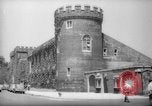
Dr. Enrico Fermi and assistants reenact experiments at site of the Chicago Pile-1 (CP-1) nuclear reactor, University of Chicago
Men walking towards the West Stands of Stagg Field, where the Institute for the Study of Metals, occupies the southern half of the abandoned stands. To the North, where the center of the building protrudes toward Ellis Avenue, is the squash court area in which the famous Chicago Pile number 1 was built, and achieved controlled, sustained nuclear fission, on December 2, 1942. Scene shifts to different area where a sign reads: "5655, Institute for the Study of Metals, Delivery Entrance." Scene shifts again, to Dr. Enrico Fermi and two assistants in front of a facsimile of the Chicago Pile 1. One assistant holds a simulated "control rod" that he "withdraws" from from the pile, while Dr. Fermi glances at a geiger counter and makes notes in a book. This is repeated for several takes, including one taken much closer. Dr.Fermi and his assistant smile as they take these actions. The second assistant, sits at a desk, where a slide rule is visible, and makes notes in a book. A large geiger counter is seen with lights flashing. Above the lights the counter is labeled "Interpolation," and the numbers: 1,2,4,16, and 32 appear above the lights, respectively. Dr. Fermi is then seen in another part of the lab, where he is making adjustments on some unseen device and annotating a book. Piping of various sizes is seen in background. He repeats these actions a number of times for the camera.
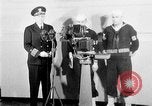
The Norden bomb sight is revealed to the U.S. public for the first time during World War II
The making of a public information film about the Norden bomb sight, during World War 2. Opening scene shows a Norden bomb sight on a pedestal, at the Museum of Science and Industry, in Radio City, Manhattan, New York City. It is flanked by U.S. Navy Captain, Irving Entwhistle and Shore Patrolman, Boatswain's Mate 2nd Class. Orville T. Payne. Another shore patrolman stands behind the bomb sight. The trio waits to begin. Then Captain Entwhistle begins to speak about the significance of the bomb sight to the war effort. The filming is interrupted and takes up again, focusing solely on Captain Entwhistle, as he continues to talk about the bomb sight, but is quickly interrupted, again, by the film director (heard, but not seen). The captain begins, repeating his scripted talk again. Scene shifts to Captain Entwhistle, now standing with hands on the bomb sight. He describes its operation as he maneuvers the sight. He notes the bomb sight's ability to take over control of the bomber's course to the precise drop point. Entwhistle, then looks up and comments: "Is that enough?" He then continues with his talk, but is interrupted, again. Next, Entwhistle picks up again, repeating part of his talk, while the camera pans over the bomb sight. Captain Entwhistle, states that, the instrument "is an automatic pilot, as well as a sight." He rotates the sight various ways for the camera, and asks: "'Want some more?" Scene changes, now showing Harold Barth, President of the Norden company, standing with Captain Entwhistle, who rotates the sight around on its pedestal, while chatting with him. (Microphones do not pick up the conversation.) Mr. Barth leans forward and peers through the sight. Next, in a closeup, the Captain manipulates the sight, while talking to Barth (sound not recorded). Mr. Barth and Captain Entwhistle, take turns looking through the sight. Closeup of the Captain looking through the sight, and manipulating its controls.
A barber shop at Tanforan assembly center for Japanese internees. Boy gets haircut
Japanese-American internment center scenes, during World War 2. They are brought to an assembly center at the Tanforan race track in San Bruno California. A man cut a boy's hair in a barber shop at the Tanforan center (relocation or internment center for Japanese-American citizens during World War 2). The boy sits on a chair with a cloth wrapped over his shoulders. The barber cuts the hair with a machine.
The robot weather station nick named 'Grass Hopper' works automatically during an experiment in Washington D.C.
The robot weather station nick named 'Grass Hopper' tested in Washington D.C. Scientists work on a field. Robot lying on the field as it stands up on its own. It's fan rotates. Plate on model reads 'An/GMT-CXG-IJ, Model 2, Serial No. 2', and gives other information. Code sent by it being recorded on a tape recorder.
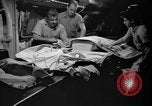
Men and aviation mechanics work on aircraft on USS Valley Forge (CVS-45) in the Caribbean.
USS Valley Forge (CVS-45) in the Caribbean. Men pack parachute riggers in the parachute loft. Aviation mechanics work on the engine of a Grumman S2F tracker aircraft's propeller. Men work on the wing fold of an S2F.
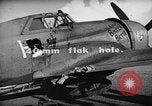
Losses of U.S. P-47 Thunderbolt fighter planes during Marianas campaign of World War II, Saipan.
U.S. P-47 Thunderbolt fighters during Mariana campaign of World War 2. Depicts some crashes and battle damage to aircraft on Aslito Airfield (Isley Field) Saipan in Mariana Islands. Opening scene shows P-47D number 43-25324 "Bouncin Bette" of the 19th Fighter Squadron, 318th Fighter Group, with severe battle damage from a Japanese 40mm Flak round. This plane was damaged on a raid over Pagan Islands. Mechanics checking over the plane and removing a damaged wing section from it. View across island showing huge crater at a crash site. Huge crowd of U.S. military personnel kept well back from the scene, in the background. Stretcher bearers running out and placing the dead pilot onto the stretcher. Scattered plane and a piece of engineering equipment which the plane crashed into showing the remains of both plane and the engineering equipment. Firemen fighting the fire on burning U.S. Navy FM-2 WIldcat aircraft. that crashed. Several men throwing dirt with shovels onto the burning remains of the plane. Men attending memorial services for lost pilots. Two P-47s buzzing the airfield. P-61 aircraft engines turning over as P-47s making landing. P-61 taking off at dusk. Aerial formation of P-47s buzzing the field at dusk. Aerial formation of four P-47s.
CRITICALPAST.COM: About Us | Contact Us | FAQs - How to Order | License Agreement | My Account | My Lightboxes | Shopping Cart | Advanced Search | Featured Collections | Website Terms & Conditions | Privacy Policy ©2026 CriticalPast LLC.
License Agreement |
Terms & Conditions |
Privacy Policy
©2026 CriticalPast LLC.