


 Francais
 Deutsch
 Italiano
Refine Your Search
V2 stock footage and images
- Showing 5275 to 5280 of 9941 results more
more Hide
Hide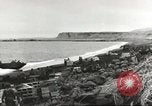
U.S. troops and supplies land at Attu Island in Aleutian Island, Alaska, during World War II
U.S. army troops and supplies being landed by Higgins boats at Massacre Bay, in preparation for battle to dislodge Japanese forces that invaded Attu Island in the Aleutians during World War 2. American forces landing at this Southern landing site included elements of the 17th and 32nd Infantry Regiments.. Troops and supplies are seen being brought to the shore by Higgins boats. Boxes of supplies are piled up and several Higgins boats are beached, including one from the Attack Transport Ship, USS Barnett (APA-5) and one from the USS Zeilin (APA-3). Weather is bleak and snow covers mountains in background. Most of the supplies are in wooden crates. Some building materials are also seen. There is no sign of Japanese resistance. The Higgins boats, aka Landing Craft, Vehicle, Personnel (LCVP) are shuttling back and forth from the attack transports seen anchored offshore. As the sequence progresses, more and more troops and supplies are seen on the beachhead. Troops form a chain to unload cargo from the landing craft. U.S. army troops and supplies being landed by Higgins boats at Massacre Bay, in preparation for battle to dislodge Japanese forces that invaded Attu Island in the Aleutians during World War 2. American forces landing at this Southern landing site included elements of the 17th and 32nd Infantry Regiments.. Troops and supplies are seen being brought to the shore by Higgins boats. Boxes of supplies are piled up and several Higgins boats are beached, including one from the Attack Transport Ship, USS Barnett (APA-5) and one from the USS Zeilin (APA-3). Weather is bleak and snow covers mountains in background. Most of the supplies are in wooden crates. Some building materials are also seen. There is no sign of Japanese resistance. The Higgins boats, aka Landing Craft, Vehicle, Personnel (LCVP) are shuttling back and forth from the attack transports seen anchored offshore. As the sequence progresses, more and more troops and supplies are seen on the beachhead. Troops form a chain to unload cargo from the landing craft.
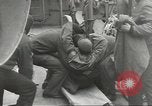
Wounded American soldiers are evacuated from Attu Island in the Aleutians, during World War II
Sailors aboard the troop transport ship, USS Harris (APA-2), receive wounded American soldiers evacuated during the battle of Attu Island in the Aleutians, during World War 2. Wounded, strapped on a platform, are raised from a Higgins boat, by rope sling, and gently placed on the ship's deck. A sailor carries one wounded soldier on his back. Another helps him onto a litter. Scene shifts to Attu Island, where an American soldier mans a 40 mm Bofors anti aircraft gun at a high point overlooking a harbor. A quonset hut and radio station, with tall antenna, are in background. What appears to be a steel pier extends into the bay below. Snow covers mountains in far background. The soldier loads shells into the gun and fires it.
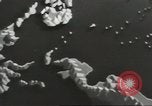
Allied amphibious assault against Japanese held Island in the Pacific, during World War II
Film opens with animated map of the Pacific theater of operations in World War 2. It illustrates Allied advances through network of islands supporting supply lines of Japan. View from an Allied ship in an invasion task force headed to a Japanese occupied island (probably in the Mariana Islands) during World War 2. U.S. troops descend rope net from their transport ship to board landing craft. Numerous landing craft making way in loose formation. Warships in the task force bombard the target island. Huge black explosion occurs. B-25 Mitchell bombers displaying "Z" on tails, are seen briefly in flight. Landing craft maneuvering and approaching the shore where numerous shells are bursting from the naval bombardment. Landing craft number 25, from the USS Bolivar (APA-34) is seen in the water. Troops rush across the sand after leaving their landing craft. Closeups of U.S. troops using small arms and flame throwers to drive Japanese defenders from their caves, blockhouses and other fortifications. Dead Japanese soldiers beside their defensive positions. At the beachhead, several large Landing Craft Infantry LCI(L) 334, 330,335, and 336 are unloading troops into the surf. Closeup front view of troops wading ashore from LCI(L)335. Troops carrying boxes of supplies ashore. At the beachhead, troops are unloading a large truck, while in the background, a Landing Vehicle Tracked is driving away from Landing Ship Tank (LST-47). Her deck is crowded with troops. A tractor drives off a nearby landing craft. Wide view of beachhead jammed with troops and equipment.
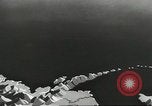
U.S. forces launch attacks against Japanese targets from the Aleutian Islands during World War II
Film opens showing animated map of Pacific and avenue of attack against Japan via the Aleutian Islands in World War 2. . Scene shifts to the Aleutian Islands, where American P-47 aircraft are seen parked on an open ramp in severe winter weather. Next, American Army truck convoys are seen traversing subarctic Canada on the Alcan highway, with supplies to sustain U.S. forces in the Aleutians. U.S. soldiers and airmen are seen obtaining various items and playing volleyball on a ramp at an airbase. Fog shrouds the Aleutians keeping aircraft grounded. Soldiers look at maps and plan targets. Aircrews are briefed about their mission and targets. U.S. Army Air Forces B-24 Liberator bombers fly in formation over snow-covered peaks. View looking down on a B-24 headed toward Japan. Airmen in a headquarters plotting the disposition of aircraft reporting to them by radio. View above thick clouds with nothing in sight. (But exploding bombs are heard.) (World War II; WW II; World War 2; World War Two)
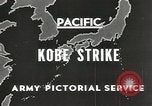
United States B-29 bombers drop incendiary bombs over Kobe, Japan
"Kobe strike" shows United States B-29 bomber aicraft dropping 3200 tons of incendiary bombs over industrial targets in Kobe, Japan during World War 2. Firebombing causes pillars of smoke to rise up. Narrator speaks of strikes on other Japanese cities also and relates statement by General Arnold that beginning July 1945, industrial Japan will be hit by bombs at the rate of 2 million tons per year, or 5480 tons per day, adding that "by the end of 1946, Japan will have ceased to exist as a bombing target."
British prosecutor Shawcross presents crimes by Nazi leaders during Nuremberg Trials; scenes from Molotov-Ribbentrop Pact signing
Trial of Nazi leaders for war crimes in Nuremberg, Germany soon after the end of World War 2. British Chief Prosecutor Hartly W Shawcross presents count no 2, crimes against peace involving wars of aggression in violation of international treaties and agreements. A document reveals Adolf Hitler's plans to occupy Poland. Footage showing Soviet Leader Joseph Stalin and Germany's Joachim Von Ribbentrop as they sign non-aggression pact between Russia and Germany on August 23, 1939 (also called the Molotov-Ribbentrop Pact). Germany prepares to occupy Poland as Pope Pius XII and President Franklin D Roosevelt appeal for peace just before start of World War II.
CRITICALPAST.COM: About Us | Contact Us | FAQs - How to Order | License Agreement | My Account | My Lightboxes | Shopping Cart | Advanced Search | Featured Collections | Website Terms & Conditions | Privacy Policy ©2026 CriticalPast LLC.
License Agreement |
Terms & Conditions |
Privacy Policy
©2026 CriticalPast LLC.