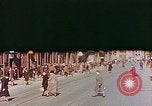
The Hippie culture in San Francisco's Haight-Ashbury district, California. A red and yellow sign for the 'Haight-Ashbury Store' in the store window. Young men wearing leather jackets and tweed coats chatting on the sidewalk. Cars move past on the street. Pedestrians outside 'The Unique Men's Shop'. Cars and a Volkswagen Type 2 bus (also known as the “Hippie bus”) pass by. Motorbikes parked by the sidewalk. Young hippie boys, one of them stands shirtless. A hippie man holds underground newspapers for sale. Several African American men in the crowd. A couple stands on the sidewalk and watches the traffic pass by. The woman smokes a cigarette as she talks with her boyfriend on the sidewalk. Pedestrians walk past the closed 'Bargain Market'. A hippie man and a tall woman in elaborate cloaks with booklets in hand. Three hippies sitting on the sidewalk.
'The Signal Corps Fights' depicts the role and contribution of the U.S. Army Signal Corps in combat and war. Montage of military equipment and combat scenes (some staged). Opens with glimpses of: massed formation of U.S. Army soldiers; similar formation of bombs in a munitions factory; row of P-47 fighter planes parked on an airfield; a huge radar antenna; battery of U.S. 120 mm M1 anti-aircraft guns; troops marching toward the camera; Martin B-26 Marauder aircraft dropping bombs, that explode on the ground; formation of German He 111 bombers in flight; U.S. battery of 120mm anti-aircraft guns firing; gun camera views of U.S. fighter strafing German aircraft on the ground, and attacking a German Messerschmitt bf 109 head-on (The tail is blown off and the pilot bails out at the last instant); fire engulfing some soldiers. Next, a soldier is seen at a large signal corps field telephone switchboard, and other communications switchboards are shown with operators. Momentary glimpse of troops, ostensibly engaged in combat. A soldier communicating from under a camouflage netting, and one holding a rifle and talking in a phone as he strings wire from a spool in his backback. A german soldier ostensibly cutting a U.S. communications cable that he discovers in the field. A U.S. soldier crawling along the line to find and repair the damage, followed by a staged "attack" by the German soldier. They engage in a knife fight. Soviet infantry advancing on the Eastern Front. Soviet T-34 tanks advancing. Soviet soldiers engaged in combat. An unusual U.S. tank with two guns, and side protection over track wheels. M3 Stuart light tanks going down hill with infantry in france during World war 2. Hand of signal corps soldier using a key to send morse code message. Soldier in bunker using field telephone. Signal corps soldiers communicating with field switchboards during combat. Momentary glimpse of German Messerschmitt bf 109 and another aircraft speeding past. Bomb exploding. Huge clouds of black smoke billowing, behind camouflaged German military vehicles parked. Twisted frames of German wrecked vehicles and rail cars. Huge number of German soldiers marshaling to retreat from advancing Allies. German officers conferring.
The role and contribution of the U.S. Army Signal Corps in combat and war, especially during World War 2. Workers organize and prepare signal communication material and equipment for transportation. Men transfer the items including wooden cartons, cables, signaling units in trolleys. Workers load the material into trucks. Shuttle ships in docks. Signal communication supplies for U.S. and Allied troops in the European Theater loaded onto the ships. The shuttle ships make their way under security in heavy seas. A Nazi U-boat wolf pack in the water during the early stages of World War II. torpedoes launched and U.S. ships are attacked bu the German submarines, smoke due to the explosions. U.S. sailors on board and jumping from burning ships into water.German wolfpack submarine fleet in a harbor. German Kriegsmarine sailors lower German Neger torpedo-carrying craft (sometimes called Human Torpedo) into the water. A U.S. B-25 bomber aircraft in flight locates a German submarine. The radio operator gives the exact location and the submarine is attacked. View from within cockpit as bomb sight is fixed on German submarine target. View of bomb doors open and bombs away from B-25 aircraft. Explosion in water is seen and the submarine is hit. Dramatized scene from inside of submarine as it is rocked by explosion and fills with water.
Montage of military footage assembled to describe Joint Assault Signal Companies, in World War 2. Some inserts are inconsistent and anachronistic. Scenes of U.S. amphibious assault on a Japanese-held island in the Pacific theater. Camera focuses on small fast-moving assault boat carrying Army and Navy personnel of a Joint Assault Signal Company. A Japanese Aichi B7A Ryusei "Grace" aircraft flying low over the water in background. U.S. troops leaving an LST (Landing Ship Tank) and wading ashore. Some pushing a jeep through the surf. Members of a Joint Assault Signal Company running ashore with a spool of communications cable. Others carrying small arms climb out of an assault boat. Signal company soldiers laying communications cable as they move through jungle. Sailor aboard a U.S. warship ostensibly communicating with the signal company via light blinker. Naval gunfire bombarding enemy positions. Narrator's mention of air support is followed by anachronistic insert of U.S. Army B-10 bombers in formation flight; of bombardier in nose; and views of bombs falling. Next, a formation of B-25 Mitchell bombers is seen in flight and bombs falling. Back in the jungle, signal company men string wire on palm tree. Field artillery firing. Soldiers hunkered down in a shell hole. Signal company soldier using SCR-300-A Radio set.
The role and contribution of the U.S. Army Signal Corps in combat and war. Amphibious landings of the first wave of Allied troops including Signal Corps Units in Normandy, France on D Day during World War 2. The Joint Assault Signal Companies (a Signal Corps Unit that accompanies the soldiers on every beach landing) go ashore in Normandy. Soldiers in landing crafts approach the beach. Landing crafts anchored along the shore line. A U.S. flag on the beach. Crafts approach the beach. U.S. Army Signal Corps combat photographers using motion picture cameras to film the battle that ensues on the beach and in the fields. Gun fire and explosions in the battlefield, filmed by combat cameraman. Allied aircraft in flight. Airmen load weekly film reports of the war in all Theaters made by Signal Corps officers from a van into an aircraft. The films are sent to the Photographic Center in New York. A soldier assembles the films. Technicians organize and arrange the films. They place the film reels onto racks. The film content is used to make training and orientation films for the U.S. troops. Troops watch the films in order to cut down the training period, and stay informed about the order of event in other Theaters of Operation. The films include 'Why We Fight' and 'The Fighting Men' series. Clips and recordings from these films.
The role and contribution of the U.S. Army Signal Corps in combat and war. Army Pictorial Service films including screen magazines and GI movies are delivered to war fronts in all Theaters during World War 2. An officer arrives in a jeep with the films. Officers and soldiers around tents at the base. Soldiers in camouflage rain coats and hats seated at a foxhole theater. The soldiers watch the latest Joan McCraken Broadway hit Bloomer Girl. Scenes from the film. US: Pictures shown to workers depict the use of products manufactured by them at the war fronts. A poster reads 'B-52 Super Bombers, Bell Aircraft'. Men working inside the Bell Aircraft Corporation plant in NY. Huge machinery, equipment and aircraft parts being manufactured. Workers near stands piled with equipment and parts. A foreign version of the films made for Chinese allies. A U.S. officer talks to soldiers. The film dubbed in Chineese.
CRITICALPAST.COM: About Us | Contact Us | FAQs - How to Order | License Agreement | My Account | My Lightboxes | Shopping Cart | Advanced Search | Featured Collections | Website Terms & Conditions | Privacy Policy ©2026 CriticalPast LLC.
License Agreement |
Terms & Conditions |
Privacy Policy
©2026 CriticalPast LLC.