


 Francais
 Deutsch
 Italiano
Refine Your Search
V2 stock footage and images
- Showing 5389 to 5394 of 9941 results more
more Hide
Hide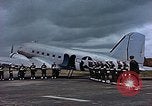
U.S. General Hoyt S. Vandenberg, Commander of the 9th Air Force greets officers of the Free French Air Force at end of World War II
A U.S. Army Air Corps honor guard stands around a C-47 transport plane, at an airport in Torgau, Germany at end of World War 2. Glimpse from behind of officers assembling on the ramp near the airplane. Closeup of the Ninth Air Force logo and the name, "Suzanne,"below the pilot's window on the aircraft. A staff car arrives and several U.S. Army Air Corps officers step from the car, including Lieutenant General Hoyt S. Vandenberg, Commander of the 9th Air Force and Major General Otto P Weyland, who would succeed him as 9th Air Force Commander. They join officers of the Free French Air Force at an area of the airfield ramp beside a destroyed hangar. They shake hands and talk with Free French Air Force officers, wearing black caps. The one in Leather jacket is General Martial Henri Valin Commander of Free French Air Force. Closeup of General Valin and General Vandenberg conversing. All stand at attention and salute colors or band plays National Anthems (unseen) General Vandenberg leaves walking toward the camera and boards his aircraft, as those behind shake hands and say good byes. A brass band plays and then the honor guard marches away from the aircraft. The right engine starts and then the left. An unidentified Air Corps Brigadier General waves goodby as the C-47 taxis out for takeoff.
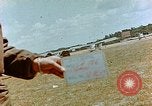
Aerial view of damaged and destroyed buildings,and houses in Braunschweig, Germany, resulting from bombing by Allied forces in World War II
Aerial views from an airplane flying over the ruins of Braunschweig Germany, right after the end of World War 2, in Europe. Whole city blocks of buildings have been reduced to empty spaces and skeletons of buildings remain elsewhere. At first glance, a large building surrounded by trees seems undamaged, but closer examination shows it roof completely destroyed. However another large building in those woods does appear undamaged. Roadways and some areas appear cleared of debris. Almost all buildings have been destroyed. Aircraft films from higher altitude, showing miles of territory surrounding the city. Closer view at lower altitude shows the scenic river, Oker, bounded by trees and nearby houses with all windows and most roofs gone. At TC: 02:07 the Brunswick Cathedral is seen near the few other relatively undamaged buildings.

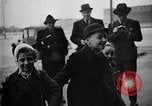
Newsreel: Victims of Nazi Rule Welcomed depicting arrival of WWII European refugees at a harbor in New York.
Newsreel titled 'Victims of Nazi Rule Welcomed'. The U.S. ship "Marine Flasher" carrying European Refugees arrives at a harbor in New York in the year after the end of World War 2. A huge crowd waits at the harbor. The refugees are welcomed with warmth by their relatives and friends in an emotional environment. Man given a warm hug by his relatives. A woman and her child. Sobbing woman welcomes her loved one. Mother and child, and two other women show prisoner number tattoos on their arms, administered by the German Nazis in a concentration camp.

Newsreel depicts a refugee camp of Czechoslovakian Jews after their land was taken over by pro-German Hungary
Early in World War 2, newsreel shows a Jewish refugee camp in Bratislava, Czechoslovakia (shortly before it became part of the First Slovak Republic, or Slovakia). An open ground with tents as the refugee camp for Czech Jews in exile, whose land was taken over by Hungary (during its time of pro Nazi Germany foreign policy.) Starving Jewish women and infant children. Men cutting trees with a saw. Boy getting all hair shaved off his head. A number of Jewish refugees including children line up for a small amount of food kept on a table, and warm themselves by the fire.
Czech Jewish people, primarily women and children, flee Prague, boarding a plane of the Dutch Airlines KLM
Evacuation of Czech Jews fleeing Nazi German persecution in Czechoslovakia early during World War 2. The Jewish refugees board a Koninklijke Luchtvaart Maatschappij or KLM (Dutch Airlines) airplane. Most passengers are women and small children. A woman, from the plane waves to her relatives standing at the airport terminal building. A large crowd gathered outside the terminal building and ticketing office. Boys and girls wave and smile as they enter the tarmac area and approach the parked aircraft. The Pilot of the plane looks from the cockpit. The same plane brought such a group to Croydon Airport (Airport House, Purley Way, Croydon CR0 0XZ, United Kingdom), London, United Kingdom, in January 1939.

French officers examine facilities used by Gestapo during Nazi occupation of France in World War II
Views of Nazi facilities that had been used by the Gestapo to torture and kill prisoners during the German occupation of Paris, France, in World War 2. A long low tunnel is seen (that had been a rifle range for the Ministry of Aviation). French soldiers and Partisans examine wooden stakes and hand prints of victims on the walls. Closeup of the uniformed French officers examining the wooden stakes where prisoners were executed by firing squads. Numerous bullet holes and damage is evident in the stakes. A blindfold and rosary are found on one stake. In another area, the officers examine wooden coffins ready for use. In the courtyard, a large excavation is shown where numerous bodies were dug up. Wooden boxes are seen that contained bodies.
CRITICALPAST.COM: About Us | Contact Us | FAQs - How to Order | License Agreement | My Account | My Lightboxes | Shopping Cart | Advanced Search | Featured Collections | Website Terms & Conditions | Privacy Policy ©2026 CriticalPast LLC.
License Agreement |
Terms & Conditions |
Privacy Policy
©2026 CriticalPast LLC.