


 Francais
 Deutsch
 Italiano
Refine Your Search
Vienna Austria 1923 stock footage and images
- Showing 319 to 324 of 702 results more
more Hide
Hide
U.S. Army soldiers guard German SS-Totenkopfverbände (SS-TV) prisoners of war being held near a village.
United States Army soldiers guarding a group of German SS prisoners of war who are being held near a village. Cameraman slate indicates location of "Wittring" (presumably Wittring France, just outside the German border, in the Moselle region), but U.S. government record accompanying the film indicates "Wittring, (?) Germany" (sic). A wheel cart is seen on the street. The German prisoners of war have SS markings on their right lapel and also the SS skull insignia on the cap, identifying them most likely as part of the SS-Totenkopfverbände or SS-TV; also called Death's Head units. (Theories on these captured soldiers include: 1) SS-TV units were primarily in charge of administering the Nazi Concentration Camps in World War II. Hinzert Concentration Camp was possibly the closest camp to Wittring. Perhaps these soldiers came from it or another camp; 2) They may have been part of the 3rd SS Panzer Division. Reportedly, whole platoons and elements of the 3rd SS Panzer division were not following orders and were giving up prior to the Budapest and Vienna battles to avoid Soviet captivity, as early as Jan 1945). Prisoners rub their hands to warm them in the cold. Camera shows a close-up view of one of the prisoners, as an American soldier attaches a Prisoner of War identification tag over around the neck of the prisoner.
President Masaryk's train arrives at President Wilson Railway Station in Prague, Czechoslovakia.
President Masaryk's train arrives at President Wilson Railway Station in Prague, Czechoslovakia. Bands play National Anthem at his arrival. Large crowd gathers at the station. Clement Simon French and representative of Great Britain, Colonel Montgomery Cunningham among the dignitaries present. Alice, Olga Masaryk and Poet Machar (whom Vienna called a traitor) ride in the royal carriage at a procession. Thousands of people cheer and celebrate. (World War I; World War 1; WWI; WW1)
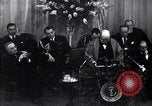
Churchill addresses people at the Westminster College in Fulton, Missouri and talks about the situation in Europe.
Prime Minister of United Kingdom Winston Churchill delivers a speech at the Westminster College in Fulton, Missouri (501 Westminster Ave, Fulton, MO 65251, United States). US President Harry S. Truman and other officials sit behind him on the stage. Churchill talks about the need to develop understanding with Russia and the situation in Europe. This is an excerpt from his speech entitled “The Sinews of Peace” (popularly known as the ‘Iron Curtain Speech’) and contains that reference. Churchill said “From Stettin in the Baltic to Trieste in the Adriatic, an iron curtain has descended across the Continent. Behind that line lie all the capitals of the ancient states of Central and Eastern Europe. Warsaw, Berlin, Prague, Vienna, Budapest, Belgrade, Bucharest and Sofia, all these famous cities and the populations around them lie in what I must call the Soviet sphere, and all are subject in one form or another, not only to Soviet influence but to a very high and, in many cases, increasing measure of control from Moscow.”
President Ronald Reagan attends the North Atlantic Treaty Organization conference in Bonn, Germany.
United States President Ronald Reagan visits with West German President Karl Carstens and travels to Bonn, Germany to attend the NATO (North Atlantic Treaty Organization) conference. At the conference, a ceremony is held to welcome Spain into NATO. President Ronald Reagan speaks before the gathering about lending support to Germany. Anti-war protesters are seen marching with banners in their hands. The United States President talks about Vienna negotiations. Photographers take pictures.

The Formal Christening of Princess Caroline Louise, of Monaco.
Opening scene shows Prince Rainier leading Princess Grace, of Monaco, who carries their baby daughter, Princess Caroline Louise, through a gathering of people as they enter the Saint Nicholas Cathedral (4 Rue Colonel Bellando de Castro, 98000 Monaco) for the baby's christening ceremony. A glimpse of the baptismal party including four bishops and 15 priests, as Bishop of Monaco, Gilles-Henri-Alexis Barthe, christens her, Caroline Louise Marguerite. Closeup of the baby Princess held in the arms of her Godmother, Margaret Ann Davis, from Philadelphia, Princess Grace's niece. Her Godfather, another cousin, Hungarian Prince Georges Festetics, from Vienna, is seen in military uniform. The royal christening party leaves the cathedral.

Hungarian troops enter Uzhorod, Czechoslovakia after Hungary takes over the town as a result of the Munich Pact.
Hungary gains control over Uzhorod, Czechoslovakia after the First Vienna Award. Czech civilians load their belongings onto carriages and leave the town as they head towards the interiors of Czechoslovakia. Soldiers load equipment on to vehicles and move away on carts or on foot. Picture of Miklós Horthy, the Regent of Hungary. The Coat of Arms of the Kingdom of Hungary (1920–1946). Hungarian cavalry units enter the city.