


 Francais
 Deutsch
 Italiano
Refine Your Search
Vietnam Bien Hoa Air Base 1965 stock footage and images
- Showing 9889 to 9894 of 13233 results more
more Hide
Hide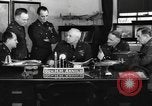
United States Army officials discuss a document at the office of General Henry Arnold in Washington D.C.
United States Army Air Force officials in Munitions Building in Washington D.C. Office of General Henry Arnold, Chief of the U.S. Army Air Forces. General Arnold and staff seated at a desk. Colonel Trubee Davison, Colonel Thomas J. Hanley, Colonel Karl L Naiden, Lt General Arnold, Brigadier General Carl Spaatz and Brigadier General Martin F. Scanlon discuss over a document. Books in a shelf in the background. Map on a wall in the background.
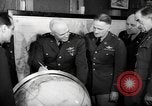
U.S. Army officials discuss a wall map in the office of General Henry Arnold in Washington D.C.
U.S. Army Air Forces officials in the Munitions Building in Washington D.C. Office of General Henry Arnold, Chief of the U.S. Army Air Forces. Colonel Trubee Davison, Colonel Thomas J. Hanley, Colonel Karl L. Naiden, Lieutenant General Arnold, Brigadier General Carl Spaatz, and Brigadier General Martin F. Scanlon discuss a wall map and a globe. General Arnold points at places on the map and talks to the other military officers. Spaatz, Davison and Scanlon looks at the globe.
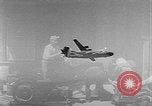
Scenes from movie about tests of incendiary bombing at the Eglin Field before use against Japanese cities in World War II.
Tests of incendiary bombing, before employing it against Japanese cities in World War 2. Planes in flight. Exterior of a building. A sign reads: 'Headquarters Army Air Forces Proving Ground Command'. Sign reads: 'Proof Department building no 8'. Hands open an envelope. U.S. Actor Lee J. Cobb, playing an Army Air Forces Captain, reads the document. The document contains information derived from tests of incendiary bombing, conducted at Eglin Field, Florida. He goes to chart and describes those tests. Scene shifts to the field where a set of Japanese-style houses has been erected. Typical fire-fighting means are shown: water tanks and sand buckets. Two types of incendiary bombs are shown. A bomber drops incendiary bombs on the Japanese-style houses. Crews on the ground attempt to extinguish the fires. But fire consumes the test village.
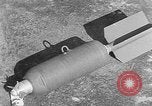
Optimum mix of fragmentation and incendiary bombs is determined during tests at Eglin Field, Florida, during World War II
Conclusions of tests conducted by U.S. Army Air Forces, at Eglin Field, Florida, seeking best way to attack Japanese homeland during World War 2. Actor Lee J. Cobb, portraying an Air Force Captain, smoking a pipe in his "office." Views of M-41 fragmentation bomb and a bundle of M-69 incendiary bombs. The Captain holds a model of a B-17 bomber and uses it to discuss bombing techniques. B-17 in flight. Views of effects of fragmentation bomb, showing numerous small holes produced by it. Aerial view of the test area houses. Mixture of M-69 incendiary bombs and M-41 frag bombs being dropped by the plane on the test area. Various views of resulting damage and effects. Test report is shown, concluding that demolition bombs are not effective against congested wooden structures; that M-41 frag bombs deter early firefighting efforts; and that a mix of 80 percent M-69 incendiaries and 20 percent M-41 frag bombs is optimum. Views of Japanese cities burning, from such bombing, during the war.
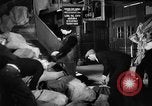
Mail transported by train and airmail by airplanes.
United States Post office employees sort mail sacks filled with letters. A locomotive train approaching camera position and passing by at high speed. Map of United States connecting destinations and a flying plane. A man examining models of various airplanes used for air mail service. Shows postmaster General James A. Farley emerging from a plane with other men to examine the latest technology and advances in airplanes for airmail service. View of exterior of Newark Air Mail Post Office building. Men emerging from plane. A plane takes off. Men load postal mail sacks on plane. View of a pilot reenacting the look of one of the original night mail pilots.
United States interests in South America and Latin America just before World War 2, and German presence in the Americas
Opening scene shows U.S. State Department officials of the Division of the American Republics in a meeting. They examine a map titled "Inter-American Highway" showing a proposed highway running from the border of the U.S. and Mexico at Laredo Texas, all the way through Mexico, Latin America, and into South America. View of South American farmers loading hay into a horse cart, then of cattle in a stockyard being herded by a cowboy on a horse. Aerial view of city of Rio de Janeiro Brazil circa 1938. Narrator discusses threat of dictatorships in countries of South America. Views of German ships and German contracted ships loading and unloading at Buenos Aires harbor. Narrator describes system of barter where Argentina sends goods to Germany in exchange for German-made goods. Swastika flag on one of the cargo ships. Dock crane with German sign "Deutsche Maschinenfabrik A.G. Duisburg". Letters on side of a ship reads 'Buenos Aires Maru'. Supplies unloaded from ship. Cargo stacked including wooden boxes with German writing labeled "Vorsicht - San Paulo Brasilien". In a Latin American or South American city, view of the storefront for luxury goods by Herm Stoltz & Co. A Nazi German flag hangs above the store entrance. Fine leather goods, cameras, figurines, steins, etc from Germany are shown in store window displays. View of Nazi German books on display in storefronts, including closeup of translated book "Mein Kampf" ("Mi Lucha") by Adolf Hitler, bearing an image of Hitler on front cover. A German passenger aircraft parked at an airfield, which narrator describes as being part of a German airline offering service to South America within two days of Berlin, Germany. More German airplanes are shown at an airport in South America. View of government offices in Rio de Janeiro Brazil. Large crest with a bird atop an entrance. Interior office view of President Getúlio Vargas of Brazil seated in discussion with American diplomats. Narrator indicates that Vargas learned of German colonists in Brazil planning his overthrow by assassination, and therefore outlawed all Nazi activity. Poster of Vargas communicating his policies. Scene switches to exterior view of the State, War, and Navy Building (later the Executive Office Building) in Washington DC, with the First Division Monument in the foreground. Interior view of office door bearing sign for Under Secretary of State. Inside, Sumner Welles is seen in discussion with officials. He is asked about the American attitude toward Latin America. Welles describes the importance of strengthening ties between the countries of the Americas. Under Secretary Welles states that the welfare of all of the countries in the region may depend on their continued solidarity.
CRITICALPAST.COM: About Us | Contact Us | FAQs - How to Order | License Agreement | My Account | My Lightboxes | Shopping Cart | Advanced Search | Featured Collections | Website Terms & Conditions | Privacy Policy ©2026 CriticalPast LLC.
License Agreement |
Terms & Conditions |
Privacy Policy
©2026 CriticalPast LLC.