


 Francais
 Deutsch
 Italiano
Refine Your Search
Vietnam Bien Hoa Air Base 1965 stock footage and images
- Showing 12757 to 12762 of 13233 results more
more Hide
Hide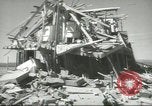
Soldiers assess damage from atomic explosive test shot,"Apple Two," during U.S. Army exercise Desert Rock 6.
Views of various structures and objects after being exposed to atomic explosive test shot "Apple 2" during U.S. Army Exercise Desert Rock VI. A wooden frame house splintered by the blast. A low concrete structure, relatively intact. An overturned Army vehicle. An unsheltered low-wing monoplane, number NG 489851, with skin stripped from its horizontal stabilizer and wing tips. A P-47 aircraft appearing relatively intact. A badly damaged two-wheel trailer. A relatively unscathed auxiliary power unit on a stabilized trailer. Vehicles reduced to rubble. Radar unit and accompanying truck and power unit, seemingly OK, but dish antenna may be damaged. Three soldiers stand around an M2HB heavy machine gun knocked from its stand. A B-29 bomber sits on a ramp with a sign in front of it warning of radiation. A ground crewman sprays the bomber down with a pressure hose to decontaminate it by washing off radioactive particles. A soldier rides a jeep out to check radiation readings on a vehicle that had been exposed. Troops walk back from ground zero and undergo personal cleaning with brooms and checks by geiger counters. A soldier being checked, including his boots. Soldiers sweeping dust from M48 tanks used in the exercise. A soldier being "interviewed" by another, about means of coping with atomic weapons on the battlefield. A formation of soldiers marching, led by one carrying a Corps of Engineers Guidon with the number 14 on it. [Note: According to the U.S. Department of State, Office of the Historian, from February 18 to May 15, 1955, the United States conducted Operation Teapot, a nuclear test series at Yucca Flat and Frenchman Flat on the Nevada Test Site in the continental United States. During the test period 14 nuclear shots and 1 non-nuclear shot were detonated. Several thousand scientific, military (army, air force, navy, marines), and civilian contract personnel participated in the organization, planning, and execution of the test series. Military exercises undertaken during and following the shots took place under the name Desert Rock 6.]

A soldier arrives at the U.S. Military District of Washington DC and reports to Fort Myer to join the U.S. Army.
A soldier (PFC Ed Griffiths) arrives in new assignment with the U.S. Army in Washington DC, United States. U.S. Army Sergeant Stuart Queen in his office. Military MATS C-131 (Convair 240) airliner in flight over Washington DC area with PFC Griffiths and other personnel aboard. Army personnel seated in the aircraft. The captain makes arrival announcements. Aerial view of the Washington Monument , the National Mall, Lincoln Memorial, and Potomac River and the Capitol. Military Air Transport Command C-131 parked and passengers descending stairs upon arrival in Washington, DC. They exit the Operations building and look for ground transportation to their destinations. Soldier gets into a taxi cab. He looks at the Washington Monument and the Lincoln Monument, across the Potomac River, as the cab drives, along the George Washington Parkway, past them. He arrives at the U.S. Army Military District of Washington Headquarters, at Fort Myer, and reports for his new assignment in Headquarters Company, U.S. Army. The Sergeant in charge introduces Sergeant Stuart Queen to the soldier. He is warmly welcomed.
Boxers fight in a ring. A U.S. Army Master Sergeant speaks about fire power and research. He points at models of missiles
The "Big Picture" public film by the U.S. Army. In it Master Sergeant Queen speaks about the use of fire power by the U.S. Army in defense of the United States. Boxers fight in a ring. Spectators cheer for the boxers. One boxer is knocked down and counted out. Then scene shirfts to U.S. Army Master Sergeant Queen speaking about the defensive fire power of the U.S. Army being like a "knock out punch.". He points to models of missiles on his desk, including models of a U.S. Hermes A-3 Missile and what appear to be a Cruise missile and an air defense missile.
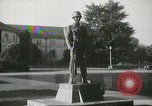
Infantry soldiers attend mechanical and practical training at the U.S. Army Infantry School at Fort Benning in Georgia, U.S.
The U.S. Army Infantry School at Fort Benning in Georgia, United States. A statue in front of the U.S. Army Infantry School. An officer teaches infantry soldiers in a classroom. They attend a mechanical training to learn tactics. Men from the U.S. Navy, the U.S. Marine Corps and the U.S. Air Force arrive for training. Men work on publications in the correspondence school operated by the infantry school. Infantry soldiers undergo practical training under the guidance of experts. The soldiers take down notes. 'Follow Me' is the motto of the school. Infantry soldiers learn to advance and fire artillery during field exercises.
Infantry soldiers fire weapons from bunkers, launch missiles and capture prisoners of war in the European Theater.
Infantry soldiers advance on a battlefield in the European Theater. The soldiers fire weapons from bunkers. A U.S. Air Force aircraft taxis and takes off during an emergency. Soldiers disembark from the aircraft and rescue wounded men. Missiles are launched. Prisoners of war are captured by the soldiers. 'Follow Me' statue at the U.S. Army Infantry School in Fort Benning, Georgia.
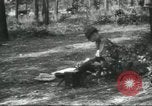
U.S. infantrymen learn to handle causalities and fire artillery during their training in the United States.
Training of U.S. Army infantrymen in the United States in the year 1928. Infantrymen read notes during their training. They learn to handle causalities in better ways. They learn to load and fire artillery. They also learn air raid techniques.
CRITICALPAST.COM: About Us | Contact Us | FAQs - How to Order | License Agreement | My Account | My Lightboxes | Shopping Cart | Advanced Search | Featured Collections | Website Terms & Conditions | Privacy Policy ©2026 CriticalPast LLC.
License Agreement |
Terms & Conditions |
Privacy Policy
©2026 CriticalPast LLC.