


 Francais
 Deutsch
 Italiano
Refine Your Search
Vietnam Bien Hoa Air Base 1965 stock footage and images
- Showing 12751 to 12756 of 13233 results more
more Hide
Hide
U.S. Army 123rd and 130th Regiment, 33rd Infantry Division troops advance in Baguio, Philippine Islands during World War II.
American soldiers advance in Baguio, Philippine Islands during World War II. U.S. Army Air Force P-38 Lightning fighter aircraft strafe the city of Baguio. A smoke column rises from explosions. Mountains in the background. Soldiers carrying full field packs and equipment move down Quezon Hill. Troops of U.S. Army 123rd and 130th Regiment, 33rd Infantry Division move towards the city from Mount Mirador on foot .
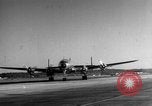
A USAF C-123B Provider transport and a C-124A Globemaster II cargo aircraft land in South Carolina.
Reserve airmen of a Recovery Unit in South Carolina. Airman gets in car and drives. Reserve airmen ready the field for use. Reserve airmen and officers of a Recovery Squadron gives a Readiness test at North Field near Columbia,South Carolina. United States Air Force (USAF) C-123B Provider transport aircraft taxis for landing. Reserve airmen check the aircraft and crew for radiation. Wounded men are evacuated by ambulance. Airman operates a radio. USAF C-124A Globemaster II cargo aircraft with modified radome nose lands at airfield. Emergency vehicles drive onto the runway.
101st Airborne Division troops and equipment are loaded onto C-119Fs aircraft during Operation Swift Strike in North Carolina.
Operation Swift Strike in North Carolina. Troops and equipment of the U.S. 101st Airborne Division are loaded onto U.S. Air Force C-119Fs Flying Boxcar transport aircraft. USAF B-57 Canberra bomber aircraft in flight. USAF KC-135A Stratotanker aerial refueling aircraft takes off. Men work at communications console and plot boards. USAF F-105s Thunderchief fighter aircraft peel off. USAF F-100Ds Super Sabre and RF-84F Thunderstreak fighter aircraft peel off. F-100 and RF-84F aircraft in flight overhead. F-100 aircraft in steep climb. C-119Fs aircraft take off and retract landing gear. C-119Fs in flight drop paratroops. USAF Chief of Staff General Curtis Emerson LeMay,USAF Major General Maurice Arthur Preston and U.S. Army Lieutenant General Thomas J. H Trapnell watch from spectator stands. USAF C-130 Hercules transport aircraft drop heavy equipment. Paratroopers descend and land on ground. Troops deploy and move equipment by Army mule. USAF C-123s Provider transport aircraft land and unload troops. Jeeps full of troops move past a line of parked C-123s.
U.S. President Dwight D. Eisenhower and Press Secretary James Hagerty arrive in Washington on President's aircraft, the Columbine
The Presidential Lockheed Constellation aircraft, "Columbine", taxis to the ramp at Washington National Airport, with number one engine shut down. It taxis with props on numbers 2,3, and 4 engines turning. President Dwight D. Eisenhower and Press Secretary, James Hagerty, step down from the aircraft and depart in a waiting car. A portal sign identifying Gate 19 of the Military Air Transport Command's Special Missions Squadron facility.
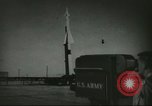
Atomic bomb scenes WWII; atomic testing at U.S. Army atomic experiment station 'Camp Desert Rock' in Nevada, United States
Episode of "The Big Picture", a U.S. Army series of news release programs. U.S. Army cameraman recording Nike missile launch. Atomic cannon fires shell creating atomic explosion and classic mushroom cloud.. Army troops spill out of Sikorsky YH-19 helicopters. U.S. Army infantry soldiers ascend hill firing their rifles. Atomic experiments at Camp Desert Rock in Nevada, United States. U.S. Army Master Sergeant Stuart Queen seated at a desk in his office. He speaks about a series of atomic experiments ("Desert Rock 6") held in barren lands of Nevada at Camp Desert Rock. Celebrating victory in Europe, during World War 2, American troops parade down the Champs Elysees in Paris, France, with the Arc de Triomphe behind them. Happy Parisians watch the parade. War scenes in Japan: footage of explosion and mushroom cloud rising after atomic bomb blast over Nagasaki on August 9, 1945. Barren land on the ground in Hiroshima after the August 6, 1945 atomic blast there . B-29 bombers in flight. Atomic bomb test detonation. Atomic artillery gun M65, also called the Atomic Cannon or Atomic Annie, fires and creates nuclear explosion on distant target.Viking missile launch. U.S. soldiers on parade. Headquarters sign at U.S. Army atomic experiment station at Camp Desert Rock, Nevada, displaying 6-pointed star with "A" in center.. Several atomic test explosions. Soldiers on hillside witness a non-nuclear explosion. Buses carry troops along a road past a sign warning of radiation hazard. Army captain, instructor, briefing troops before the start of atomic maneuvers.. Maps of planned maneuvers. Engineer surveyors lay out ground zero target. View of the ground zero area which is the target area for testing. Signal men lay communication lines to receive and transmit teletype messages. Men operate machinery and dig trenches in which troops will take cover. Other men cover them with sand. [Note: According to the U.S. Department of State, Office of the Historian, from February 18 to May 15, 1955, the United States conducted Operation Teapot, a nuclear test series at Yucca Flat and Frenchman Flat on the Nevada Test Site in the continental United States. During the test period 14 nuclear shots and 1 non-nuclear shot were detonated. Several thousand scientific, military (army, air force, navy, marines), and civilian contract personnel participated in the organization, planning, and execution of the test series. Military exercises undertaken during and following the shots took place under the name Desert Rock 6.]
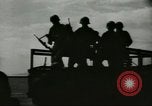
U.S. Army conducts exercise Desert Rock VI, as the "Apple 2" atomic explosive test shot is fired at the Nevada test site
U.S. Army troops silhouetted against sky at dawn as they step from trucks and then proceed to their protected positions in area of ground zero prior to the "Apple II" atomic explosive test shot, "Apple Two," associated with the Army exercise Desert Rock 6. They enter sand-bagged trenches. A briefing officer in a trench issues final instructions that are broadcast over a loudspeaker. View of desert dry lake bed, beyond which is ground zero (detonation site) about 5 miles away. Soldiers are seen foxholes and trenches. An M48 Patton tank, of Task Force Razor is seen, with a tank commander speaking to his group by radio. He instructs them to shut down engines, close all hatches and turn turrets to the rear. Views of tank crew members inside their tanks. The Commander goes down closing his hatch behind him. Other tank crews do likewise. Two Soldiers seen waiting in a trench. One smokes a cigarette. Others standing in their trench. At H-Hour minus two minutes, a siren blows and all begin taking protected positions deep within their trenches and foxholes, as instructed over the loudspeaker. Views of some soldiers in their positions. Glimpse of jeep and of B-45 bomber sitting unprotected on the desert. View of P-47 aircraft in protected positions. Several trees in a line. White flash fills screen as the atomic device is detonated. The explosion seen through camera filming through a porthole. A building flashes into flame and then is blown over by blast wave or shock wave. Interior of house containing mannequins seen, as windows burst in flames and then blast destroys it. Other buildings being swept away. A steel tower bending but remaining upright. Troops out of their trenches moving forward toward ground zero, as the mushroom cloud forms in the distance, and a helicopter flies overhead. Patton tanks of Task Force Razor move toward ground zero, "fighting" their way through obstacles. [Note: According to the U.S. Department of State, Office of the Historian, from February 18 to May 15, 1955, the United States conducted Operation Teapot, a nuclear test series at Yucca Flat and Frenchman Flat on the Nevada Test Site in the continental United States. During the test period 14 nuclear shots and 1 non-nuclear shot were detonated. Several thousand scientific, military (army, air force, navy, marines), and civilian contract personnel participated in the organization, planning, and execution of the test series. Military exercises undertaken during and following the shots took place under the name Desert Rock 6.]
CRITICALPAST.COM: About Us | Contact Us | FAQs - How to Order | License Agreement | My Account | My Lightboxes | Shopping Cart | Advanced Search | Featured Collections | Website Terms & Conditions | Privacy Policy ©2026 CriticalPast LLC.
License Agreement |
Terms & Conditions |
Privacy Policy
©2026 CriticalPast LLC.