


 Francais
 Deutsch
 Italiano

Refine Your Search
Vietnam Bien Hoa Air Base 1965 stock footage and images
- Showing 2539 to 2544 of 13268 results more
 Hide
Color Sound
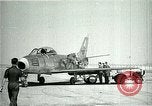
The USAF F-86 Sabre prepared to refuel by the airmen at a USAF base in South Korea during Korean War.
Airmen at a USAF base in South Korea during the Korean War. An airman showing arm signals to a USAF F-86 Sabre taxiing on the runway at the USAF air base. The aircraft in the parking area of the air base. A truck loaded with a few bombs moving on the airfield. The airman climbs on to the aircraft and stands beside the cockpit. A fuel tanker approaches the aircraft and parks beside it. The airmen sitting on one of the wings of the aircraft. Two airmen taking the fuel pipe from the tanker, preparing to refuel the aircraft.

South Vietnamese and U.S. soldiers in a helicopter fly over enemy positions in Kontum, Vietnam.
Views from a helicopter manned by a South Vietnamese crew. Smoke is rising from strikes against Viet Cong targets below. U.S. Lieutenant Colonel Thomas L. Stanford, advisor to the 2nd ARVN (Army of Vietnam) Ranger Group, in the Kontum area, is seen in the helicopter along with his Vietnamese counterpart. (This is during the "Vietnamization" phase of the Vietnam War.) Stanford is the red-headed U.S. officer wearing glasses. He and his Vietnamese counterpart are observing air strikes they requested on enemy positions. The explosions and black smoke are from the bombs being dropped. A vietnamese gunner aboard the helicopter fires a machine gun at ground target. A U.S. Army Bell UH-1D Iroquois or 'Huey' helicopter takes off from a paved road.

Vietcong soldiers attend a political lecture in South Vietnam during Operation Junction City.
Operation Junction City in South Vietnam during the Vietnam War. Vietcong soldiers attend a political or propaganda lecture. The soldiers cross a road. A Vietcong soldier carries an AK-47 submachine gun. An abandoned bus at the side of a road. A dead body beside the bus. Vietcong soldiers in a field. A dead ARVN (Army of the Republic of Vietnam) soldier. United States Air Force C-123B Provider aircraft in flight

President John F Kennedy arrives at Homestead Airforce Base, United States.
Sign for Homestead Air Force Base. President John F Kennedy arrives at Homestead Air Force Base in Florida. President Kennedy inspects aircraft and men and adds battle streamer to flag. RF-101 recon aircraft. President Kennedy speaks. Air force burial ceremony and formation of jets in flight.

U.S. Pacific fleet at sea before Pearl Harbor attack, and Italian sailors establish barrage balloons around Italian Naval base
The U.S. Naval fleet underway in the Pacific before Pearl Harbor. Italian narrator describing names and sizes of various ships including the USS Arizona,USS Oklahoma, USS West Virginia, USS California and USS New Mexico. Footage of the U.S. Pacific fleet ships in heavy seas with water crashing over their bows. Army Air Force biplanes take off from the deck of the USS Langley Aircraft Carrier. Sailors stand by as a biplane aircraft lands on the deck of the USS Langley (CV-1). Biplane aircraft on the deck of the USS Langley. Topic then changes to Air-Raid Defenses in and around Italian naval bases. Italian Sailors roll helium barrage balloon inflation tanks into ships. Sailors direct air into a balloon. Numerous barrage balloons in the sky. Soldiers prepare to release a balloon from a boat and fasten the metal cables. Deck guns in position. Soldiers observe through binoculars, telescopes, other instruments and monitor gauges and radar on a machine. A soldier talks on the radio from amidst sand bag barricades. Soldiers watch as two play a bacci ball game. They run to take their positions as a soldier signals incoming enemy aircraft. Enemy planes attack the Italian base. Explosions near ships in the water. A barrage balloon is hit and bursts into flames. Sailors fire anti aircraft artillery from behind a barricade. Mobile units dash to substitute the destroyed barrage balloon with a new one. Soldiers in a truck hold onto the new balloon and then release it. (World War II period).
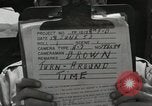
Air Force test pilot, Major R.L. Johnson, sets speed record in U.S. Air Force North American F-86A airplane number FU-611
Air Force Test pilot, Major R.L. Johnson, boards North American F-86A armaments test Sabrejet aircraft number FU-611 at Muroc Air Base (soon after renamed Edwards Air Force Base). Ground crew assists the pilot with chute. Pilot puts on the helmet and oxygen mask. Aircraft taxis. Aircraft in level flight -- extends and retracts speed brakes. Plane rolls to its right and dives. Men at monitoring post on the ground. Aircraft performs several low level high speed passes.Plane lands, and Major Johnson hops out of cockpit all the way to ground where he is congratulated by another Air Force major and ground crew personnel. He puts cigarette in his mouth and feels in his flight suit for a lighter. Major Johnson set an official record of 670.981 mph by flying four times over a 1.86-mile course at altitudes below 150 feet.
CRITICALPAST.COM: About Us | Contact Us | FAQs - How to Order | License Agreement | My Account | My Lightboxes | Shopping Cart | Advanced Search | Featured Collections | Website Terms & Conditions | Privacy Policy ©2026 CriticalPast LLC.
License Agreement |
Terms & Conditions |
Privacy Policy
©2026 CriticalPast LLC.