


 Francais
 Deutsch
 Italiano
Refine Your Search
Vietnam Bien Hoa Air Base 1965 stock footage and images
- Showing 3619 to 3624 of 13233 results more
more Hide
Hide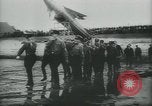
Montage of German rocketry scenes from 1930s through World War II. Nazi surrender. Atomic bomb. Japanese surrender
German rocket pioneer, Gerhard Zucker, attempting to develop postal rockets in the 1930s. Location is Wadden Sea off Cuxhaven, on April 9, 1933, where Zucker follows Nazi Sturmabteilung (also called SA or Stormtroopers) carrying the mail rocket across wet sands. The rocket is set up on a launch stand. Zucker and an assistant ignite the 8 side rockets and the mail rocket takes off. It noses up and loops over backwards, falling to the sand. German Stormtroopers lift up the damaged device. Next, is seen a later, more modern, rocket trial ending in failure. Two German engineers display a model similar to the pulse-jet-powered "buzz bomb" (V-1) employed by the Nazis in World War 2. A brief glimpse of similar American machine on sand flat, as narrator states German acknowledgement of knowledge gleaned from Dr. Robert Goddard's work. A German V-1 flying bomb (aka Doodle Bug) being launched in 1944, during World War 2. View of British houses of Parliament, London, England; an air raid shelter sign in City of Westminster. Londoners waiting out a raid in the shelter. Scenes of fire and destruction during German bombing of London, as narrator speaks about the more advanced German V-2 ballistic missiles employed later in the war. Londoners trudging through debris amongst bombed out buildings. Change of scene to U.S. infantry and armor advancing deep into Germany. Narrator refers to them overrunning rocket bases and other vital war-making facilities, near the end of the war. Glimpse of large number of German prisoners of war. Documents of military surrender being signed by Field Marshal Wilhelm Keitel, in Berlin, May 8, 1945. Closeup of Keitel. Scenes of American forces operating in Pacific theater. Aerial view of atomic bomb explosion. Japanese surrender ceremony on September 2, 1945, aboard the battleship USS Missouri. U.S. soldiers and other service personnel return home and greeting loved ones at end of war. Aerial view of Pentagon building and surrounding area in Arlington Virginia near Washington DC. U.S. troops boarding a ship in San Francisco, bound for war again, this time in Korea (1950).
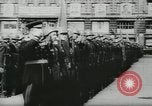
U.S. Regular Army, National Guard, and Army Reserve units operating together in combat, in Korea, and returning home after the truce
Soviet military forces in massed formations at Red Square, in Moscow, Russia. Joseph Stalin stands on balcony above. Scenes of rebellion in Europe and Asia. A map of Korea. June 25, 1950, as Korean War war broke out between North and South Korea. Buildings burning. Refugees fleeing. View of United Nations building on East River in New York City, where American ambassador Warren Austin is speaking. View of the Capitol in Washington, DC. President Truman, speaking, committed U.S. forces to action. U.S. Reservists are recalled to active duty to fight in Korea. Some are seen getting off a bus at a military base reception center. Recalled reservists with full field gear, starting their journey overseas, and later seen in Korea. U.S. tanks moving over the road manned by soldiers with World War Two experience. Numerous scenes of heavy artillery firing, mostly at night. U.S. regular Army, National Guard, and Army reserve soldiers engaged in fire fights in Korean War using tanks, artillery, mortars, and rifles. Soldiers administer first air and assist wounded comrades. American troops slogging through rain and snow in Korea. Soldiers eating from mess kits, and reading the Stars and Stripes newspaper, during a lull in combat. North Korean officers arriving, in snow, for armistice talks. Following the truce, American soldiers are seen packed up and heading home from Korea.
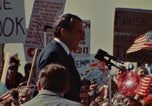
U.S. President Richard Nixon speaks to a crowd about a decrease in automobile sales at Tri-City Airport in Saginaw, Michigan.
U.S. President Richard Nixon arrives at Tri-City Airport in Saginaw, Michigan. Placards held by a crowd display welcome messages for President Nixon and anti-Nixon protest demonstration messages such as, "Impeach Nixon" and "Jail to the Chief." A large crowd cheers for President Nixon. President Nixon delivers a speech and thanks all present. He says 'We can be thankful for the fact that American is at peace with every country after 12 years'. He says that his administration is working for an increase in automobile sales in Saginaw base which affects the whole of Michigan. Around 3:48 he says the shortage of energy (following the October 1973 OPEC oil embargo) is the main reason for decrease in automobile sales and it affects jobs directly. He speaks about his proposals to the Congress for bringing up the automobile sales and increasing the jobs in Michigan. President Nixon talks about a bill which would deregulate natural gas for the production in Michigan which would make gasoline available which is not available at the present. He addresses automobile emissions standards and the need for clean air and a good environment, but also the need for jobs. He calls for relaxing auto emissions standards to allow more automobile production and more jobs. He speaks about alternative energy sources and natural resources which the United States has and can use, including more coal. He stumps for James Sparling, recommending voters elect him to Congress.
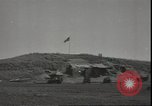
USMC (United States Marine Corps) officers confer at Henderson Field on Guadalcanal during World War II.
American flag flying from a tall flagpole over a hill near Henderson Field on Guadalcanal during World War 2. U.S. Marine officers are seated at a table in a local headquarters tent dug in and sandbagged at the base of the hill, which sits on the edge of the captured Japanese airfield (Henderson Field). One of the officers is looking through binoculars. Nearby, behind them a C-45 transport plane (Beechcraft Model 18) is approached by a fuel truck. Many other aircraft parked aircraft are seen in the distance. Two Marines standing in front of a mound of sandbags discuss something on a clipboard. Several Marines relax in front of a wooden building. Another Marine officer wearing a sidearm joins them with a large map, which they discuss. One of the Marine officers is a Colonel (O-6). Scene shifts to a B-17, tail number 41-2403, taxiing. Next, several B-17s are seen through palm trees, flying overhead. One has its landing gear extended and descends, beyond some trees, to land. Camera moves to a site where pipelines are being repaired by Seabees. A Seabee welder is at work on one. Seabees move new pipe into position on cross ties. (Note: The B-17 Number 41-2403 ditched January 27, 1943, on the way from Guadalcanal to Espiritu Santo, with Brigadier General Nathan Farragut Twining, Commander, 13th Air Force, on board. On 1 February 1943, the U.S. Navy rescued him and 14 others from their life rafts, near New Hebrides Islands.)
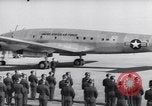
Color Guard marching as the Constellation aircraft takes off after the visit of U.S. Army Secretary Kenneth C Royall in Japan.
U.S. Army Secretary Kenneth C Royall visits Japan. Constellation aircraft getting ready to take off. Honor Guard standing in formation. The aircraft taxis away towards the take off strip. The aircraft takes off. Army band playing music in the background. Color Guard marching. Cars arrive at the air base.
People seated inside a DC-4 transport airplane during its test flight in Los Angeles, California.
The trial flight of a DC-4 transport airplane in Los Angeles, California. The airplane parked at an air base. People embarking the airplane. The airplane takes off and in flight. Interior of the airplane. People seated and a pilot at the controls.
CRITICALPAST.COM: About Us | Contact Us | FAQs - How to Order | License Agreement | My Account | My Lightboxes | Shopping Cart | Advanced Search | Featured Collections | Website Terms & Conditions | Privacy Policy ©2026 CriticalPast LLC.
License Agreement |
Terms & Conditions |
Privacy Policy
©2026 CriticalPast LLC.