


 Francais
 Deutsch
 Italiano
Refine Your Search
Vietnam Bien Hoa Air Base 1968 stock footage and images
- Showing 6115 to 6120 of 13286 results more
more Hide
Hide
General Henry (Hap) Arnold reports to the nation on status of U.S. Army Air Forces in World War II
General Henry H. Arnold, Commander of the U.S. Army Air Forces, seated in front of world map, reports that since start of World War 2, the U.S. Air Force has gone from number 7, to number 1, in the world. Defense plant workers are shown walking near their place of work. A college football game shown in progress. Individual young men who left civilian life to became pilots, bombardiers, radio technicians, and gunners, in the Air Forces. A commercial DC-3 aircraft taxing to park at an airport. Shown are people who make the Air Forces possible, including many men and women workers at factories and manufacturing plants making aircraft and parts for the World War 2 effort: Steel workers, a woman working on a plane fuselage, actor James Stewart (in uniform), a welder at work, a typist, a machinist using a caliper, and an older couple at home, who forgoe driving their private car, shown covered in their garage. The flaming wreckage of U.S. aircraft at Hickam Field, on December 7, 1941. Large formation of German Heinkel He-111 bombers in flight. Formation of Japanese Mitsubishi G3M (Nell) bombers. U.S. P-40 pursuit planes taxiing out from parking places. Assembly line in U.S. aircraft manufacturing plant. U.S. Army Air Forces B-17 Flying Fortress planes on assembly lines. Workmen work on engines and aircraft fuselages. At the Douglas plant U.S. Army Air Forces B-26 Marauder bombers being assembled. Workmen inserting machine guns into a wing.
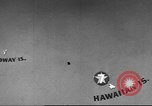
United States 8th Air Force B-17 Flying Fortress bomber planes destroy enemy targets in Germany during World War II.
U.S. Army Air Forces operations in Germany during World War 2. Animation of the Aleutian Islands in the North Pacific and location of U.S. 11th Air Force. Location of U.S. 6th Air Force. Location of U.S. 8th Air Force in England. Interiors of German armament and munitions factories shows armament works, steel works, and German war production workers. German factories making bomb shells, crankshafts, and other war materiel. U.S. Army Air Forces B-17 Flying Fortress in flight. B-17 drops bombs over German targets. German anti-aircraft gunners. Interior of the plane shows British air crews. Bombs being dropped. Mock ups of bombs exploding on German target. Fire in a German city. German search light crew at work. Bombs exploding in German cities. Rubble on street in German town.
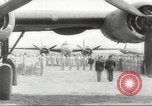
Major General Chennault reviews 14th Air Force pilots in China and the Allies bombard Italy during World War II.
United States Army Air Forces Major General Claire Lee Chennault Commander of the 14th Air Force in China during World War II. Airmen of the 14th Air Force lined up on a field with aircraft in the background. Chennault inspects the 14th Air Force. A Captain with a medal pinned onto him. Chinese pilots shake hands with Major General Chennault. In Washington DC Major General Chennault receives the Mitchell Trophy for the services rendered by the 14th Air Force. U.S. Army Air Force B-17 Flying Fortress aircraft in flight and drop bombs over Sicily and Sardinia in Italy. Explosions occur.
USAF Lieutenant General Ira Eaker speaks about his experiences in the U.S. Air Force in the United States.
An interview of United States Air Force Lieutenant General Ira Eaker conducted by Dr. Maurer in the United States. Dr Maurer and General Eaker seated at a desk. Dr Maurer talks about the work and the contribution of General Eaker in the U.S. Air Force. He says that General Eaker was the Commander of the 8th Air Force. In 1944, he became the Commander in Chief of the Mediterranean Allied Air Force. Then from 1945 until his retirement in 1947, he was the deputy commander of the Army Air Forces and chief of the Air Staff. General Eaker talks about his experiences. He talks about the first airplane flight he saw. He further speaks that he was sent to a training camp in 1917. A man came in the camp looking for some fliers. He was already selected for an examination of regular army. He says that in November 1917, he was on a parade grounds. An airplane was in flight overhead. The aircraft landed and he looked at the engine of the aircraft.
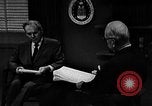
During an interview in the US, Lt. Gen. Ira Eaker talks about the urgency and the efforts of European air forces to win.
An interview of United States Air Force Lieutenant General Ira Eaker conducted by Dr. Maurer in the United States. General Eaker talks about why had he said that the United States Army Air Force was inferior to certain European air forces in the beginning of World War II. He said that European air forces were in operation during the war. He says that very few people in the U.S. had visualized that the country would get involved in the war. European Air Forces were in urgent need of advanced air forces and further efforts to win against the enemy. U.S. was not in the same position. Their aircraft production was also limited.

Balloonists prepare shortly before ill-fated hot air balloon race from Catalina Island
Hot air balloon race disaster in Catalina Island, California. Five hot air balloons in Catalina Island. Participants use gas tanks and flames to inflate the hot air balloons. A 42-year old woman, Barbara Ruth Keith, puts on her life vest and helmet before the race. Barbara Keith boards her hot air balloon and tucks her toy mascot, a stuffed toy dog, into the top of her hot air propane tank. Hot air balloon contestant Barbara Keith waves at spectators upon her ascent. POV from balloon of spectators on ground as it ascends. Catalina Island. Swiss-born American balloonist, Donald Louis Piccard (also known as Don Piccard), ignites his heater and leaves the ground aboard balloon. Distant shot of balloon over ocean.
CRITICALPAST.COM: About Us | Contact Us | FAQs - How to Order | License Agreement | My Account | My Lightboxes | Shopping Cart | Advanced Search | Featured Collections | Website Terms & Conditions | Privacy Policy ©2026 CriticalPast LLC.
License Agreement |
Terms & Conditions |
Privacy Policy
©2026 CriticalPast LLC.