


 Francais
 Deutsch
 Italiano
Refine Your Search
Vietnam Bien Hoa Air Base 1968 stock footage and images
- Showing 6169 to 6174 of 13286 results more
more Hide
Hide
U.S. Army Air Forces officers confer with General Electric executives about producing America's first turbojet airplane engine
Documentary film 'The Jet Engines' about the develpment of an American jet airplane, with help of the British who provide General Electric Company with a prototype engine developed by British RAF Group Captain Frank Whittle. A B-17 aircraft taxis and takes off from the runway. Vehicles carry U.S. Air Forces officers and civilian engineers to an airfield where a man stands with a gun next to a U.S. Army Air Forces B-17 Flying Fortress aircraft. The visitors look at cargo containers being offloaded from the aircraft. They contain a prototype British Whittle turbojet engine. Scene shifts to meeting of executives of the General Electric Company with U.S. Army Air Forces officers. They look at schematic of the Whittle engine. GE officials commit to building an American turbojet engine to power U.S. Air Forces airplanes.
U.S. Army Air Corps airplanes and crews preparing for Alaskan Flight in 1934
Slate lists planned flight legs of U.S. Army Air Corps aircraft as: Washington DC to Edmonton, Alberta; Fairbanks Alaska to Seattle Washington; and Washington DC to San Diego California. Another slate explains that under command of Lieutenant Colonel H.H. Arnold,ten B-12 bombers demonstrate their capabilities in an 18,000 mile flight. Lt. Col Henry H. Arnold, U.S. Army Air Corps, stands in front of a large map on which planned flights are charted. Sign behind him identifies "Engineering Office," at Patterson Field. Arnold uses pointer to show the routings to another officer who has joined him. The next sequence shows Arnold describing the flight plans to more participants, using more charts. Camera pans across ten assembled Army personnel. Lt. Col. Arnold poses with 15 aviators in front of a YB-12 bomber (displaying air intake on port side of engine). Camera pans over eighteen mechanics and ground crewmen posed in front of the bomber. Symbol of eagle superimposed over map of alaska, is painted on side of forward fuselage. Arnold discussing the mission with Army officers and civilian officials, as they walk past a YB-10 (with air intakes atop the cowlings). Camera pans across Patterson field ramp, where officials, automobiles, YB-10 aircraft, and local civilian workers, including several women, are seen. Crew chief seen refueling a YB-10 with long hose from an underground fuel tank installed at edge of the ramp.
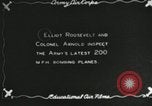
Elliot Roosevelt and Colonel H. H. Arnold inspect YB-10 bombers of the Army Air Corps Alaska Flight
Elliott Roosevelt, son of the U.S. President, and his wife, Ruth J.(Googins) Roosevelt, are seen at Bolling Field, Washington, DC, with U.S. Army Air Corps Colonel H. H. Arnold, as they visit the fliers taking part in the Air Corps Alaska Flight project. Elliot Roosevelt shakes hands with project commander, Colonel H. H. Arnold, as his wife, Ruth Roosevelt, stands behind them. They are in front of an Air Corps Martin YB-10 bomber. Air Corps aviators climb in and out of the aircraft and stand behind the wing of one, as they don mosquito netting headgear, that might be needed on the expedition. Closeup of the Alaska Flight logo painted on their YB-10 bombers, consisting of an eagle perched on a totem pole, superimposed on a map of Alaska.
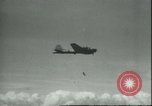
U.S. Army Information film about air sea rescue using B-17 and A-24 aircraft and Army rescue boat
A film on U.S. Army air-sea rescue operations. A U.S. Army Air Forces B-17 Flying Fortress aircraft in flight over water. Crew at controls of the aircraft. Number 1 engine is feathered. Then, number 4 engine fails and is feathered. View from behind shows the B-17 descending with all four engines feathered. (Some of these scenes probably employed models.) Crew members in the aircraft. A wireless operator sets a key at automatic SOS. Crew preparing for ditching. The aircraft ditching in the water.Crew evacuates from the ditched aircraft in 6-man life rafts. They employ their various survival gear, including Gibson Girl radio with balloon-mounted antenna, signal mirrors, fishing gear, dye marker, and smoke flares. They are spotted by an Army Air-Sea rescue Douglas A-24 aircraft. The aircraft reports their position and a rescue boat is dispatched to their location. They are reached by U.S. Army air sea rescue boat, number P-249 (An 85 foot, wooden, gas- powered boat, built by Eddy Ship Building, Bay City, Michigan). Crewmen are taken aboard and given refreshments.

P-47 Thunderbolt aircraft being prepared for an air raid on Italy during World War II.
A film about role of U.S. Army Air Forces P-47 Thunderbolt aircraft during Allied air attacks on Italy in World War II . Aerial views of a damaged bridge after an Allied air attack. Bomb craters on the ground. A U.S. Army Air Forces P-47 Thunderbolt aircraft taxis along a field. Aircraft lined up at an airfield. Pilots in the cockpits of the aircraft as they clean canopies. Crew members work on P-47 aircraft.
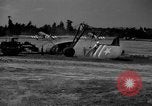
U.S. Army Air Force P-47 Thunderbolt, Martin B-26 Marauder and Lockheed P-38 Lightning taxi and take off in France.
Several United States aircraft taxi on a runway and take off in France during World War II. A tractor crane hooked to a wrecked U.S. Army Air Force Waco CG-4 glider. U.S. Army Air Force P-47 Thunderbolts parked in the background. A U.S. Army Air Force Silver Lockheed P-38 Lightning taxi past the parked aircraft in the background. The aircraft while taxiing raises dust. Invasion markings on the aircraft. A USAAF C-47 taxis forward, takes a turn and takes off. The aircraft in flight over the low field. Insignia of the United States. A U.S. Army Air Force Martin B-26 Marauder taxis on a runway and raises dust. Another C-47 taxis on the runway and takes off. A signal aircraft in the foreground. Parked aircraft and trees in the background.
CRITICALPAST.COM: About Us | Contact Us | FAQs - How to Order | License Agreement | My Account | My Lightboxes | Shopping Cart | Advanced Search | Featured Collections | Website Terms & Conditions | Privacy Policy ©2026 CriticalPast LLC.
License Agreement |
Terms & Conditions |
Privacy Policy
©2026 CriticalPast LLC.