


 Francais
 Deutsch
 Italiano
Refine Your Search
Vietnam Bien Hoa Air Base 1968 stock footage and images
- Showing 6181 to 6186 of 13286 results more
more Hide
Hide
During an interview in the US, Lieutenant General Ira Eaker talks about problems and experiments done by air corps.
An interview of United States Air Force Lieutenant General Ira Eaker conducted by Dr. Maurer in the United States. General Eaker talks about problems of the air corps during World Wars I and II. He says that achievements have to be in keeping the idea of air power alive. He talks about experiments in aviation done by them. He talks about the Question Mark flight. He also talks about opportunities to be exposed to several leaders which they got as fliers. He talks about the cancellation of United States Army Air Force B-17 Flying Fortress aircraft. Maneuvers were organized by them.
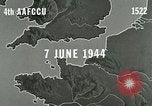
U.S. 9th Air Force B-26 aircraft drop bombs on marshaling yards in Normandy, France during World War II.
U.S. 9th Air Force air attacks against France during World War II. Aerial views of the 9th Air Force aircraft in flight on June 7, 1944. A convoy of Allied ships underway in the English Channel. Landing crafts circle around the ships. Aircraft attacks German gun emplacements and smoke rises as bombs hit the targets. Saint Lo being bombarded. U.S. Army Air Forces B-26 Marauders bombard marshaling yards. Billows of smoke rises due to bombing. Bombs drop and impact results in smoke and fire.
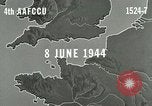
U.S. 9th Air Force B-26 aircraft drop bombs on a communication center and marshaling yards in France during World War II.
U.S. 9th Air Force air attacks against France during World War II. Aerial views of the 9th Air Force L-5 Sentinel aircraft in flight on June 8, 1944. An aircraft flies over Allied camouflaged positions in France. Aerial views of an abandoned tank, abandoned parachutes and 155 mm gun emplacements. U.S. Army Air Forces B-26 Marauders in flight over a convoy of Allied ship in the English Channel. Smoke rises from a ship on fire. Smoke rises from the city of Caen. Marauders bombard a communication center and smoke rises. Bombs being dropped on communication lines and marshaling yards.
United States Eighth Air Force command headquarters WW2.
United States Eighth Air Force officials deliberate and issue field orders to drop bombs during World War II. Writing on the frosted glass door reads “Operations A3”. A sign in door reads “No Admittance Briefing in Progress”. Daily operations conference headquarters of the Eighth Air Force. The commanding general shares his plan of action. Map of the United Kingdom and Ireland is seen behind the general. The assistant of the commanding general uses a long stick to point to a wall map. Eighth Air Force officials review a map on the desk. An official shows the commanding general a place on the map. The general makes a decision. An officer from the general’s officer makes a call. Men and women using teletype to write field orders and messages. Operational staff of air division headquarters discuss important details regarding the new field order. Operational staff member points to a large wall map. Other officers listen during a meeting. The chemical officer puts down his phone after a call.
People board a Stout Air Lines passenger airplane flight in the United States.
A Stout Air Lines Flight carries passengers during an early civilian passenger airplane flight in United States People get off a bus outside a building and walk towards the "Passenger Terminal" sign. A woman, accompanied by a group of young children, buys tickets from a man behind the 'Ticket Office'. Two woman at a window. People stand outside the building. View of terminal from a field. Aircraft parked on the field. The sign above the door of the plane reads "Stout Air Lines". A man with luggage stands outside the plane. A man in uniform loads baggage over seats in aircraft. People wait to board the plane. Porters help people. The man shuts the door. The Ford Trimotor airplane taxis on the runway and takes off. The sign on the side of aircraft reads "Stout Air Lines, Detroit--Cleveland--Chicago".View of inside of the aircraft. Passengers inside aircraft cabin look out of the windows. Group of boys excitedly watches outside windows. Aerial view of countryside, a bridge over a river. View of aircraft from another aircraft. The plane lands on the runway. A man at the runway. The plane taxis to a halt and the door opens. The passengers get up and get off the plane.
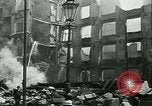
British response to Nazi air raids in Battle of Britain, and use of American radar in the European Theater during World War II.
The role and contribution of the U.S. Army Signal Corps in combat and war. Opening scenes show bomb damage due to German Luftwaffe blitzkrieg air raids (The Blitz) in Southern Counties of London earlier during Battle of Britain in World War 2. Firemen and rescue workers try to extinguish the fires with water hoses. The rescue workers conduct operations amidst bomb damaged buildings and rubble. Severely damaged buildings. Rubble strewn all over the streets in England. A Food Flying Squad van makes its way on the streets. Food distributed from the van. A British man walks amidst the rubble. Relief work in progress. Buckets of food and water lying at camps. Displaced civilian people eat and drink. London civilian residents evacuate numerous areas. Evacuees walk across a bridge. Big Ben seen in the background. Allied bombers in flight. Royal Air Force de Havilland Mosquito aircraft track and shoot down enemy aircraft. The dogfights result in mid air explosions. Two soldiers operate a U.S. radar designed to direct antiaircraft fire in combat area. The radar tracks a target moving up to 600 miles an hour. The soldiers track down aerial targets, the gun directors make adjustments and the antiaircraft guns are fired at buzz bombs. Enemy V-1 Flying bombs are hit and downed before they can reach the coastline. German V-1 rockets are tracked over England by radar and shot down. An V-1 is hit. It descends to the ground and explodes. France: A downed V-1 flying bomb is examined. The wreckage of a V-1 in a field. Soldiers and civilians near the wrecked V-1 Flying Bomb
CRITICALPAST.COM: About Us | Contact Us | FAQs - How to Order | License Agreement | My Account | My Lightboxes | Shopping Cart | Advanced Search | Featured Collections | Website Terms & Conditions | Privacy Policy ©2026 CriticalPast LLC.
License Agreement |
Terms & Conditions |
Privacy Policy
©2026 CriticalPast LLC.