


 Francais
 Deutsch
 Italiano
Refine Your Search
Vietnam Bien Hoa Air Base 1968 stock footage and images
- Showing 9619 to 9624 of 13286 results more
more Hide
Hide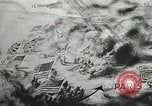
Allied Forces advance and French Army takes Paris in World War II.
Animated map shows American forces advancing toward Paris. Views of German troops disorganized and making their way individually among burning and destroyed military tanks and vehicles. A U.S. Army colonel confers with U.S. Armored unit officers, using hood of jeep as a table. U.S. Sherman tanks and tank destroyers moving along dirt roads toward Paris, at high speed and passing beyond the Orleans region. They move rapidly through groups of cheering French citizens in a French town. American armored units moving to bypass Paris. U.S. Army Air Force airplanes dropping maps to the armored units by parachute, because they were moving too fast to be supplied by ground. French forces, armed with American tanks, vehicles, and arms, are ordered to advance and take Paris. As they proceed, U.S. Army Air Forces support them from the air. Formations of P-51 fighter and B-26 bombers are seen. The French forces advance at rate of 25km per day. They are joyously welcomed as they pass through French towns on their way. Scenes of Paris. Local residents in line at a shop. German occupiers are seen beginning to leave Paris. A line of horse-drawn wagons is seen in the street. On August 14, 1944, Paris Police go on strike. They are seen drawn up in formation. August 15, 1944, the Gestapo left Paris. French citizens and police open fire on German Army vehicle. Parisians begin to hang the tricolor from their windows. French resistance fighters seen running in streets of Paris and firing weapons as they work to find remaining German forces. A doctor and several nurses run for cover. Parisians begin to fill the streets during liberation of Paris as elements of the French Army enter Paris. General Charles de Gaulle walking along a street in Paris.
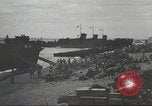
U.S. forces prepare for attack against Japanese forces on Munda, readying supplies, troops, and aircraft.
Planning and moving of U.S. equipment, supplies, aircraft, and soldiers in preparation for attack at Munda Point on New Georgia Islands, Solomon Islands during World War 2. U.S. Marines and infantry massed up on Guadalcanal beach prepare for the invasion of Munda Point. Gasoline barrels are rolled on the beach. Crated food in cargo nets hoisted aboard ships. Equipment is loaded onto ships. U.S. combat aircraft assemble for an aerial offensive. U.S. Army General Douglas MacArthur exits car and talks with another U.S. officer. General MacArthur, U.S. 13th Air Force Lieutenant General Hubert R. Harmon, U.S. Army Air Force General Nathan Twining and U.S. Fleet Admiral William Halsey plan the attack on Munda Point. United States Army Air Force P-40 Warhawk fighters taxi and take off from an airfield. U.S. aircraft including P-40 Warhawk, P-39 Airacobra, U.S. Navy F4F Wildcat, TBF Avenger, B-25 Mitchell and B-24 Liberator aircraft in flight heading to destroy enemy positions on Munda. Japanese aircraft seen taking off and in flight.
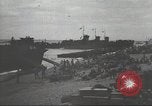
General MacArthur, General Hubert R. Harmon, Nathan Twining and Fleet Admiral William Halsey plan an attack on Munda.
The U.S. Army plans an attack at Munda Point on New Georgia group of Islands, Solomon Islands during World War II. U.S. Marines and infantry massed up on Guadalcanal beach prepare for the invasion of Munda Point. Gasoline barrels rolled on the beach. Crated and canned foods in cargo nets hoisted aboard ships. Equipment is loaded onto ships. U.S. combat aircraft assemble for an aerial offensive. U.S. Army General Douglas MacArthur gets out of car and talks with another U.S. officer. General MacArthur, U.S. 13th Air Force Lieutenant General Hubert R. Harmon, U.S. Army Air Force General Nathan Twining and U.S. Fleet Admiral William Halsey coordinate the attack on Munda Point. U.S. Army Air Force P-40 Warhawk fighter aircraft taxi and take off from an airfield. U.S. planes including P-40 Warhawk, P-39 Airacobra, U.S. Navy F4F Wildcat, TBF Avenger, B-25 Mitchell, and B-24 Liberator aircraft in flight head to destroy Japanese enemy positions on Munda. Japanese aircraft take off and in flight.
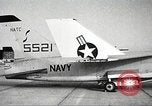
Comparison of U.S. Navy F8U-2 Crusader fighter with F8U-1 Crusader fighter, United States.
Film introduces U.S. Navy F8U-1E Crusader and F8U-2 Crusader aircraft and compares them with the F8U-1 Crusader aircraft, United States. F8U-1E and F8U-2 parked at an airfield. Pilot makes an inspection. Three pneumatic system pressure gauges located on right hand forward fuselage of F8U-2. A pair of air scoops added to provide additional cooling air to after burner. Ventral fins on each side of plane. Pilot boards the F8U-2. F8U-2 cockpit arrangement shows instrument panel with various switches and indicators. Scope for APS-67 radar in F8U-2. APS-67 control panel on left console. Armament panel with indicators. Chart depicts AC and DC generator installation due to additional radar system installed. Pilot control knob on air conditioning panel. Emergency canopy handle located on instrument panel hood. Airmen around F8U-2. F8U-2 takes off from an airfield.
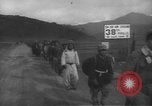
Lieutenant General James Van Fleet, assumes command of the Eighth Army in Korea, after General Douglas MacArthur is relieved of command by President Harry Truman
Opening scene shows a sign identifying the 38th Parallel separating North from South Korea. Refugees with their few belongings walk from North Korea to South Korea. A U.S. Patton tank is seen next, followed by another. Closeup of treads on a Patton tank, raising dust as it passes. Another Patton heading toward the camera, with a crewman waving. A Cessna L-19 Bird Dog, aircraft, marked with three stars, arrives, carrying the new Commander of the Eight Army, Lieutenant General James Van Fleet. He climbs out of the airplane and shakes hands with a Brigadier General. Standing behind him is Air Force Lieutenant General Earle E. Partridge, commander of the 5th Air Force. A jeep carrying General Van Fleet turns in from a dirt road. A sign reads "56th Regiment, Message Center." Lieutenant General Van Fleet, climbs out of the front right seat of the jeep. He is wearing a pair of pearl handled side arms. U.S. Air Force Lieutenant General Partridge is seated in the back seat of the jeep and jumps out behind Van Fleet. View of explosion in distant hills, part of the initial barrage in advance of the next United Nations offensive. Sounds of aircraft and artillery are heard. American infantry are seen moving forward. Narrator notes that numerous Chinese troops were in the hills around the Chosin reservoir and they were committed in vast numbers against the UN forces. UN infantry in Korean War moving through forests and mist. Large numbers of Chinese prisoners of war are seen walking along a dirt road.
Soviet military examine a German Dornier DO-17 airplane that crash landed in a grass field
Soviet officers and soldier mechanics swarm over a German Dornier DO-17, that crash landed in an isolated grass field in the Soviet Union during World War II. Views of the aircraft , including tail, fuselage, wings, engines and cockpit. Several unexploded bombs are seen on the ground. The aircraft is basically intact. Greatest damage is bent propellers (and possible unseen internal engine damage) suffered during crash landing with gear up or collapsed during landing. Some battle damage is evident in cockpit area from air-to-air or ground-to-air Soviet weapons fire. The Soviet mechanics examine the downed airplane in great detail.
CRITICALPAST.COM: About Us | Contact Us | FAQs - How to Order | License Agreement | My Account | My Lightboxes | Shopping Cart | Advanced Search | Featured Collections | Website Terms & Conditions | Privacy Policy ©2026 CriticalPast LLC.
License Agreement |
Terms & Conditions |
Privacy Policy
©2026 CriticalPast LLC.