


 Francais
 Deutsch
 Italiano
Refine Your Search
Vietnam Bien Hoa Air Base 1968 stock footage and images
- Showing 9775 to 9780 of 13286 results more
more Hide
Hide
Testing effect of Atomic explosion on aircraft parked at different angles in Nevada, United States
Continental atomic tests Nevada, United States. Air Force C-54 aircraft in flight. Air Force Flight Surgeons wear masks and observe the atomic bomb explosion from an aircraft to test its effect on a pilot's vision. They immediately test their vision, while aboard the airplane, following the atomic blast. A truck drags a P-47 airplane. B-17s, P-47s, and newer aircraft are stationed at different angles. Atomic explosion tesst the effect of this explosion on the aircraft. High-speed cameras record effects of atomic blast. Elevator on tail of a B-17 in flames. Afterwards, technicians examine the damage on the various aircraft. Views of damaged aircraft after explosion on ground. USAF B-57B aircraft in flight. B-47 takes off with JATO. Smoke trails from the boosters.
U.S. B-50 Superfortress drops bombs over target areas during atomic tests in Nevada, United States
Continental atomic tests in Nevada, United States. An Air Weather officer at podium speaks to the high ranking people that includes Dr. Alvin C Graves, scientific test director and Carol Tyler, test manager for atomic energy commission. They decide upon an atomic test. An army sentry stands guard as B-50 named "Rosebud" starts engines for the test mission. Wheels and bottom of the aircraft. U.S. Air Force B-50 Superfortress aircraft in flight. Pilot , radio navigator and bombadier at their crew positions inside the B-50. Monitoring personnel track progress of the B-50, against flight plan, at the Atomic Energy Commission control room. Navigator in the aircraft communicates to the pilot, who turns to align with final bomb run. The bomb bay of the aircraft opens. The Bombardier takes control of aircraft. Aerial view of the target to be hit by the bomb. When bomb is released, aircrew and all observers on ground don protective glasses or goggles. The bomb detonates on the target with blinding flash of light. Mushroom cloud seen from aircraft, above.
U.S.Army Medical Service. Successive treatment of casualties, from battlefield to evacuation to japan, during the Korean War.
U.S. tanks and troops under fire in Korea. A medic crawling through mud to keep up with infantry. Medics rendering emergency aid to wounded on battlefield, treating them for blood loss and shock, administering blood plasma and treating wounds. U.S. trooops carrying their wounded, under fire, to Battalion aid stations. Ambulatory wounded walking to air station. U.S. wounded being loaded into ambulance for transport to the Regimental Collection Station. Wounded on litters being carried on jeeps, Wounded on litters being loaded on helicopter. View of Division Clearing Station. Helicopter brings wounded to a hospital at Pusan. U.S. Army doctors, who specialize in surgery, orthopedics, etc. seen at work. Surgeons scrubbing before surgery. Casualties being loaded on open trucks for transport to airfield for evacuation by combat cargo planes. Group of C-47 aircraft parked on ramp. Casualties on stretchers being carried aboard a C-54 aircraft. The air evacuation aircraft takes off for Japan.
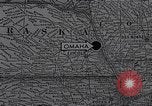
City of Omaha, Nebraska, highlighted on map of United States.
Several scenes of large map of United States of America. Nebraska is outlined and Omaha (Headquarters location of the U.S. Air Force Strategic Air Command (SAC) is highlighted. An arrow points a bold dot representing city of Omaha in Nebraska,United States.
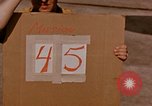
B-47, F-94 and T-33 in flight for mission no. 45 of human downward ejection test
Mission No. 45 of human downward ejection test. Three USAF (United States Air Force) planes B-47 Stratojet, F-94 Starfire and T-33 Shooting Star. Test subject and seat ejected from plane. Seat and test subject separates. Parachute opens and parachutist descends. Footage is from U.S. Air Force aero-medical studies.
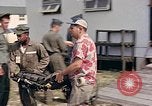
Pre-flight preparation for human downward ejection test in United States.
Parachute placed in an USAF (United states Air Foce) truck. Preparation prior to flight for human downward ejection test. Military men carry parachute from truck to plane. Parachute is installed in the ejection seat. Test subject in pink climbs up into the plane. Footage is from U.S. Air Force aero-medical studies.
CRITICALPAST.COM: About Us | Contact Us | FAQs - How to Order | License Agreement | My Account | My Lightboxes | Shopping Cart | Advanced Search | Featured Collections | Website Terms & Conditions | Privacy Policy ©2026 CriticalPast LLC.
License Agreement |
Terms & Conditions |
Privacy Policy
©2026 CriticalPast LLC.