


 Francais
 Deutsch
 Italiano
Refine Your Search
Vietnam Bien Hoa Air Base 1968 stock footage and images
- Showing 10501 to 10506 of 13286 results more
more Hide
Hide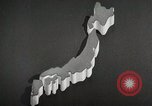
Views of China and Japan in the period leading up to the 2nd Sino-Japanese war
Film opens with outline map of Japan shown in contrast to 20 times larger China and figures representing China's 6 times greater population. Map of China is shown in pieces representing its numerous internal fiefdoms. In contrast, Japanese soldiers are shown marching in review before their singular leader, Emperor Hirohito and other national military leaders. Film shows contrasting 20th century characteristics of China and Japan. Sun Yat-sen, who figured prominently in post-Imperial China, and is considered the founding father of the Republic of China, is shown speaking to crowds. Narrator states that in 1911, this man fathered a peoples' revolution which brought to an end, China's ancient Imperial government. View of Chinese people marching and carrying flags and banners. Books are shown comparing China's Sun Yat-sen to America's George Washingon. Sun Yat-sen's political statement, shown in Chinese, contains words similar those in Abraham Lincoln's Gettysburg address. View of schools and colleges built in the new Republic of China. Chinese students shown in libraries. A couple dining in a Chinese hotel restaurant, overlooking other buildings. A tall clock tower looms at the same height outside their window. Steel being erected for a tall building. Architects at work. Scientist looking through a microscope. Technicians at work in a chemistry laboratory. Medical staff and patients in a modern hospital. Children in school under compulsory education program. Chinese people exercising their freedoms of expression and religion. The funeral of Sun Yat-sen, in 1925, attended by his successor, Chiang Kai-shek, and other Chinese leaders in military uniforms. Chinese people attending an outdoor ceremony. Examples of areas needing modernisation. Chinese workers using manually operated machinery to process fabrics. Commercial vessel plying a river using wind and sail only. Views of steam locomotives and trains being introduced to link parts of China. Trucks moving goods over roads (still unpaved). Miners working in open air mines, digging coal and iron. Molten tin being poured from a crucible. Machines performing complex tasks in a fabric mill and women tending spinning and knitting machines. School children engaged in collective outdoor games and exercise drills. Scene shifts to Japan, where Emperor Hirohito, on a white horse, leads military leaders in reviewing Japanese forces. A formation of Japanese Model 97 medium tanks passing in review, with tank commanders saluting from their turrets. Glimpse of Japanese steel mill. Headline in World-Telegram newspaper of 14 february, 1934, reads: "Tokyo House Passes Huge Arms Budget." A Los Angeles newspaper of 23 November, 1934, expands on the same story. New Orleans Times-Picayune, Sunday, 5, May, 1936, reports that Japan is strained by its huge arms costs.
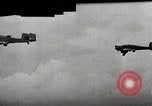
Aerial bombing of Shanghai City by Japanese during Second Sino-Japanese war
Japanese air attack against city of Shanghai, at start of 2nd Sino-Japanese war. Formation of Japanese 93-Shiki Soukei bombers in flight (Mitsubishi Type 93 Twin engine Light Bombers). Bombs falling from aircraft with city seen below. Bomb striking ground with large explosion. Civilians running for cover. Buildings on fire. Bombs striking ships in the Shanghai port. Buildings aflame. Japanese Aichi D3A1 aircraft diving. (anachronistic insert) Panic in the streets as people use any means of escape, carrying belongings in wagons and rushing into the International Settlement, by hundreds, or thousands, moving past British and French soldiers. French soldiers pass an infant to safety, across a barbed wire barrier. Shanghai International Settlement gates are closed as thousands remain outside, pressed against the barriers. Views of Chinese people crammed into the streets. Then they stampede into the center of the city, where some are trapped under falling buildings. More scenes of bomb explosions and burning buildings. A formation of Japanese Mitsubishi G3M bombers in flight overhead. More bombs exploding in the city. Fires burning and heavy smoke rising over the city. Dead and injured Chinese civilians. Firefighters spraying water on burning building. People trying to aid one another amongst dead and dying everywhere. Wounded being carried on stretchers and dead being piled into an open truck. Animated map showing Japanese occupying the entire peninsula east of Shanghai and then executing a coordinated drive through Soochow (Suzhou) and Kahsingfu, toward Nanking (Nanjing).
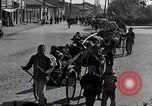
Chinese people migrate towards west in advance of Japanese forces during the 2nd Sino-Japanese war
Millions of Chinese people migrating west and invoking a "scorched earth" policy to slow advance of Japanese forces invading from Shanghai and Nanking, during the second Sino-Japanese war. Long line of Chinese refugees making the trek on foot and transporting their belongings on hand-pulled carts. Chinese entering a library, a school, and a hospital to salvage contents and take them west. Chinese people pulling amazing large loads on carts. Narrator says they salvaged hundreds of millions of pounds of machinery from factories. Trucks and oxen being employed to move goods and equipment on a two thousand mile journey westward. A huge crowd of refugees gathered along a railroad, all rise up from the ground as a steam locomotive appears in the distance. Closeup of Chinese people climbing into rail cars. A glimpse of some intrepid travelers climbing atop the cars. Next, the crowd works to dismantle the railroad, placing rails and ties aboard the train for future use and to deprive the Japanese of them. View of the train, moving slowly, with people occupying every imaginable place. Many crowd the front of the locomotive, itself. Scenes of other trains show many persons riding on tarpaulins that have been tied across the tops of rail cars. Some simply sit on the car roofs. Others are Jam-packed together on open air flat cars. Sampans and barges loaded with refugees and supplies are seen moving westward on China's rivers. Closeups of vessels filled with people. Passengers rowing and working to move the boats. Lines of Chinese crewmen pulling their boats upstream through narrow river gorges. Closeups of gangs of men pulling on tow ropes, as men on the boats assist using long poles to push the boats forward. People walking with backpacks. Narrator speaks of 30 million people moving westward. More scenes of the masses of humanity on the trek.
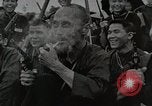
Chinese employ guerrilla warfare against Japanese occupying forces in the Second Sino-Japanese War (WW2)
Opening scene shows closeups of many smiling Chinese Guerrilla fighters during the Second Sin-Japanese War (World War II). Animated map shows Japanese occupied areas as clinging to lines of communication (roads, railroads, and waterways), Japanese troops, carrying Rising Sun flag, march into a Chinese town. A Japanese armored boat, flying the naval ensign, cruises along a narrow stretch of river, with a large Chinese fortress in the background. Its officers watch carefully through binoculars. A Japanese armored train is seen patrolling a stretch of railroad. A long line of Chinese guerrilla fighters marching along a dusty road carrying a variety of weapons. Some, both men and women, are seen. One carries a homemade flag. The camera pans across them, all carrying shouldered arms. Chinese farmers threshing grain by shoveling it into the air, as they might have done before becoming guerrilla fighters. One guerrilla carrying two grenades around his neck. Many marching with shouldered arms and conical straw hats on their backs. Views of their feet clad in sandals. More scenes of Chinese guerrilla fighters marching. Animated map shows guerrilla attacks against Japanese-held lines of communication. A Chinese guerrilla fighter running through a field, banging a tin to sound a call to arms. Others picking up weapons and responding. Next, a group of them are seen diving into a river and moving along low to the water. Others are seen running across a ridge of rock. Still others come over a hill ostensibly attacking a Japanese patrol. Two large explosions and black smoke are seen behind running guerrilla fighters. Another scene also shows Chinese guerrillas running from an explosion. Heavy smoke and Wreckage of building and equipment at a railroad site. Japanese troops struggling to transit marshes and mud, with horses pulling artillery pieces, and many men pulling a rope to retrieve a sunken field piece from a stream. One Japanese officer wipes his face with a handkerchief, as he confers with others about the situation.
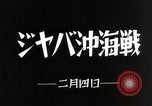
Japanese planes attack Dutch ships in Java Sea
Japanese planes in air. Japanese pilots get ready to bomb Dutch ships. Japanese planes attack Dutch ships in Java sea.1942. (World War II period).
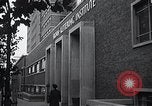
Women prove themselves as workers in the United States
Importance of American women as workers and women in the work force as well as homemaker and housewife. American woman working as scientist in a laboratory at the Sloan-Kettering Institute. Male scientist injects serum into white mice. Female scientist runs tests. Woman nurse in operation theater. Woman hairdresser works in a salon. Woman farmer driving a tractor on a farm. Woman wearing a protective shield mask operates machinery in a factory. Woman administrative worker files papers in an office filing cabinet. Air hostesses or flight attendant stewardess group lined up for inspection in front of a parked aircraft. Woman homemaker holds a needle and appears to be threading it. A mother bandages the skinned knee of a young boy seated on the side of a bath tub. Woman sewing. A woman sitting in a rocking chair with a cat on her lap, listening to a radio or phonograph. Young American woman with an American man standing on a wooden bridge over a stream.
CRITICALPAST.COM: About Us | Contact Us | FAQs - How to Order | License Agreement | My Account | My Lightboxes | Shopping Cart | Advanced Search | Featured Collections | Website Terms & Conditions | Privacy Policy ©2026 CriticalPast LLC.
License Agreement |
Terms & Conditions |
Privacy Policy
©2026 CriticalPast LLC.