


 Francais
 Deutsch
 Italiano
Refine Your Search
Vietnam Bien Hoa Air Base 1968 stock footage and images
- Showing 11713 to 11718 of 13286 results more
more Hide
Hide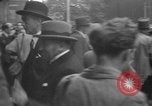
Spectators stand outside 10 Downing street in London, England where the Prime Minister is meeting with his War Cabinet.
Two British officials leave 10 Downing Street following a meeting of Prime Minister Chamberlain's War Cabinet. The Silhouette of them is seen as they pass through an archway. Next, Sir Howard Kingsley Wood, Secretary of State for Air, steps from Number 10, and walks close past the camera. Another official leaves the residence. He turns right and walks toward Horse Guards Road. Police make sure spectators stay on the sidewalk as he passes. Glimpse of a military officer leaving quickly, followed by a young official. The crowd standing dutifully, on the sidewalk (but just barely, all with their feet at the very edge). A man enters number 10 just as a uniformed messenger arrives. The man enters and the messenger makes his delivery and leaves. Lord Halifax, Secretary of State for Foreign Affairs, is seen leaving next, together with Leslie Hore-Belisha, British Secretary of State for War. The camera follows them as they walk along Downing Street and across Whitehall-Parliament Street. They pass pedestrians who stop to watch them. View of St. Stephens entrance Houses of Parliament A group of officials in bowler hats crossing towards Parliament. A few cars, and pedestrians moving about.
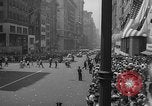
Jeeps, tanks, half tracks, other mechanized equipment, and many U.S. military units march in War Parade on 5th Ave in New York (WW2)
War Parade on Fifth Avenue, in New York City, United States during World War II . An open car driven by an Army soldier, escorted by motorcycle police, and carrying Army and Navy officers. United States flags raised on the buildings. A huge crowd gathered on the sidewalks. Mechanized equipment on parade. Band in the parade. Jeeps, tanks, and half-tracks loaded with soldiers. A Curtis Aircraft float with a real P-40 airplane on it. A display of a Wright Cyclone 9 aircraft engine rated at 1200 horsepower, the type used on Flying Fortresses, with sign reading: "US Army Air Forces at War:" Infantry units march with massed colors in the parade. Military units participate with countless Soldiers, Sailors, Marines, and Airmen marching.
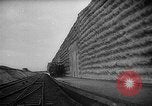
German General Field Marshal Erwin Rommel inspects German fortifications (Atlantic Wall) near Boulogne-sur-mer, France,
Generalfieldmarschall Erwin Rommel, with entourage of senior German military officers, inspects German defenses on the coast of France (so-called "Atlantic Wall"). They tour heavy gun emplacements and shore obstacles. During the tour, they view a large bunker, camouflaged to look like a barn, from the air. Sliding doors are opened revealing a railroad gun. This is a 28cm K5 railway gun of battery E712, at Pointe aux Oies, nearBoulogne-sur-mer, France. Gun crew moves it out, partway on the rails, and raises the barrel to a high elevation. Views of rotating gun turrets; more railway guns, and a 60cm railway mortar called "Thor."
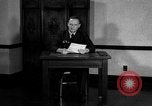
Charles A. Lindbergh speaks against United States participation in European Wars early in World War 2.
Charles A. Lindbergh delivers an anti-war speech early during the outbreak of World War II in Europe. Lindbergh speaks in a studio of the Mutual Broadcasting System. He speaks against American involvement in wars in foreign lands. He states that the Americans should not be asked to fight in foreign countries, but to focus on defense of the United States. Among other things, Lindbergh says: "The doctrine that we must enter the wars of Europe, in order to defend America, will be fatal to our Nation, if we follow it. When men are called upon to fight, and to die, for their country, there must not be even the remotest question of foreign influence involved." He states that Americans have no confidence in decisions of their leaders. He talks about the high number of aircraft and war materiel manufactured to fight in European countries. He talks about the affect on the National debt of the current spending for armaments and war production. He speaks out against the current American leadership (democratic party under Franklin Roosevelt) and how it did not do the right things to see what was coming in Europe and take steps to prevent it. He says that Americans are not confident in their leaders. Lindbergh speaks out against building of untold thousands of military aircraft, but he speaks in favor of a defense-focused American Air Corps.
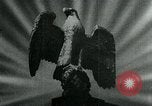
German Leader Hermann Goering officiates at a military funeral for World War II German pilot ace, Helmut Lent
Film begins showing German ace pilot Oberleutnant (Major) Helmut Lent, of a night fighter wing, with other pilots on the occasion of his 100th aerial victory, on July 31, 1944, when he was awarded the Knight's Cross of the Iron Cross with Oak Leaves, Swords and Diamonds. Next, a night fighter Messerschmitt Bf 110 twin-engine heavy fighter is seen taxiing out for takeoff at night in heavy rain. Scene shifts to a Nazi memorial service for Major Lent, who was killed in a crash on October 5, 1944. His flag-covered coffin is seen flanked by an honor guard. A display of his military awards is seen, also. View from beside the honor guard shows Field Marshal Hermann Goering raising his baton in salute as other attending the ceremony render the Nazi salute. Goering offers his condolences to parents of Major Lent. He then ascends steps toward the coffin and salutes. View from behind the honor guard as Goering delivers a eulogy. View Luftwaffe (Air Force) officers filling the seats of the hall, including famous ace, Adolf Galland. Goering steps from the podium and stands in front of the coffin, saluting with his baton, as the audience rises and all render the Nazi hand salute. With help of two soldiers, Goering places a large wreath of flowers before the coffin. Closeup of the wreath and Goering saluting with his baton. A large wreath with ribbons showing it is from the Furhrer (Hitler).
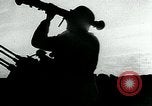
German antiaircraft defenses fire at British attacking aircraft at night, during World War II. Wreckage of numerous downed British aircraft is seen.
Opening scene shows a German soldier using a sounding range and direction finder to locate British aircraft attacking German installations in France during World War 2. The next scene is during a foggy night. German searchlights are seen trying to locate attacking British aircraft. A flare is seen falling toward the ground. German antiaircraft guns fire. Engine sounds of aircraft are heard. View of German gunners firing tracer bullets and heavier antiaircraft guns skyward. A ball of fire in the air marks a struck British airplane. Closeup of burning British aircraft wreckage. Next, a ledger of British aircraft downed by a German antiaircraft battery is seen. It shows a list of British aircraft shot down in July and August, including: Bristol Blenheim light bomber; Short Stirling bomber, numerous Spitfires; and other aircraft. Workers are seen walking through a yard filled with the wreckage of British aircraft in a junk yard, where a powered crane is seen raising wings, and engines of the aircraft and loading them onto rail cars. The Narrator states that by November, the German defenses had downed 923 British aircraft. View of a loaded open rail car and a locomotive pulling loaded rail cars.
CRITICALPAST.COM: About Us | Contact Us | FAQs - How to Order | License Agreement | My Account | My Lightboxes | Shopping Cart | Advanced Search | Featured Collections | Website Terms & Conditions | Privacy Policy ©2026 CriticalPast LLC.
License Agreement |
Terms & Conditions |
Privacy Policy
©2026 CriticalPast LLC.