


 Francais
 Deutsch
 Italiano
Refine Your Search
Vietnam Bien Hoa Air Base 1968 stock footage and images
- Showing 12667 to 12672 of 13286 results more
more Hide
Hide
B-25 bomb at Brest, Canadian troops advance, civilians buy goods and U.S. soldiers secure voting cards in France (WW2)
Normal life of civilians resume after German surrender in some parts of France during World War II. Aerial view of flak in sky. Close-up view of two U.S. Army Air Force B-25 Mitchell bomber aircraft in flight. (Narrator incorrectly states they are British Lancaster bomber aircraft.) View from bomb bay doors of bombs away shot as the B-25 bomber aircraft drop bombs on U-boat pens at Brest. Explosions and smoke rise. The aircraft drop bombs over ground installation over enemy area. Canadian soldier scenes: Troops advance through a burning coastal town in France. Buildings collapsing and gunfire in streets. Smoke rising. Ruins of destroyed French town are seen. Allied Army tanks advance and fire artillery. German prisoners of war from Wehrmacht 7th and 15th armies being marched under watch by Canadian forces. Among the German prisoners is a 13 year old Russian boy who was forced to work by the Nazis. German prisoners in a soup line and seen drinking from mugs. Some appear to be very young boy soldiers. U.S. Army soldiers in Le Mans: American soldiers are welcomed by civilians of France. Happy French civilians waving to U.S. forces including a happy young woman who runs forward and pats a U.S. Army tank with her hand. Men and women collaborationists who assisted the Germans are rounded up by French and marched away. U.S. Army soldiers seated at stools in a French bar drink as the bar maid pours more into their glasses. French civilians line up at shops and groceries to buy food and goods in Le Mans. Pictures of General De Gaulle for sale. American women in U.S. Army uniforms (possibly nurses or Womens Army Corps WAC members) look in shop windows at French fashions. Voting cards: U.S. Army troops read pamphlets that read "requirement of soldiers to vote" and "Soldiers Voting". The U.S. Army GI's receive and mail postcards to their homes requesting absentee voting ballots for the upcoming November 1944 election. The soldiers line up to secure their application cards for absentee ballots.
Aviation cadets take part in mass calisthenics and Sergeant Beranek demonstrates sit-ups in Yale Bowl, New Haven, Connecticut.
Aviation cadets do sit-ups at AAF Training Command School in Yale Bowl, New Haven, Connecticut. Army Air Force cadets at AAF Training Command School at Yale, take part in mass calisthenics in Yale Bowl. Sergeant Beranek demonstrates sit-ups. He demonstrates his techniques in setting his world record of 6034 sit-ups in 6 hours. Cadets do sit-ups.
Annie Oakley demonstrates her skills shooting with lever action rifle
Sharpshooter Annie Oakley, performer with Buffalo Bill's Wild West Show, displays her skills with a Marlin lever action rifle, by rapid fire shooting of glass balls on a board and coins tossed into the air. She is assisted in her demonstration by husband, Frank Butler. Filmed at the Edison Studio in West Orange, New Jersey, United States
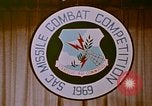
SAC personnel participate in the '1969 SAC Missile Combat Competition' and the winner receives award in the U.S.
'1969 SAC Missile Combat Competition' of USAF Strategic Air Command units in the United States. Seal of '1969 SAC Missile Combat Competition'. An SAC officer speaks on the dais. SAC units disembark an aircraft. A sign reads : 'Welcome, 1969 SAC Missile Combat Competition'. The SAC units enters a building. The personnel receive well wishes. The SAC personnel work on various equipment during the competition. An announcer makes an announcement during the award ceremony. General Bruce K. Holloway, Commander-in-Chief of the SAC speaks. General Holloway congratulates each SAC personnel. The SAC personnel applaud. The award is given for the best maintenance wing and the best minute man wing
Effects of the atomic bombing of Hiroshima, Japan, in World War II, and early international efforts to control atomic weapons
Film showing city of Hiroshima, Japan, before and after the August 6, 1945 dropping of the atomic bomb over the city in World War 2. Sequence opens on what the narrator says is August 5, 1945, the day before the event (but the footage is likely from before that date). Camera pans over the city of Hiroshima before the atomic bomb destroyed the city. Japanese air raid lookouts are seen on watch for allied bombers. View of atomic bomb detonation as seen from aircraft high overhead (this is actually a view of the Nagasaki blast, not the Hiroshima blast despite narrator's comments). Next, the complete destruction of the city of Hiroshima is seen from camera at low altitude showing the four and one half square miles of the city flattened and burned. A Japanese hospital still functioning, with red cross flag on it. Hospital workers retrieving wounded victims of the bombing. Ambulatory victims clustered in doorways and halls. Shadow image of a large industrial valve wheel burned onto wall behind it. Similar image of a ladder burned onto a wall. The decorative pattern on a woman's dress burned onto skin of her back. Japanese physicians treating victims of thermal and radiation burns. Views of various victims, including some children, and their respective injuries. Scene shifts forward one year, to August 6, 1946. Children are lined up outside a school building, and then seen inside their classroom. Disfiguration and wounds on children resulting from injuries are still evident on the children at their desks. Sequence shifts again, this time to an early United Nations meeting with delegates grappling with the issue of controlling nuclear power and atomic weapons. Closeup view of American delegates, including James F. Byrnes (Secretary of State)and James B. Conant, President of Harvard University in the assembly. Closeups of representatives from South Asian nations. Closeup of USSR delegation, headed by Foreign Minister, Vyacheslav Molotov. Signs identifying delegates from Colombia, Egypt, Iraq, Bolivia, China. Final sequence shows several U.S. atomic scientists in their respective laboratories, including Enrico Fermi and Vannevar Bush. United States representative to the UN, Warren Austin, speaking about the so-called Baruch Plan, for international control of atomic weapons. (Principal author, Bernard Baruch, is standing behind speaker's left shoulder.) USSR delegation, headed by permanent representative, Andrei Gromyko, who is seen presenting the Soviet plan. View of explosion and mushroom cloud during U.S. Operation Crossroads atomic bomb test in the Pacific.
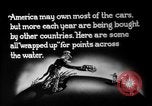
American made automobiles are exported to foreign countries. A Studebaker sedan travels over dirt roads on Catalina Island off California.
Workers in a Studebaker automobile factory move a fully wooden crated new automobile on an overhead hoist. It is labeled "Studebaker Automobiles" on it's side. Views of crated cars bound for different destinations overseas. Seen are those headed to: Buenos Aires, Capetown, Melbourne, and Cairo. Next, a Studebaker sedan car is seen raising lots of dust as it races at high speed over a dirt road on Catalina Island, off the coast of California. The driver is trying to climb a 1500 foot hill over a distance of 3 miles, as fast as he can. His car is seen negotiating hairpin turns during the ascent and finally arriving at the summit.
CRITICALPAST.COM: About Us | Contact Us | FAQs - How to Order | License Agreement | My Account | My Lightboxes | Shopping Cart | Advanced Search | Featured Collections | Website Terms & Conditions | Privacy Policy ©2026 CriticalPast LLC.
License Agreement |
Terms & Conditions |
Privacy Policy
©2026 CriticalPast LLC.