


 Francais
 Deutsch
 Italiano
Refine Your Search
Vietnam Bien Hoa Air Base 1968 stock footage and images
- Showing 3577 to 3582 of 13285 results more
more Hide
Hide
Latin American students on board the United States aircraft carrier Franklin D Roosevelt underway at sea in Panama.
The United States aircraft carrier Franklin D Roosevelt (CV-42) on its way to Balboa Panama. Latin American students of Albrook Air Force Base on board the aircraft carrier. They pose in front of jet planes parked on the carrier as others take pictures of them. A girls poses for a picture with an aircraft. Soldiers move up a ramp. Metal engravings having some names. Flight deck of the carrier. Colonel Taute and other officers get into H-19 helicopter and leave for a mission to Peru.
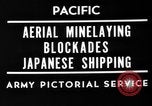
Allied aircraft lay mines in Pacific Theater during World War II.
'Aerial mine laying blockades Japanese shipping' depicts Allied preparations and Operations of the 21st Bomber Command, for aerial dropping of mines in the Pacific ocean to thwart Japanese shipping in World War 2. . Rows of stacked bombs are shown in a munitions dump at Tinian Air Base in the Mariana Islands. Camera focuses on a 2000 pound MK25 mine. Men demonstrate hydrostatic safety devices on the mine, including an extender that holds the detonator away from the booster charge until sufficiently immersed, and a clock delay mechanism. MK 25 transported to B-29 aircraft named Flak Alley Sally. (This is B-29 Number 42-24878 of the 40th Bomb Squadron, 6th Bomb Group, 313th Bomb Wing.) Airmen attach a parachute to the end of the mine. Another inserts the detonator and its extender plus the timer device into the side of the mine. Soluble washers are then placed in arming device ports. Scene shifts to Army and Navy planners working with maps, dividers, and a Weems plotter to mark the target location and mine laying pattern. 313th Bombardment Wing Group Commanders are seen being briefed in a war room. Next, engines are seen starting on a B-29, that then takes off and is seen in flight.(Narrator notes that missions are flown at night, but this one is photographed in the day to show how it is done. View of B-29 cruising above clouds. View from inside the aircraft, of bomb bay slowly opening. View of the target area below. The parachute of a mine opens by a static line as it falls from the bomb bay. Scene shifts to water level closeup of a mine striking the water. ('Presumably a demonstration inserted here.) Final scene shows a Navy Grumman TBF/TBM Avenger torpedo bomber dropping a parachute equipped mine. in the same location.
German reconnaissance plane takes off on Eastern front during World War II. German forces mount offensive with heavy weapons.
German offensive on the Eastern Front of World War II. Nazi officers look at a map and discuss plans for attack on Soviet positions. A German reconnaissance plane takes off from an air base. German Stug III Assault Gun being re-armed. Nazi soldiers loaded on Panther tanks advance, with a Sdkfz.251halftrack in Kursk markings, to the battle field. SS commander in Sdkfz.222 armored car. Pz.IV tank of 2.Pz.Div. ("Das Reich") with skirts operating in village. Heavy firing takes place. StuH42 105mm artillery mounted on tank fired. Explosions occur and smoke rises.

Aerial views of buildings, landmarks, and monuments along the Potomac River from Rosslyn to National Airport
Aerial views of Washington DC in United States. Flying down the Potomac River. Development on either side of the river including Georgetown University and Rosslyn. Views of the Key Bridge over the Potomac River and the old pilings from the removed Aqueduct Bridge, and the Memorial Bridge leading to the Lincoln Memorial. The Munitions Building and Main Navy Building visible on the National Mall beyond the Lincoln Memorial. Roosevelt Island visible. The 14th Street Bridge and the railroad bridges adjacent. View of the Jefferson Memorial. The U.S. Capitol can be seen in the far background. View of the National Airport and the Bolling Air Force Base. Taxied plane on the airstrips and views of the hangars and terminal at Washington National Airport.
Londoners celebrate VE Day, the end of World war II, in Europe
With the surrender of Germany, World War 2 in Europe ends, on VE (Victory in Europe) Day, May 8, 1945. Scene opens with church bells ringing and view of west front of St. Paul's Cathedral, on Ludgate Hill, in London, England. Crowd is celebrating in the square. around the statue of Queen Anne. Amongst the crowd are men and women in uniform. Here and there Union Jack flags are seen, one held by a little girl hoisted upon a man's shoulder. Camera pans across various parts of the celebrating crowds. View from above, of several couples dancing within a circle of people. Several uniformed U.S. Air Force officers in a jeep celebrate with the crowd. High altitude view of Trafalgar Square in London, England. 'Victory over Germany 1945' banner draped on base of Nelson's Column. Crowd of British citizens celebrating on streets of Whitehall and closeup of the Cenotaph with inscription "The Glorious Dead".
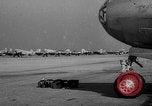
USAF General Henry Arnold meets crew of a U.S. B-29 at Bolling Field, Washington, DC (WW2)
USAF General Henry Arnold meets crew of U.S. Army Air Forces B-29 Super Fortress at Bolling Field, Washington, DC during World War II. C-47s lined up on the flight line. General Arnold, Lieutenant General Barney Giles and Brigadier General Lauris Norstad walk on the field. Crew members lined up in front of B-29. General Arnold in the foreground. General Norstad introduces the Aircraft Commander, Lt. DO Horsfall of Kalamazoo, Michigan, who salutes and shake hands with General Arnold. Lt. Horsfall introduces members of his crew who step forward, salute and shake General Arnold's hand. General Arnold tells the crew that U.S. bombers from China bases had been unable to reach the Japanese heartland. But B-29s from the Marianas would now be able to strike places like Hokkaido and Kyushu. He dictates a message for Horsfall and crew to write on a bomb. Crew members gather around bombs as the pilot writes the message, reading: 'To the war lords of Japan we have not forgotten. The B-29s will remind you again, again and again!'
CRITICALPAST.COM: About Us | Contact Us | FAQs - How to Order | License Agreement | My Account | My Lightboxes | Shopping Cart | Advanced Search | Featured Collections | Website Terms & Conditions | Privacy Policy ©2026 CriticalPast LLC.
License Agreement |
Terms & Conditions |
Privacy Policy
©2026 CriticalPast LLC.