


 Francais
 Deutsch
 Italiano
Refine Your Search
Walcheren Island Netherlands 1944 stock footage and images
- Showing 1183 to 1188 of 9701 results more
more Hide
Hide
Scenes from 1929 Geneva Convention; surrender of 20,000 Germans to U.S. General Macon by German Major General Elster near Loire
A U.S. Army Signal Corps training film on Rules for controlling German prisoners of war in World War 2. International conference 1929 in Geneva, Switzerland. Various officers and dignitaries in the conference where the Geneva Convention was agreed-upon by many nations. Image of Field Manual 27-10 states the Rules of Land Warfare based on the Geneva Conventions and describes standard procedures for handling Prisoners of War. Scene of 20,000 Prisoners of War who surrender under Nazi Major General Eric Elster at Loire, France September 16, 1944 to the United States 3rd Army, 83rd Division, under General Macon. General Elster salutes General Macon, then approaches the microphones in the middle of a roadway and delivers a surrender speech. General Macon then replies accepting the surrender on behalf of General Simpson. General Macon states that the men will be treated according to the rules made during the conference in Geneva.
U.S. Signal Corps employ the Eureka/Rebecca transponder system during the American airborne landings in Normandy, France.
The role and contribution of the U.S. Army Signal Corps in combat and war. Parachute drop-markers with radio signals guide an airborne operation in the European Theater. U.S. airborne troops board a U.S. Army Air Forces Douglas C-47 Skytrain or Dakota transport aircraft. A woman soldier greets the paratroopers as they prepare to board the aircraft. The paratroopers jump out and descend towards the ground. The paratroopers are furnished with markers for every dropping point. A paratrooper with a radio beacon hooked onto his belt. The beacon is the ground section of the Eureka/Rebecca transponder system. The paratrooper fixes the Eureka extension including the cable and the receiver transmitter. Animation depicts the working of the Eureka-Rebeca system. An aircraft unloads paratroopers over Normandy in France during World War II. Allied troops, landing crafts, landing ships arrive at Normandy on D-Day (6 June 1944). Soldiers wade through the water towards the shore and advance inland across the beach during Allied invasion of France.
Army Signal Corps receive and send messages via various methods in World War II; Pentagon signal center operations.
The role and contribution of the U.S. Army Signal Corps in combat during World War 2. Submarine cables laid down by the Signal Corps. Soldiers operate field army communication equipment for communication within and between units. Soldiers talk over the radio in a military jeep. American soldiers employ communication equipment seated at a table in a camp. A U.S. Army Signal Officer goes through documents. An officer receives a message in Washington DC. The message is relayed from the State Department to the Signal Center in the Pentagon building. Exterior views of the Pentagon building circa 1943 or 1944. Inside the Army Communications Signal Center in the Pentagon, technicians work using various communication equipment. They receive messages punched on tape as the tapes emerge from machines. Workers encoding and decoding secret and confidential messages that run the war. Workers at the 'Traffic Control, Army Command and Administrative System'. Paper messages seen gliding across a track near the ceiling above a signboard. A man inserts and removes cables from switchboard slots. The plans are then passed on in code through a maze of antennas all over the world. An animated map depicts the sending of these messages by radio multi-channels, radio teletypes, and manual radios to the front lines. A vast network of Army communication system from Washington DC to the rest of the world to carry a message around the world in three and a half minutes.
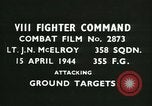
U.S. AAF VIII Fighter Command Lt. Gen. JN Mcelroy strafes an airdrome and a train in Germany during World War II.
U.S. Army Air Forces Eighth Air Force, VIII Fighter Command operations in Germany during World War II. 15 April 1944: Lieutenant General JN Mcelroy of the 355th Fighter Group 358th Squadron attacks ground targets. He strafes an airdrome and a train. Smoke due to the bombardment and firing. An aircraft on the ground. Black smoke rises up into the air.
U.S. AAF VIII Fighter Command 1st Lieutenant DW Howe strafes German aircraft at an airdrome in Germany during World War II.
U.S. Army Air Forces Eighth Air Force, VIII Fighter Command operations in Germany during World War II. 18 April 1944: 1st Lieutenant DW Howe of the 4th Fighter Group 334th Squadron attacks ground targets. The aircraft in flight over hills and fields. He strafes an airdrome. Black smoke from various targets. German aircraft parked at the airdrome. He attacks a German cargo bomber and fighter aircraft. Smoke all around due to the strafing.
U.S. AAF VIII Fighter Command 2nd Lieutenant JF Scott strafes a locomotive and an airdrome in Germany during World War II.
U.S. Army Air Forces Eighth Air Force, VIII Fighter Command operations in Germany during World War II. 18 April 1944: 2nd Lieutenant JF Scott of the 4th Fighter Group 334th Squadron attacks ground targets. The aircraft in flight over fields. 2nd Lt. Scott strafes a German locomotive. Smoke rises due to the strafing. He attacks German aircraft at an airdrome.
CRITICALPAST.COM: About Us | Contact Us | FAQs - How to Order | License Agreement | My Account | My Lightboxes | Shopping Cart | Advanced Search | Featured Collections | Website Terms & Conditions | Privacy Policy ©2026 CriticalPast LLC.
License Agreement |
Terms & Conditions |
Privacy Policy
©2026 CriticalPast LLC.