


 Francais
 Deutsch
 Italiano
Refine Your Search
Walcheren Island Netherlands 1944 stock footage and images
- Showing 1237 to 1242 of 9701 results more
more Hide
Hide
Allied forces preparing in England for the Invasion of Normandy.
A dramatized film entitled "Beachhead to Berlin" describes preparations for the Allied invasion of France and the drive toward Berlin. Film combines actors and actual footage. Harbor in Greenway England in July, 1944. U.S. Coast Guard Barracks. Coast Guard men playing cards. One on a bunk contemplating. Chaplain's office: Chaplain typing and smoking a pipe. Audio narration of his letter being read, describing how things transpired at the Normandy beaches during the Invasion of France. Then actual footage of wounded being transported on ships after D-Day Normandy invasion. In England, footage of LCIs, LCVPs, Coast Guard cutters, including the Flying Angel Rescue Cutter. All of these ships participating in "dry run" practices for the actual Normandy landing. Coast Guard crews on decks of ships. Infantry loading landing crafts in England for dry runs. Landing craft arriving on English beaches during dry runs. A jeep drives off a landing craft and gets stuck on metal mesh on the beach. A tank is driven off a landing craft. Men maintaining ships. Scraping rust from the deck, painting identifications on ships, repairing rope ladders, and welding. (World War II period).
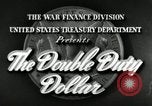
World War 2 film promoting public investment in War Bonds and stamps to aid the war effort and temper inflation
World War 2 era film that also includes some World War 1 scenes. Show girls or chorus girls in follies-like show, costumed as U.S. silver dollars and marching to tune and lyrics alluding to dramatic increase of currency in circulation, over the years. Animation with stacks of coins shows increase in national income from $46 billion,in 1933, to $71 billion, in 1939, and $142 billion in 1943. Back to the "follies dollars," a boy asks why, and then scenes of the Japanese attack on Pearl Harbor,are shown, with U.S. battleships being sunk. Wartime arms plants are shown. An M2A3 Light Tank rolls off a production line. Ships being constructed in a shipyard. B-24 Liberator bombers being built in a factory. Artillery shells being produced. Defense workers receiving their pay. The "follies dollars" group themselves to illustrate the fractions of income devoted to taxes and savings. But other spending is curtailed by wartime shortages. A woman talking with clerk in a drug store. U.S. Army troops crossing a pontoon bridge in open trucks, towing 75mm M1A1 howitzers. Infantry on the march. Animation showing industrial production devoted to war materiel and lots of dollars chasing few civilian goods. A grocery clerk offers to sell a woman customer butter for more than the established price, and she agrees. The "follies" performers then introduce the idea of an "inflationary dollar," and some history of past U.S. inflations. Animated examples of price inflation are shown. Glimpses of World War I scenes are seen, circa 1917 -1918, including: a 12-inch railway gun firing; a huge explosion from shell bursting near the camera; various scenes of United States infantry soldiers and French soldiers in battle action, running to bomb craters for cover and emerging from trenches to go up "over the top" into no-mans land during combat. Meanwhile, singing narration refers to the home front inflation due to competition for limited civilian goods. Map shows Europe and singing narration cites rising prices for food in occupied France and other countries suffering ravages of World War II. Montage of scenes showing needy civilians obtaining food in those countries. Animation shows increases, by 1944, in cost of U.S. civilian goods since the Pearl Harbor attack. "Follies" character called "Double-duty dollar," appears explaining he serves the war and curtails inflation on the home front by being saved through investments in War Bonds and stamps.
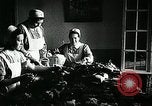
German Red Cross women pack Christmas gifts and German soldiers receive gifts and mail in the front lines.
German women Red Cross workers in Germany. They pack Christmas gifts for the German soldiers for Christmas 1944. The gifts on a table. Scene on front lines as German soldiers receive mail from home. A German soldier reads a letter and looks at a photograph. Separately, clips ends with views of the Allied invasion forces landing in France and German efforts at repulsing them. (World War II period).
Meeting of European Advisory Commission in Lancaster House London.
European Advisory Commission meeting to sign the protocol between the Allies on the occupation zones in Germany at Lancaster House London. Chairman Feodor Tarasovich Gousev of Russia, Ambassador extraordinary and plenipotentiary to the government of Great Britain; John Gilbart Winant, American ambassador to Great Britain and Sir William Strang, UK representative on European Advisory Commission enter and have a discussion. View of Advisory Commission with Mons. Gousev at head of table and other military advisors with Sir Strang at top left. Diplomats can be seen talking to each other. 12 September 1944. (World War II period).
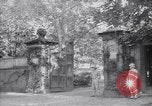
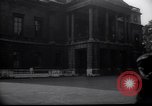
Front of Dumbarton Oaks in Georgetown U.S.
Front gate of Dumbarton Oaks with a car driving inside. A plaque outside inscribed with "Dumbarton Oaks" is there. Front of the building where men with military police walking inside. Exterior of Executive Office Building of State Department. September 1944.
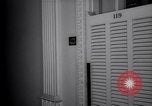
Interior of "department of state press room" in U.S.
Interior of state department building in U.S. A sign - department of state press room outside a room. Reporters sitting inside the room, two of them playing chess, two are typing. Reporters receive a report. September 1944.
CRITICALPAST.COM: About Us | Contact Us | FAQs - How to Order | License Agreement | My Account | My Lightboxes | Shopping Cart | Advanced Search | Featured Collections | Website Terms & Conditions | Privacy Policy ©2026 CriticalPast LLC.
License Agreement |
Terms & Conditions |
Privacy Policy
©2026 CriticalPast LLC.