


 Francais
 Deutsch
 Italiano

Refine Your Search
Walcheren Island Netherlands 1944 stock footage and images
- Showing 163 to 168 of 9743 results more
 Hide
Color Sound
Events of World War 2, and creation of United Nations Organization following the surrender of Germany and Japan
Summary of World War II events and formation of the United Nations Organization. Soviet troops on Eastern Front of Europe fire artillery on German positions in 1944. Russian troops advance. German soldiers come out of buildings and surrender. Allied Forces land in France on D-Day. Allied troops and tanks fight Germans on streets in towns and villages of France. U.S. Army tanks fire at German positions. Various groups of German prisoners of war march along roads and are herded into prison camps operated by American and British forces. In 1945, the Allied leaders meet at Yalta on the Crimean Peninsula to discuss Allied military strategy in the final months of WWII. Leaders included British PM Winston Churchill, U.S. President Franklin D Roosevelt and Soviet Premier Joseph Stalin. The meeting of U.S. and Soviet Russian troops at the Elbe River. German Nazi Swastika symbol blown up in explosion atop Zeppelinfeld Nazi party rally grounds in Nuremberg. Aerial view of Berlin in ruins, as seen from low-flying aircraft flying directly over the Unter den Linden boulevard and the Brandenburg Gate. Wrecked and bombed German buildings seen everywhere. German officials signing surrender instrument at Rheims. U.S. President Harry S Truman, Winston Churchill and Joseph Stalin at Potsdam Conference. U.S. Marines battling on beaches of Pacific Islands. Iconic shot of U.S. Marines raising the American flag on Mount Suribachi at Iwo Jima. Aerial view of bombed and ruined city of Tokyo, Japan. The Japanese surrender to MacArthur aboard the battleship USS Missouri. General MacArthur speaks aboard Missouri. Victory celebrations all across the world, with some scenes from earlier V-E Day (Victory in Europe) day in May 1945, including crowds celebrating in Paris, France, and some scenes on V-J Day (Victory over Japan day) in August 1945. Crowds on streets celebrate. Happy crowds jam streets. Delegates of Nations, among them Andrei Gromyko and Vyascheslav Molotov meet in San Francisco and create a United Nations organization. Truman arrives at signing of UN charter. Various delegates sign charter. U.S. troops disembark troop carrier ships at U.S. ports and are discharged after completing military service in World War 2. Group of U.S. Army soldiers exits a church (the Chapel at Fort Dix, New Jersey), waving their discharge papers in hand.
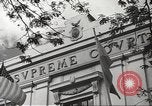
Courts and legislature in the Philippines shortly before World War 2, also President Quezon and Moro people
Scenes in the Philippines before World War II, from a 1944 film. Exterior of the Supreme Court of the Philippines. Judges and officials of the court seated in the court and trials being conducted. Exterior of House of Congress. Interior view with legislature in session. Filipino President Manuel Luis Quezon seen speaking to legislators and seated at a desk in discussion by telephone and with officials. View of his Vice Presiden, Sergio Osmeña, seated in an office. Filpino children pray in front of an altar with the figure of Jesus at a church. Women cross themselves in church. View of beaches on islands. Moro men on Mindanao. Moro man using a bolo (steel blade with handle akin to machete) to cut open a coconut and to cut down crops in field. Moro men gathered near docks at a beach area. Earlier views of U.S. Army General John J. Pershing between time of Spanish American War and World War I. Street views in city and town areas of Zamboanga, Mindanao, with businesses, rickshaws, commercial traffic. A monkey with a very short stub of a tail that is local to Mindanao (stump-tailed macaque). Moro women and men dancers perform a traditional dance and play music. A moro woman spinning a large clay vessel to husk rice. Moro woman walking with goods piled and balanced on her head. Moro men moving a small house using large poles. Moro man getting a haircut. Moro woman washing clothes. Moro fishing vessels with small sails heading out to sea.
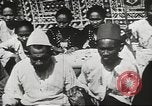
Culture and traditions of the tribal people in the Philippines before World War 2.
Activities of indigenous Filipinos in the Philippines shortly before World War II, from a 1944 film showing earlier scenes. Moro musicians sit beside gongs. Animated map of the Philippines showing the main islands of the archipelago such as Mindanao, Cebu, Mindoro, and Luzon. An American man compares his height to a Negrito man. Negrito men pose wearing loin cloths and running from a field. Negrito boy hugs a U.S. soldier. Igorot people gather near a house in the Cordillera region. Terraced rice fields and irrigation ditches made by the Igorots for thousands of years. View of the Banaue Rice Terraces. Mountains in the foreground. Young Igorot men and women in lowland attire such as Barong Tagalog and Terno perform a rice dance.
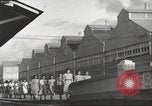
Filipino people going about their routine activities in the Philippines; Filipinos trained by American soldiers.
Part of a 1944 film showing scenes of Filipino people circa 1940, before World War 2. At opening, Filipino women are seen walking alongside a row of factory buildings. A factory room filled with Filipino women dressed in white caps and white uniforms engaged in production at individual individual work stations in a factory. A machine shop filled with Filipino men engaged in metal work. Several people at the window of an office, conducting business with a woman inside. A stock or commodities market office with quotes on tote boards. Women working alongside a moving production line. A woman operating a fabric processing machine. Filipino miners pushing hopper cars of mined ore across a bridge. Miners riding on an engine pulling a train of hopper cars filled with ore from a mine. Filipino longshoremen handling cargoes on a wharf. Scene shifts to an open field where a number of Filipino men are being trained to use firearms during World War 2. One is being coached by an American soldier as he works with a Browning M 1917 water cooled machine gun. Lines of Filipino men firing rifles under supervision of U.S Army trainers. A contingent of uniformed Filipino soldiers, led by an American soldier, marches past a sign, in an camp of tents, reading "A-T Company, 1st Filipino Infantry." Filipino soldiers at a tent camp, being instructed by an American soldier, using a large set of maps. Camera pans over a camp of many tents laid out in order. A formation of Filipino soldiers marches between tents. An American soldier opening his foot locker at his quarters. An illustrated portrait of General Douglas MacArthur. A formation in a field with a Filipino band playing and a Color Guard carrying the American and Filipino flags. A large group of Filipino children walking along a path. A Filipino boy lying on the floor in his home, reading a large book. Filipino school girls seated at benches next to tables. Women doing laundry at an outdoor pond. Next, an actor in khaki clothing sits in a tent and speaks as if addressing American soldiers regarding the Philippines. Among other things, he says,"These people aren't natives. They aren't beggars. They have cities and farms and industries.They have schools and courts and a Constitution. They also have pride and patriotism and self-respect. They love freedom They'll die for it." He cautions American soldiers about their behavior vis-a-vis Filipinos. He states that "Filipinos are American." He alludes to messages received from American and Filipino defenders in Fort Mills, at the fall of Corregidor on May 5, 1942. View of radio towers and worker in radio studio. Morse code messages heard as an American army radio operator with a headset transcribes the messages. Scene shifts to an amphibious invasion fleet attacking a Japanese held island in the Pacific.

Scenes of German-occupied Utrecht, Netherlands, and Brussels, Belgium during World War 2
Scenes in Utrecht, Netherlands, during its occupation by German forces in World War Two. The Dom-tower ( clock tower known as: de Dom). Dutch pedestrians and vehicular traffic on the roads. Pedestrians by a canal. Dutch civilians on bicycles. A busy market street. Scenes of Brussels, Belgium in Second World War. Trams make their way up and down a street. Pedestrians and cars on roads. Belgian civilians seated at street side cafes. Civilians and German soldiers outside a monument. Pedestrians and cyclists on the streets. Soldiers and civilians at a vegetable market.

President Lopez Portillo welcomes Queen Juliana, Prince Bernhard and Princess Beatrix of Netherlands in Mexico.
Aerial view of Mexico City and a large crowd awaits the royal family of Netherlands. President Lopez Portillo welcomes Queen Juliana and Prince Bernhard of Lippe-Biesterfeld. President Portillo shake hands with Prince Bernhard. Cheering crowd and a band of musicians in the background. The royal family and other dignitaries accompany and walk towards the official cars. The procession of dignitaries in cars moves on the crowded streets. Mexican guards in motorcycles in convoy with the Dutch royal family. Confetti falling from buildings during motorcade for the Dutch royal family in Mexico City. The Mexican people wildly cheer their guests holding welcome banners in Dutch and Spanish. People gathered outside the National Palace (P.za de la Constitución S/N, Centro Histórico de la Cdad. de México, Centro, Cuauhtémoc, 06066 Ciudad de México, CDMX, Mexico) in Mexico City. Queen Juliana along with her daughter Princess Beatrix and Prince Bernhard visits several historical places such as the Teotihuacan pyramid (Teotihuacán, State of Mexico, Mexico).
CRITICALPAST.COM: About Us | Contact Us | FAQs - How to Order | License Agreement | My Account | My Lightboxes | Shopping Cart | Advanced Search | Featured Collections | Website Terms & Conditions | Privacy Policy ©2026 CriticalPast LLC.
License Agreement |
Terms & Conditions |
Privacy Policy
©2026 CriticalPast LLC.