


 Francais
 Deutsch
 Italiano
Refine Your Search
Walcheren Island Netherlands 1944 stock footage and images
- Showing 157 to 162 of 9704 results more
more Hide
Hide
Proceedings take place at Ludwigsburg Palace during the World War II war crime trials in Ludwigsburg, Germany.
World War II war crime trials in Ludwigsburg, Germany. Defendants on trial for killing seven U.S. airmen captured on Borkum Island after their aircraft crashed there on August 4, 1944. A courtroom at Ludwigsburg Palace. Proceedings take place in the court room. Chandeliers hanging from the ceiling. Prisoners seated in the courtroom. Witnesses and court personnel arrive and leave the palace. Trucks parked outside the palace. The trucks move.
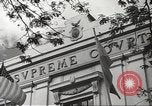
Courts and legislature in the Philippines shortly before World War 2, also President Quezon and Moro people
Scenes in the Philippines before World War II, from a 1944 film. Exterior of the Supreme Court of the Philippines. Judges and officials of the court seated in the court and trials being conducted. Exterior of House of Congress. Interior view with legislature in session. Filipino President Manuel Luis Quezon seen speaking to legislators and seated at a desk in discussion by telephone and with officials. View of his Vice Presiden, Sergio Osmeña, seated in an office. Filpino children pray in front of an altar with the figure of Jesus at a church. Women cross themselves in church. View of beaches on islands. Moro men on Mindanao. Moro man using a bolo (steel blade with handle akin to machete) to cut open a coconut and to cut down crops in field. Moro men gathered near docks at a beach area. Earlier views of U.S. Army General John J. Pershing between time of Spanish American War and World War I. Street views in city and town areas of Zamboanga, Mindanao, with businesses, rickshaws, commercial traffic. A monkey with a very short stub of a tail that is local to Mindanao (stump-tailed macaque). Moro women and men dancers perform a traditional dance and play music. A moro woman spinning a large clay vessel to husk rice. Moro woman walking with goods piled and balanced on her head. Moro men moving a small house using large poles. Moro man getting a haircut. Moro woman washing clothes. Moro fishing vessels with small sails heading out to sea.
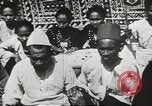
Culture and traditions of the tribal people in the Philippines before World War 2.
Activities of indigenous Filipinos in the Philippines shortly before World War II, from a 1944 film showing earlier scenes. Moro musicians sit beside gongs. Animated map of the Philippines showing the main islands of the archipelago such as Mindanao, Cebu, Mindoro, and Luzon. An American man compares his height to a Negrito man. Negrito men pose wearing loin cloths and running from a field. Negrito boy hugs a U.S. soldier. Igorot people gather near a house in the Cordillera region. Terraced rice fields and irrigation ditches made by the Igorots for thousands of years. View of the Banaue Rice Terraces. Mountains in the foreground. Young Igorot men and women in lowland attire such as Barong Tagalog and Terno perform a rice dance.
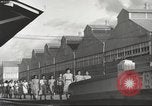
Filipino people going about their routine activities in the Philippines; Filipinos trained by American soldiers.
Part of a 1944 film showing scenes of Filipino people circa 1940, before World War 2. At opening, Filipino women are seen walking alongside a row of factory buildings. A factory room filled with Filipino women dressed in white caps and white uniforms engaged in production at individual individual work stations in a factory. A machine shop filled with Filipino men engaged in metal work. Several people at the window of an office, conducting business with a woman inside. A stock or commodities market office with quotes on tote boards. Women working alongside a moving production line. A woman operating a fabric processing machine. Filipino miners pushing hopper cars of mined ore across a bridge. Miners riding on an engine pulling a train of hopper cars filled with ore from a mine. Filipino longshoremen handling cargoes on a wharf. Scene shifts to an open field where a number of Filipino men are being trained to use firearms during World War 2. One is being coached by an American soldier as he works with a Browning M 1917 water cooled machine gun. Lines of Filipino men firing rifles under supervision of U.S Army trainers. A contingent of uniformed Filipino soldiers, led by an American soldier, marches past a sign, in an camp of tents, reading "A-T Company, 1st Filipino Infantry." Filipino soldiers at a tent camp, being instructed by an American soldier, using a large set of maps. Camera pans over a camp of many tents laid out in order. A formation of Filipino soldiers marches between tents. An American soldier opening his foot locker at his quarters. An illustrated portrait of General Douglas MacArthur. A formation in a field with a Filipino band playing and a Color Guard carrying the American and Filipino flags. A large group of Filipino children walking along a path. A Filipino boy lying on the floor in his home, reading a large book. Filipino school girls seated at benches next to tables. Women doing laundry at an outdoor pond. Next, an actor in khaki clothing sits in a tent and speaks as if addressing American soldiers regarding the Philippines. Among other things, he says,"These people aren't natives. They aren't beggars. They have cities and farms and industries.They have schools and courts and a Constitution. They also have pride and patriotism and self-respect. They love freedom They'll die for it." He cautions American soldiers about their behavior vis-a-vis Filipinos. He states that "Filipinos are American." He alludes to messages received from American and Filipino defenders in Fort Mills, at the fall of Corregidor on May 5, 1942. View of radio towers and worker in radio studio. Morse code messages heard as an American army radio operator with a headset transcribes the messages. Scene shifts to an amphibious invasion fleet attacking a Japanese held island in the Pacific.
The birth of Princess Margriet of the Netherlands in Ottawa during the Dutch royal family's exile to Canada (WW2)
Princess Margriet, third child of Princess Juliana of the Netherlands, is born in Ottawa, Ontario, Canada during World War II. View of Netherlands flag flying on Parliament Hill (Wellington St, Ottawa, ON K1A 0A9, Canada). View of the Ottawa Civic Hospital (1053 Carling Ave, Ottawa, ON K1Y 4E9, Canada) after King George VI of the United Kingdom temporarily declared the hospital as “extraterritorial”. Prince Bernhard of Lippe-Biesterfeld, consort of Princess Juliana and father of Princess Margriet, carrying his infant daughter inside the Ottawa Civic Hospital. Prince Bernhard writes down Princess Margriet’s name during the registration of her birth. Two Dutch officials stand as witnesses during the registration of the royal birth. Princess Margriet's name on the registration document is shown. Prince Bernhard plays with his daughters, Princess Beatrix and Princess Irene, and pet dog in the snow.
Crown Princess Beatrix of the Netherlands is honored during visit to Hollywood and meets celebrities.
A long table is set with Netherlands Coat of Arms displayed on drapes behind. Princess Beatrix of the Netherlands is escorted to the table and meets Hollywood mogul Samuel Goldwyn. As she stands behind the table, a succession of Hollywood actors come up to greet her. The setting is a studio stage with smaller round tables set up for other guests. After the dinner, the Princess mingles with Actresses Hedy Lamarr and June Allyson, and speaks with actor Lionel Barrymore (confined to wheel chair ). She is then escorted to a working film set where she converses with actors in costume and observes how movies are made.
CRITICALPAST.COM: About Us | Contact Us | FAQs - How to Order | License Agreement | My Account | My Lightboxes | Shopping Cart | Advanced Search | Featured Collections | Website Terms & Conditions | Privacy Policy ©2026 CriticalPast LLC.
License Agreement |
Terms & Conditions |
Privacy Policy
©2026 CriticalPast LLC.