


 Francais
 Deutsch
 Italiano
Refine Your Search
Walcheren Island Netherlands 1944 stock footage and images
- Showing 2233 to 2238 of 9701 results more
more Hide
Hide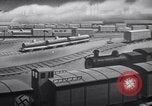
Allied bombing missions to destroy railroads and marshaling yards in occupied France and Germany during World War II
Cartoon representation of German rail yards and war factories, opens the film. Cities of : Anklam; Bremen; and Frankfurt are highlighted as critical factory and railroad junctions. Animated map shows Allied air strikes against French marshaling yards in Spring of 1944 in preparation for the invasion at Normandy. In February, 1945 Allied officers use large wall map to discuss and plan the destruction of all railroad operations in the Ruhr and surrounding areas. View of U.S. bombers in formation (with fighter cover overhead) on bombing missions in Operation Clarion, against all small and medium rail junctions in Germany. View from Allied bomber of Bombs falling and exploding at a rail junction. More aerial views of bombs exploding in numerous places during this operation. An American B-17 Flying Fortress bomber dropping bombs on a railroad marshaling yard. Aerial view of bombs exploding on targets in Essen. Views of wide destruction wrought at German railroad facilities. A US Army Air Forces P-51 fighter plane descending to strafe a target. Gun camera views of aircraft strafing lines of communication in Germany, including road and barge traffic. Closeup of runs firing from P-51 aircraft. Railroad trains being strafed and dramatic explosions at target rail sites.
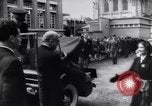
Renaming of Paris Street in honor of Général Philippe Leclerc de Hautclocque
French official arrives by car to officiate at ribbon-cutting ceremony renaming the Avenue d'Orleans as Avenue du General Leclerc, in honor of Général Philippe Leclerc de Hautclocque, who formally liberated Paris, entering along this street, at the head of his French 2nd Armored Division, in 1944. The French official is greeted by a young woman wearing a sash. Members of the French 2nd Armored Division are seen holding unit flags. The official unveils the new street sign on the corner of a building decorated with tricolor bunting. A member of the French 2nd Armored Divison poses on top of a sherman tank, parked in the square. The official cuts a ribbon..
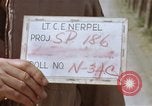
Liberated United States airmen prisoners at Stalag 7A in Moosburg, Germany (WW2)
Liberated United States prisoners (mostly military airmen) at POW camp called Kriegsgefangenen-Mannschafts-Stammlager (Stalag) VII A, located just North of Moosburg, Germany during World War II. The airmen cook food. Several are seen sunning themselves. Airmen seen shaving, shining shoes and cleaning clothes. A group of airmen around sign 'I Wanted Wings' and 'Luft 3'. These are some of the prisoners who were originally held at Stalag Luft III, in German Province of Lower Silesia, near the town of Sagan (now in Poland). (Note: Stalag Luft III is famous because the "Great Escape" took place there in March, 1944. Prisoners were forced to march from Sagan to Spremburg during the coldest winter in Germany in 50 years. There, they boarded a train of boxcars for a 3 day trip to Moosburg in January 1945, because the Russians were closing in. The addition of these prisoners to Stalag 7A, at Moosburg, led to serious overcrowding of the camp. On May 1, 1945, the New York Times reported that "The Fourteenth Armored Division liberated 110,000 Allied prisoners of war at Stalag 7A at Moosburg." This corrected an earlier report that 27,000 prisoners had been liberated.)
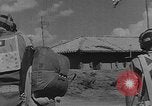
1st American Volunteer Group attacks and shoots down Japanese planes in Kunming, China.
United States Army Air Force operations against the Japanese in China in 1944. United States Army Air Force 1st American volunteer Group pilots look at a map. A pilot in a cockpit with a sign on the plane as it reads 'Pilot R.T. Smith' Soldiers are briefed and a man puts an insignia on the collar of a soldier. An animated map shows the transportation of supplies across the Himalayas to China. Chinese troops. Planes in flight. Aircraft take off and fly in formation. American Fighters in flight. Japanese plane burns and descends. Another plane explodes in mid air and falls. Men look at wreckage of crashed aircraft. Allied Officers confer. Animation shows location of Chinese towns. U.S. Army Air Force aircraft take off for attacking the Japanese positions. (World War II period).
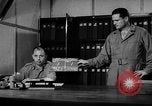
A WAC checks papers against a reference book and marks information on a sheet in Kandy, Ceylon (WW2)
WAC (Women's Army Corps) activities in Kandy, Ceylon during World War II. A U.S. soldier writes while seated at a table. A WAC personnel approaches a shelf with books. She removes a reference book and goes through it. She checks papers against the reference book and marks information on a sheet. She then returns the book to the shelf. Labeled books in shelf. A label reads 'WAR DIARY, July 1944 - 26th to 31st'.
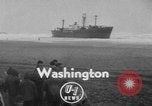
The freighter SS Yorkmar aground, awaits re-floating, on a beach near Grays Harbor, Washington State, United States
The freighter SS Yorkmar, owned by the Bethlehem Steel Company, and operated by the Calmar Line, is aground on an open beach north of Grays Harbor, Washington State, United States. A ship's officer and some members of the crew are seen briefly,on the shore. A Coast Guard helicopter hovers over her stern while carrying a line out to the ship from the shore. Crew members are seen standing in the water near the Yorkmar,and pulling on a line from the ship to the shore. Others climb a rope ladder up the side of the Yorkmar. The crew remains with the ship awaiting tide to refloat her. (Note: The SS Yorkmar, seen here, should not be confused with a ship of the same name that was torpedoed in 1943. This ship was originally a Liberty Ship, launched in 1944, and named the "Walter Kidde." After the war, she was operated by Calmar SS Corporation of New York and renamed the "Yorkmar," in 1947.)
CRITICALPAST.COM: About Us | Contact Us | FAQs - How to Order | License Agreement | My Account | My Lightboxes | Shopping Cart | Advanced Search | Featured Collections | Website Terms & Conditions | Privacy Policy ©2026 CriticalPast LLC.
License Agreement |
Terms & Conditions |
Privacy Policy
©2026 CriticalPast LLC.