


 Francais
 Deutsch
 Italiano
Refine Your Search
Waltham Massachusetts 1932 stock footage and images
- Showing 397 to 402 of 893 results more
more Hide
Hide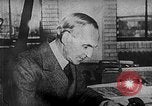
Henry Ford's work in the area of historic preservation. Construction of Ford Museum and Historical Greenfield Village
Henry Ford works on historical preservation project. McGuffey readers are seen. Sketch of Ford family farm in Springwells, Michigan. View of homestead at the farm, that Ford restores. He examines the farm's steam engine. The historic Wayside Inn, in Sudbury, Massachusetts, which Ford purchased to construct a community of historic buildings. View of the restored Botsford Inn,Detroit, Michigan, that Ford bought in 1924.View of Eagle Tavern, in Clinton, Michigan,before,and,after its purchase and restoration by Henry Ford. Concerned about need for additional buildings to house artifacts, Henry Ford consulting with Detroit architect,Robert O. Derrick (with mustache) and two other men. Derrick's plan for the Henry Ford museum is unrolled. It borrows from Independence Hall, Congress Hall, and the old City Hall in Philadelphia.Views of the Clock Tower and museum, as completed in 1929. A pictorial map of the Edison Institute Museum and Historical Greenfield Village, in Dearborn, Michigan. View of construction begun in 1927. Thomas A. Edison laboratory in Menlo Park, New Jersey, that Ford acquired for Greenfield Village. On a windy September 17, 1928, Thomas A. Edison steps from a car, and pauses before entering the doorway of his restored laboratory, in Greenfield Village. Henry and Mrs.Ford step from their car to quickly join him in the building.Edsel Ford and his wife, also follow. Inside the building, Edison officially open the site by starting a steam engine in the laboratory. Ford and Edison converse (Ford speaking close to Edison's ear, because he is hard of hearing). Later, Edison, in a cornerstone ceremony, imbeds, a shovel contributed by Luther Burbank, and then writes in cement of the cornerstone.Newspapers show coverage of the formal dedication of the museum and Greenfield village, October 21, 1929. Workers rushing the Village toward completion for that event. The Smithcreek Railroad depot is moved to the Village. Workers preparing installation of the depot.

U.S. aircraft carriers USS Belleau Wood and USS Bunker Hill, and battleship USS New Jersey are launched in the United States.
Launch of two aircraft carriers and a battleship in the United States during World War II. People gathered at shipyards of New York Shipbuilding Corporation for the launch of the USS Belleau Wood (CVL-24). Sponsor Mrs. Thomas Holcomb seen with U.S. Marine Corps General Thomas Holcomb. Mrs. Holcomb christens the ship as it launches. Scene shifts to Fore River Shipyard in Massachusetts and launching of the USS Bunker Hill (CV-17). The aircraft carrier slides down skids into the water. Scene shifts to Philadelphia Naval Shipyard on the same day, December 7, 1942, as the launching ceremony for the Battleship USS New Jersey (BB-62). Carolyn Edison, wife of New Jersey Governor Charles Edison is seen christening the ship and it then slides into the water. Two boats underway in the background assist with positioning the Battleship.

Description of American demographics in 1970 emphasizing diversity of backgrounds and cultures
Animated map assembles sections of the United States of America reflecting various kinds of inhabitants. A woman of Native American Indian origins weaves a straw hat as a young boy plays nearby. Sign outside a building identifying the "Slovak Political Benefial Assn." Other signs on seen on different buildings include: "Polish Army Veterans Association of America;" "Ukrainian American Youth Association;" and "Germantown Hospital." A brass plate on a building reading: "English-Speaking Union." Asian-American school girls, and a Japanese-American man with a boy. View of a wood carving in ancient African style. A street scene showing many Hispanic Americans, and commercial signs in Spanish. A group of new American citizens reciting oath at a naturalization ceremony, each receiving a small American flag. Some appear to be of Asian or South Asian descent, including possibly Vietnamese. Animated map shown again, indicating the geographical distribution of Americans in the U.S. First it shows areas where citizens live near water, either the oceans, Gulf of Mexico, or the Great Lakes. Montage of urban scenes showing some of the cities where most Americans live. The Massachusetts State House in Boston. New York City street scene with the Empire State Building in background. City Hall in Philadelphia, Pennsylvania. The Capitol in Washington, DC
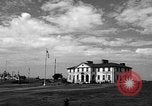
U.S. Coast Guard barracks at Salem Air Station and a machine shop in the United States.
U.S. Coast Guard station in the United States. Entrance to U.S. Coast Guard barracks at Salem Air Station in Salem, Massachusetts. Interior of a machine shop. Officer's recreation room (exterior). Garage, containing battery room.
Stanley Hiller demonstrates his "Hiller Copter" and Filene's Dept. stores deliver cigarettes with a helicopter in the U.S.
Hiller's coaxial bladed helicopter is demonstrated and helicopter delivers cigarettes to veterans in the U.S. Berkeley, California: "Hiller Copter" on ground. It is coaxial bladed helicopter, a ship which has rigid blades and no tail rotor. Stanley Hiller, 19 year old inventor demonstrates his coaxial bladed helicopter at University of California at Berkeley football stadium. Next scene is Boston, Massachusetts: Filene's Department stores deliver cartons of cigarettes to patients at the Veteran's Hospital with an ultra modern helicopter. The Helicopter takes off and lands at Veteran's Hospital in West Roxbury. Cigarettes are distributed to veterans.
People celebrate the Douglas World Cruisers aviators across the United States.
U.S. Army Air Service Douglas World Cruisers (DWC) in the United States during their first flight around the world. In Boston, Massachusetts Major General Patrick, head of the Army Air Service, praises his aerial pioneers and Mayor of Boston James Michael Curley presents Lieutenant Lowell H. Smith, and Lt. Erik H. Nelson watches. Views of the ceremony. Major General Patrick inspecting an aircraft. Aerial view of a squadron of airplanes flying over New York City. Aerial view of two world cruisers in flight. Edward. Prince of Wales, visiting the United States, is among those at Mitchel Field awaiting the aviators. He looks at the sky. Several people in the crowd look through binoculars. A world cruiser coming in for a landing at Mitchel Field, Long Island. View of the world cruisers on the airfield and the crowd around the aircraft. The Prince of Wales in the crowd. Several views of crowd welcoming the world cruisers.