


 Francais
 Deutsch
 Italiano
Refine Your Search
Waltham Massachusetts 1932 stock footage and images
- Showing 403 to 408 of 893 results more
more Hide
Hide
Soviet Flag flutters in wind from flagpole on top of Old Soviet Embassy building in Washington D.C., United States.
Old Soviet Embassy building in Washington D.C., United States. Soviet Flag flutters in wind from flagpole on top of Old Soviet Embassy building,Washington D.C. Trees in foreground. Other unidentified buildings in the foreground. Traffic moves along Massachusetts Avenue. Main entrance of the Soviet Embassy. Autos parked in foreground.

Americans voting and electioneering in national election on November 7, 1944, during World War II.
On November 7, 1944, during World War 2, citizens of Marblehead, Massachusetts, United States, are seen entering the Old Town House (built in 1727) to cast ballots in 40th quadrennial presidential election (in which incumbent President Franklin D. Roosevelt is running for an unprecedented 3th term). Scene shifts to inside a polling place, where voters stand in booths to privately mark their ballots. Others are seen depositing their marked, folded paper ballots in a collection box, as they finish voting. Closeups of several aged voters. One, an African American man, the narrator says is old enough that he was sold as a slave early in his life. Scene shifts to a full-blooded Native American Indian voter in Maryland, entering his polling place to cast a ballot. An old man who is a United States Civil War veteran, is shown sitting on a bench in a park in Los Angeles California, with friends. He holds a newspaper and wears a Civil War Union cap. A U.S. soldier wearing field uniform and steel helmet, looks at a bulletin board containing State-by-State voting information. A Technical Sergeant marks his paper ballot and leaves to mail it. A soldier takes an oath confirming legitimacy of his ballot as he turns it in at a military collection site. Sign in commercial establishment window of a U.S. town declares "Election Today." A bank window sign reads: "this Bank will observe Election Day, Tuesday, November 7th, a Legal Holiday." Sign in Bar window reads: "Bar Closed during Election Hours, Tuesday, Nov.7, 1944. Will Open at 9 PM." Republican political party workers advertise for their Presidential candidate, Thomas E. Dewey. Democratic political party workers drive a truck towing a trailer office plastered with advertisements for their candidate, Franklin Roosevelt. Republican and Democratic party voter information booths are seen next to one another where advertise their respective candidates to passersby on the sidewalk. A voting place identified by white wash sign on a window, and another, in a rural setting, by a sign pointing to it on a fence post. More signs and voters showing sentiments for their candidates. One displays a picture of Dewey on his car. A woman wears a large Roosevelt button on her sweater. Views of more imaginative signs for candidates and for ballot issues. People discussing ballot issues on the streets.
Smoking U.S. Navy F6F Hellcat lands on carrier underway in Gulf of Leyte, Philippines during World War II.
U.S. Task Force no. 38 ships head for Leyte, Philippines during World War II. Aerial view of Philippines Islands. USS Massachusetts (BB-59) underway. Smoking F6F Hellcat lands on flight deck of carrier.
Boy Scouts visit the Pentagon building and meet U.S. Secretary of Defense James Forrestal during Boy Scout Week 1949.
Eagle Scouts from the 12 regions of the Boy Scouts of America visit the Pentagon building in Arlington Virginia during Boy Scout Week 1949 (celebrating the 39th anniversary of the Boy Scouts of America). The group of Boy Scouts on the steps of the Pentagon building. The Boy Scouts look around at the building and surroundings. The scouts walk up the stairs and enter the Pentagon building. U.S. Secretary of Defense James Forrestal seated in his office. The Defense Secretary meets with the scouts and talks to them. He shakes hands with various Boy Scouts. The 12 scouts in the group are: Alan Fritts of Troop 11 in Mankato, Minnesota; Andrew L. Clement, senior patrol leader of Troop 2 in Raleigh, North Carolina; George Barron of Troop 17 in Franklin, Virginia; Daniel Abbott of Senior Outfit 16, in Newtonville, Massachusetts; James Roswurm of Troop 31 in Huron, Ohio; Charles S. Wilson of Troop 3, in Bristol Tennessee; H. Cumings Johnson of Senior Outfit 230 in Traverse City, Michigan; Joseph L. Cox of Troop 98 in Trenton, Missouri; Howard M. Williams of Explorer Post 345 in Houston, Texas; James C. Vincent of Sea Scout Ship 232 in Brookings, Oregon; James E. Gill of Air Scout Squadron 234 in Berkeley, California; L. Drury Cathers of Troop 22 in Gouverneur, New York.
U.S. Army Brigadier General Prichard talking to Boy Scouts in his office at the Pentagon building in Arlington County, Virginia.
Eagle rank Boy Scouts representing the 12 regions of the Boy Scouts of America visit the Pentagon building in Arlington County, Virginia, during Boy Scout Week 1949. The interiors of the office of U.S. Army Brigadier General Vernon E Prichard. Boy Scouts arrive in the office and meet Brigadier General Prichard. A wall map in the background. Brigadier General Prichard speaks to the boys. The Vice Chief of Staff General Joseph Lawton Collins, talking to the boys in his office. The 12 Boy Scout representatives are: Alan Fritts of Troop 11 in Mankato, Minnesota; Andrew L. Clement, senior patrol leader of Troop 2 in Raleigh, North Carolina; George Barron of Troop 17 in Franklin, Virginia; Daniel Abbott of Senior Outfit 16, in Newtonville, Massachusetts; James Roswurm of Troop 31 in Huron, Ohio; Charles S. Wilson of Troop 3, in Bristol Tennessee; H. Cumings Johnson of Senior Outfit 230 in Traverse City, Michigan; Joseph L. Cox of Troop 98 in Trenton, Missouri; Howard M. Williams of Explorer Post 345 in Houston, Texas; James C. Vincent of Sea Scout Ship 232 in Brookings, Oregon; James E. Gill of Air Scout Squadron 234 in Berkeley, California; L. Drury Cathers of Troop 22 in Gouverneur, New York.
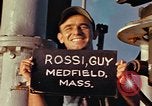
U.S. Navy Crew members are photographed in motion pictures made while their submarine is making way on the surface in the Pacific ocean during World War II
Brief film shows members of a U.S. submarine crew as they pose for camera during World War 2. A sailor named Guy Rossi from Medfield, Massachusetts holds a sign identifying himself. Other crewmen pose looking through binoculars. Some of the crew stand on the conning tower of the submarine. A sailor photographer with elaborate motion picture equipment is seen atop the boat's deck.